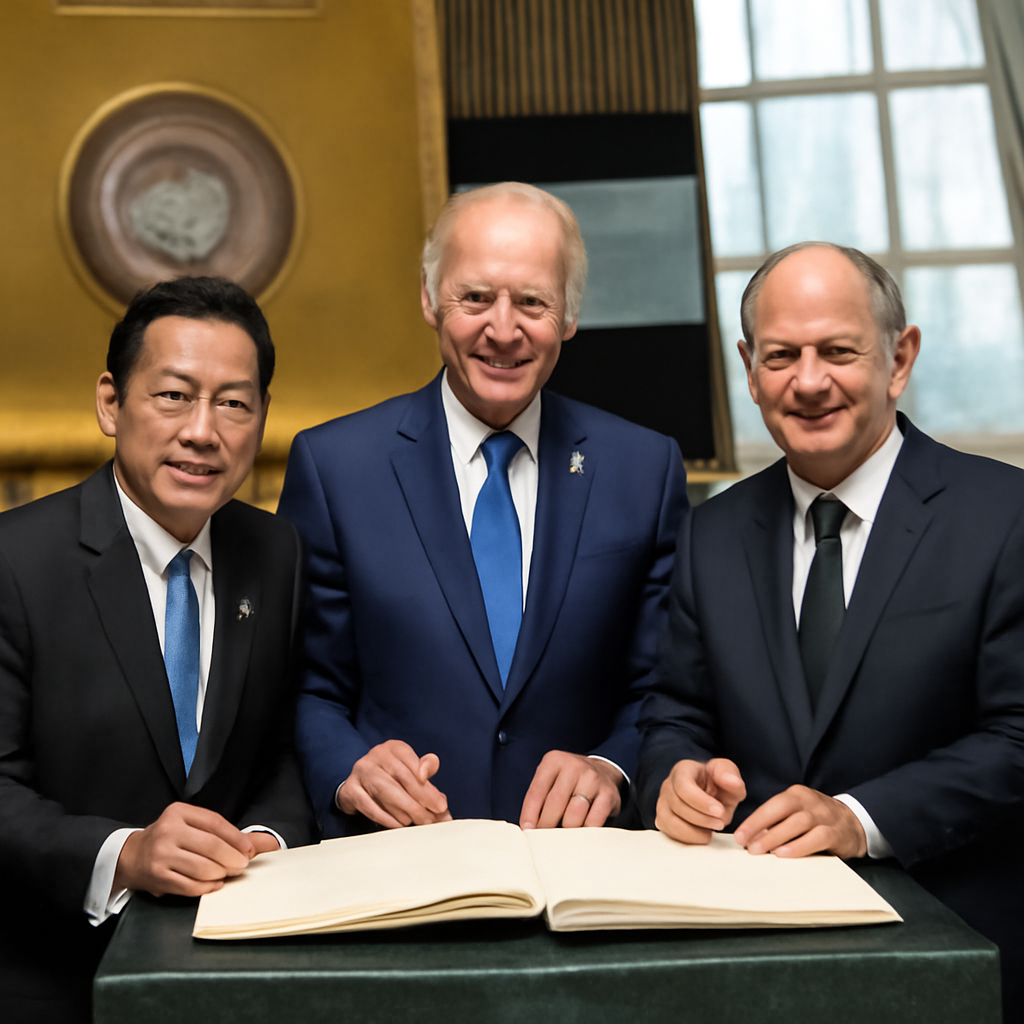
"Today we are signing an even bigger and better agreement," said Danish Prime Minister Mette Frederiksen, and in a closely watched ceremony in New York on Tuesday those words were formalized into a new Arctic security pact signed by the president of the United States, the prime minister of Denmark and the prime minister of Greenland.
A New Pact Signed in New York
The agreement was signed immediately after the president addressed the United Nations General Assembly. Signatories were the president, Danish Prime Minister Mette Frederiksen and Prime Minister of Greenland Jens‑Frederik Nielsen. Frederiksen framed the deal as one that “can last forever” and said it was “good for the United States, it’s good for Greenland, for Denmark, for the NATO alliance, and therefore also good for Europe.” The ceremony closed weeks of negotiations and, publicly at least, appeared to reduce the political tensions that had risen between the three parties.
Terms: unfettered access, two defense areas, and Pituffik
Under the agreement the United States receives broad operational rights in Greenland: unfettered military access to Greenland and its territorial waters, including the ability to fly over or land on “any territory” on the island. The pact authorizes the U.S. to establish a “defense area” in two Greenland locations, with “modalities and technical details to be mutually agreed by the Parties.” The president described those plans at the UN as: “We’ll be building two very major military bases.”
The text also calls for the modernization and expansion of U.S. Pituffik Space Base in Greenland, which the source notes currently supports Department of Defense early warning and missile defense capabilities. The agreement identifies potential sites for the two defense areas: Narsarsuaq in southern Greenland and Mestersvig on the east coast. The source reports U.S. officials have been measuring the Narsarsuaq runway, and that Mestersvig is of interest for surveilling potential Russian activity down Greenland’s east coast.

Audit-ready is a season. It shouldn't be.
Evidence in spreadsheets, controls drifting between audits, frameworks multiplying on flat headcount. Nubivance runs continuous compliance on Rapid7 Cyber GRC - SOC 2, HIPAA, ISO 27001, PCI, CMMC.
End the scrambleSovereignty and self-determination explicitly recognized
The agreement includes explicit language reaffirming “the sovereignty and territorial integrity of the Kingdom of Denmark” and recognizes “that the People of Greenland constitute a people pursuant to international law with the right to self-determination.” The inclusion of those clauses follows months during which the president had publicly threatened Greenland’s sovereignty and said in January that the United States was considering taking control of the semi‑autonomous island through military means, a justification he tied to preventing occupation by other powers.
When asked at the ceremony whether the new pact removes the prospect of U.S. ownership of Greenland, the president did not answer directly. Frederiksen, in turn, emphasized the agreement’s language that recognizes U.S. historical and ongoing contributions to the defense of Greenland and the North Atlantic, noting “the sacrifices and billions of dollars spent, and the role that United States military plays in defense, when it comes to Greenland now and also in the future.”
Reactions: political leaders and analysts
NATO Secretary General Mark Rutte welcomed the pact in a post on X, saying it “enhances our collective security.” Rasmus Søndergaard, senior researcher for foreign policy and diplomacy at the Danish Institute for International Studies, told Breaking Defense ahead of the signing that “worst outcomes have been averted.”
Søndergaard also cautioned that the president may be “overselling a little bit, the degree to which the US gets control” of Greenland. From his reading of the agreement, “he has not achieved” control of the Arctic territory and the deal does not appear to be “substantially different from the existing 1951 [defense treaty] agreement,” though it does allow for an expanded U.S. military presence.
How Denmark, Greenland, and the U.S. military are responding
- Denmark and Greenland: Prime Minister Frederiksen publicly positioned the pact as strengthening “our common deterrence” and preventing adversaries from securing “any control or significant influence” over Greenland; Prime Minister Jens‑Frederik Nielsen signed the agreement alongside his Danish and U.S. counterparts.
- The United States and U.S. military: The president portrayed the deal as delivering two major bases, while officials have been reported measuring Narsarsuaq’s runway and planning modernization work at Pituffik Space Base to support early warning and missile defense functions.
- NATO and allied capitals: NATO’s secretary general publicly welcomed the pact as an enhancement of collective security, framing the agreement within alliance-level defense considerations.
The compact resolves an immediate diplomatic rupture and locks in expanded U.S. operational rights in Greenland while simultaneously affirming Danish sovereignty and Greenlandic self‑determination. It leaves concrete implementation steps — the “modalities and technical details” of the two defense areas, runway and base work at Narsarsuaq, and modernization at Pituffik — to further negotiation and planning. The president’s choice not to answer whether the agreement takes U.S. ownership off the table, and analysts’ view that the pact is not a radical departure from the 1951 defense treaty, mean the public rhetoric of victory will be tested against the technical and legal work now required to make the pact operational.