North Korean state media’s launch-display claimed the missile traveled 908.2 kilometers, reached 35.8 kilometers altitude, and flew for roughly 445 seconds — figures that Seoul and Tokyo’s tracking assessments do not match.
Visual record: Kim Jong Un, Kim Ju Ae, and the coastal test site
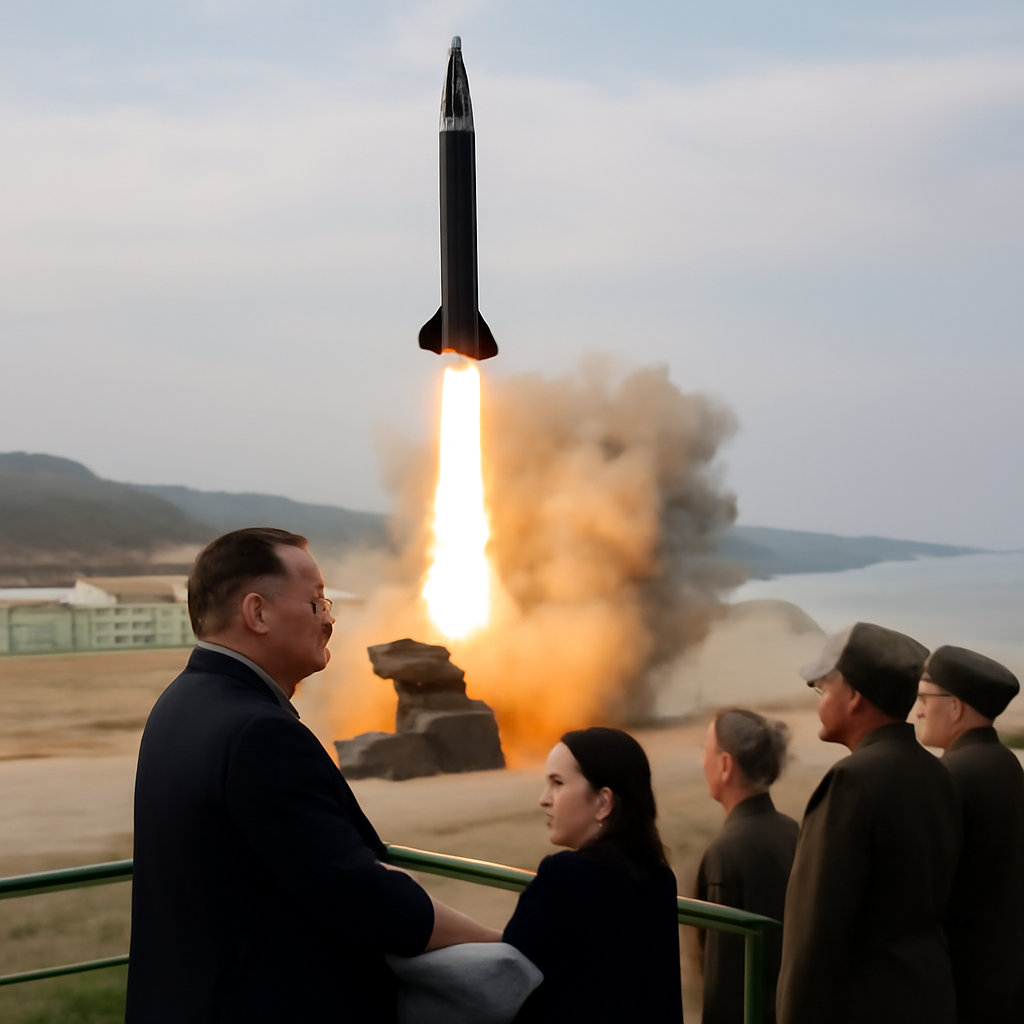
Photographs released by North Korean state media show a September 20 test from a launch facility in Anbyon County, south of Wonsan, with Kim Jong Un and senior missile officials observing the event. Kim’s daughter, Kim Ju Ae, also appears in the imagery. The coastal launch site permits eastward firings over the Sea of Japan, a direction used repeatedly by Pyongyang for short- and medium-range system tests.
Design evolution: Hwasong-11Ma → Hwasong-11Ma-1 and launcher changes
North Korea labeled the photographed weapon Hwasongpho-11Ma-1 (Hwasong-11E-1 in English equivalents), an iterative designation that Pyongyang has not explained. The Hwasong-11Ma concept substitutes a wedge-shaped glide vehicle for the conventional warhead on the Hwasong-11 (KN-23) family booster. The original Hwasong-11Ma mock‑up was publicly displayed at the Defense Development-2025 exhibition in October 2025 and later appeared at a Pyongyang military parade.
The new imagery shows a change in the transporter-erector-launcher (TEL): where the Hwasong-11Ma was earlier shown on five-axle TELs, the photographed -1 configuration is carried on a six-axle TEL with modified retractable covers. Pyongyang did not say whether the vehicle represents a standardized operational launcher or a test-specific configuration.

Audit-ready is a season. It shouldn't be.
Evidence in spreadsheets, controls drifting between audits, frameworks multiplying on flat headcount. Nubivance runs continuous compliance on Rapid7 Cyber GRC - SOC 2, HIPAA, ISO 27001, PCI, CMMC.
End the scrambleDisplayed flight data and independent tracking reports diverge
North Korea’s launch-site display graphic shows a flight that initially follows a ballistic path, descends, then performs a pull-up before continuing toward the target area — a profile consistent with boost‑glide concepts. The display gives specific figures: 908.2 kilometers distance, peak altitude 35.8 kilometers, flight time ~445 seconds, and velocity 2,146 meters per second (about 4,800 mph). An enhanced version of the image was circulated with a note that AI tools may introduce slight inaccuracies.
South Korean and Japanese authorities reported two SRBM launches on September 20. South Korea’s Joint Chiefs of Staff assessed the missiles as travelling about 450 km and 600 km. Japan’s assessment put them at approximately 440 km and 590 km, with maximum altitudes roughly 60 km and 70 km. Those tracking figures differ substantially from Pyongyang’s 908.2 km claim. The discrepancy could reflect different measurements, portions of the flight not publicly reported by Seoul and Tokyo, or, as South Korean analysts told Yonhap, the possibility that Pyongyang altered the displayed figure.
Technical context: boost‑glide architecture, propulsion, and prior North Korean claims
The imagery and North Korean commentary frame the weapon as a boost‑glide system: a solid‑fuel SRBM booster provides initial velocity and altitude, after which an unpowered glide vehicle traverses the atmosphere at hypersonic speed while maneuvering. The Hwasong‑11Ma family uses a solid‑fuel booster, which Pyongyang says allows faster launch timelines than earlier liquid‑fuel designs.
Pyongyang has claimed multiple hypersonic tests since 2021: an early wedge‑shaped vehicle aboard the liquid‑fuel Hwasong‑8 in 2021, and a similar-looking vehicle paired with the solid‑fueled Hwasong‑16B IRBM in 2024. The Hwasong‑11 family is identified in the source as the KN‑23 family; the source also notes KN‑23 configurations have been used by Russia against Ukraine. Outside analysts have repeatedly been unable to determine from public imagery whether Pyongyang’s hypersonic tests demonstrated the advertised maneuvering performance.
What this means for South Korea’s Joint Chiefs of Staff, Japan’s defense authorities, and Tal Inbar
- South Korea’s Joint Chiefs of Staff: The differing range and altitude assessments will keep Seoul focused on independent tracking and characterization of the two launches it assessed at roughly 450 km and 600 km, and on whether a boost‑glide profile was achieved.
- Japan’s defense authorities: Tokyo’s roughly 440 km and 590 km assessments and reported peak altitudes of about 60 km and 70 km underscore the importance of cross‑national tracking to reconcile public displays with sensor data.
- Tal Inbar (Fisher Institute): The analyst called the Hwasong‑11Ma/Ma‑1 “a very significant weapon,” saying it brings hypersonics to an operational/tactical arena and poses a challenge to air and missile defense systems — a view reflected in state media’s depiction of the displayed maneuvering trajectory.
Pyongyang’s imagery and assertions point to continued development activity: a modified missile, a new six‑axle TEL, and the public depiction of a boost‑glide flight path. Yet the concrete performance claims — distance, altitude, flight time, and maneuvering — remain disputed by independent tracking reported by Seoul and Tokyo. The test is therefore evidence of ongoing investment in hypersonics, but not a standalone confirmation that the Hwasong‑11Ma‑1 achieved the operational capabilities presented on North Korean displays.
Original source: North Korea Tests New Hwasong-11Ma Hypersonic Missile — The Warzone (TWZ)