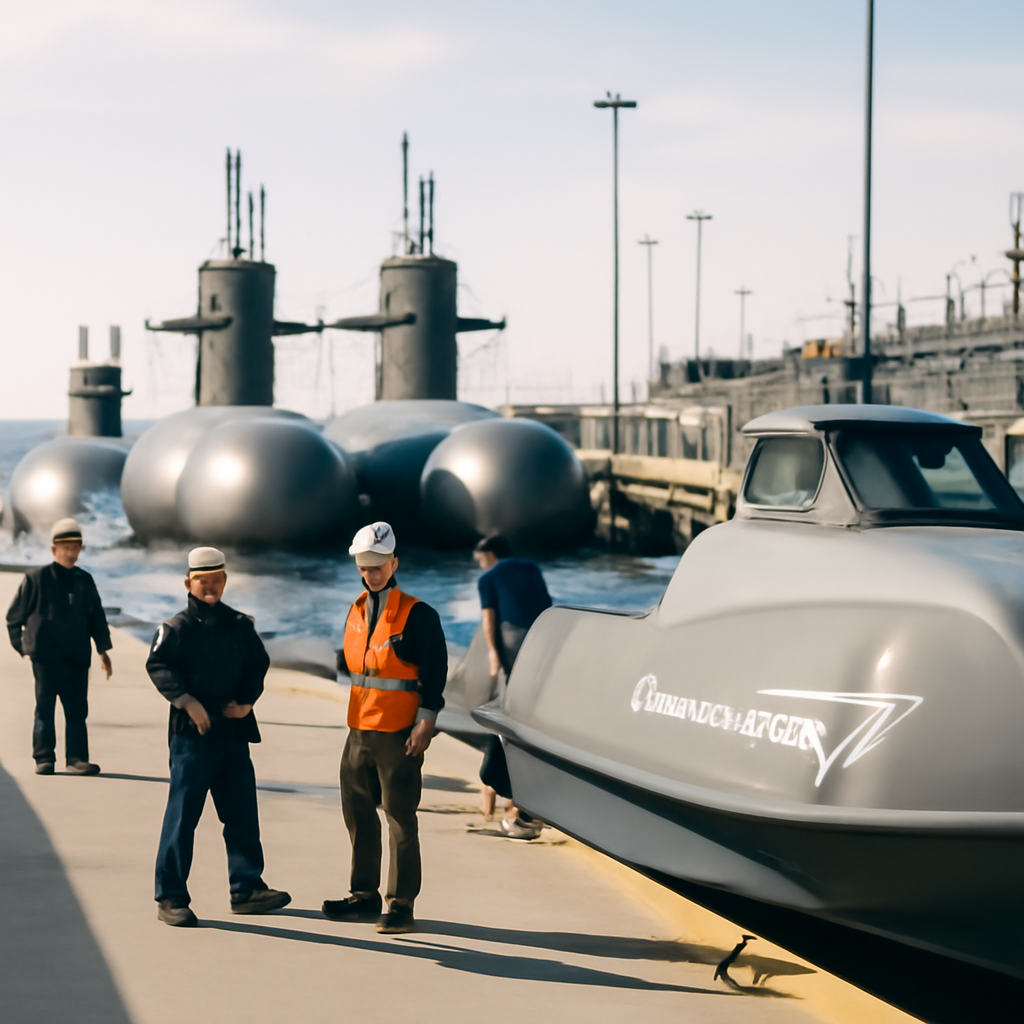
"An underwater Great Wall" — that is how US Vice Adm. Richard Seif, a submariner, described China’s recent subsea sensor and unmanned systems effort, and on July 6 three major defense players acted like they agreed.
Lockheed Martin’s $3.5 billion purchase of Ultra Maritime
On July 6, Lockheed Martin announced it would spend $3.5 billion to acquire undersea specialist Ultra Maritime. Ultra Maritime, with roughly 2,000 employees, brings a portfolio of torpedo and sonar technologies, radar, electronic warfare and sonobuoys. The company has a long heritage and has undergone multiple transformations in the past decade, including time as a component of Ultra Electronics and ownership by private equity firm Advent International before being carved off to strategic buyers. Lockheed described the deal as a major expansion of its undersea capabilities — an effort that the source says complements the company’s existing reputation in sub-hunting and submarine combat systems and its growing offering of unmanned undersea systems. The acquisition was Lockheed’s first financially significant buy since the 2015 acquisition of Sikorsky.
Thales’ 36% stake in Exail Technologies at an implied $4.5 billion valuation
Also on July 6, France’s Thales announced it had purchased a 36 percent stake in Exail Technologies, a French undersea warfare and defense technology company, with long-term plans to acquire the firm entirely at an implied $4.5 billion enterprise valuation. Exail reported 40 percent revenue growth in Q1 2026, employs roughly 1,600 people, and is best known for subsea solutions and mine countermeasures. The company had also been courted by other investors, including France’s Safran, underscoring its market position in maritime, aerospace and defense systems and photonics.

Audit-ready is a season. It shouldn't be.
Evidence in spreadsheets, controls drifting between audits, frameworks multiplying on flat headcount. Nubivance runs continuous compliance on Rapid7 Cyber GRC - SOC 2, HIPAA, ISO 27001, PCI, CMMC.
End the scrambleFincantieri’s nearly $700 million investment in four unmanned and undersea firms
On the same day, Italy’s Fincantieri announced a nearly $700 million investment across four maritime drone and undersea engineering firms: Next Geosolutions, WSense, Graal Tech and Defcomm. Next Geosolutions operates a fleet of dynamic-positioning vessels used for maritime studies and mapping. WSense provides subsea wireless and mesh wireless monitoring systems capable of tracking subsea targets and monitoring pipelines and cables. Graal Tech builds autonomous underwater vehicles (AUVs) and robotic technologies, while Defcomm supplies satellite communications services used by autonomous vessels. Fincantieri had already been active in the underwater space, having previously purchased maritime engineering company Remazel and torpedo producer WASS (formerly part of Leonardo). In 2024 Fincantieri CEO Pierroberto Folgiero told Breaking Defense, "We are very serious about growing underwater capabilities," even comparing the potential market to the space sector.
Adversary activity: China’s mapping, Russia’s GUGI operations, and mine warfare in the Strait of Hormuz
The acquisitions align with a trio of undersea threats documented in recent years. China has conducted a large-scale seabed mapping project — described in the source as involving at least 42 research vessels over five years — primarily to support undersea warfare through surface and subsea sensors, uncrewed systems and data fusion. Russia has run operations targeting undersea internet cables and Western undersea pipelines, employing its GUGI submarine fleet and uncrewed undersea capabilities to reach depths that, per the source, only the United States can match. And undersea mines remain a potent asymmetric tool: the Strait of Hormuz episode is cited as a case where mine deployment altered both trade and military calculations, while virtually no US or allied mine countermeasure capabilities were on hand to address the Iranian mine-laying operation; the full scale of mines deployed there remains not public.
What this means for technologists, policymakers, and Gulf countries
- Technologists and procurement leaders: expect primes to prioritize established small and mid-tier specialists that already hold market share and manufacturing capability. The July 6 deals echo earlier capacity and capability plays — for example, Bollinger’s 2022 acquisition of VT Halter Marine, Leidos’ 2021 purchase of Gibbs & Cox, and HII’s 2020 acquisition of REMUS AUVs from Kongsberg — suggesting integrators will continue to scoop up proven undersea technologies.
- Policymakers and military planners: the convergence of surface and subsea mapping, uncrewed systems and mine threats across multiple theaters underscores the need to replicate surveillance, countermeasures and undersea response capabilities among NATO nations and US allies in the Asia-Pacific, as described in the source.
- Gulf countries: the source notes Gulf states are likely to notice Iran’s use of mines and invest in countermeasures; unmanned maritime capabilities, including subsea and surface drones, are specifically identified as potential leading roles in those missions.
The July 6 buying spree by Lockheed Martin, Thales and Fincantieri is more than an M&A coincidence: it signals a market shift toward undersea systems driven by concrete operational challenges — seabed mapping, cable and pipeline vulnerability, and mine warfare. Whether these integrations will accelerate production, broaden allied capabilities, and change how navies deploy unmanned systems remains a central question. For now, as the authors note, the moves are "a welcome pivot to a critical undersea warfighting domain that has grown in prominence."