On June 23, China’s third aircraft carrier, the Fujian, transited through the Taiwan Strait — a movement that Taiwan’s Ministry of National Defense said prompted the military to activate “its joint intelligence, surveillance, and reconnaissance measures to closely monitor” the vessel.
Taiwan’s immediate response and the aerial image
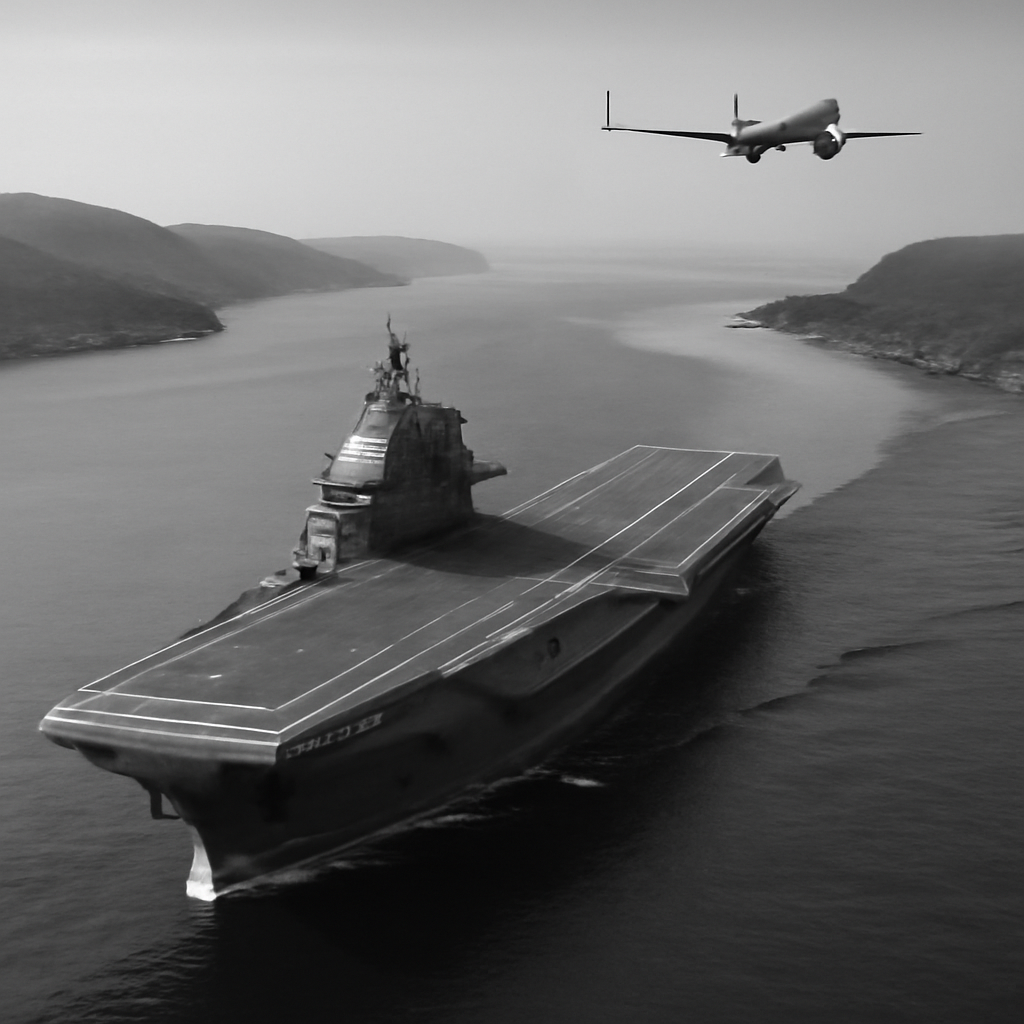
Taiwan’s ministry confirmed the Fujian had passed through the Strait and released a high-altitude black-and-white aerial image of the carrier. The image, the ministry noted, showed no carrier-based aircraft on the flight deck; the ministry did not disclose the precise time or location at which the photo was taken. The transit came amid Taiwan’s recent rapid combat-readiness drills and expanded surveillance activities.
The three hulls versus operational capacity
China now possesses three aircraft carriers — the Liaoning, the Shandong, and the Fujian — but the available evidence in open sources suggests the People’s Liberation Army Navy (PLAN) lacks the fully mature logistics, air wings, and trained personnel to operate all three simultaneously at full strength. The Liaoning recently returned to its home port in Qingdao after more than 40 days of operations in the Western Pacific. The Shandong has reportedly been in a carrier-capable dry dock at the Yulin naval base in Sanya since late January 2026, and satellite imagery from April 26 still showed the Shandong in dry dock more than three months after it reportedly entered the facility on January 20.
The Fujian’s transit therefore occurs against a background of staggered availability: the Liaoning signaling long-range power projection, the Fujian in a testing-and-training phase, and the Shandong undergoing substantial maintenance. Analysts in the source estimate that sustaining simultaneous full-deck deployments across three carriers would require roughly 100 carrier-capable aircraft plus corresponding pools of pilots, deck crews, maintainers, and logistics personnel — a scale the PLAN does not yet appear to possess.

This site is the portfolio.
OSINTSights runs on Cloudflare Workers, D1, R2, and Vectorize, with an AI pipeline on Hetzner ARM. Nubivance designed, built, and operates it. We do the same for clients.
See what we buildTwo carrier aviation ecosystems: ski-jump and electromagnetic catapult
A central technical constraint is that China’s carriers use two different launch-and-recovery systems. The Liaoning and the Shandong rely on ski-jump launch systems; the Fujian is equipped with an electromagnetic aircraft launch system (EMALS). That difference creates two distinct carrier aviation ecosystems rather than a single, interchangeable force.
The Liaoning and Shandong remain centered on the J-15 system. The Fujian is expected to integrate aircraft such as the J-15T, J-35, KJ-600, and J-15D. That mix complicates pilot conversion, flight-deck procedures, maintenance, munitions support, and avionics integration, and it raises the operational bar for generating and sustaining multiple carrier strike groups.
South China Sea training, Sanya support, and the Yulin dry dock
The Fujian’s southward movement suggests a shift from near-shore waters toward the semi-operational environment of the South China Sea. The carrier can take advantage of support infrastructure at Sanya on Hainan Island while exerting influence on regional activity. Media reporting and satellite observers point to newly developed dry dock facilities at Yulin used for carrier repairs and maintenance after 2022; operations observed there in early 2026 indicate a growing shore-side logistics effort but also show the Shandong tied up in an extended maintenance period rather than available for sustained deployments.
China’s pattern appears aimed at linking a training and deployment circuit that connects the Taiwan Strait, the South China Sea, and the Western Pacific — a geographic logic that raises the operational stakes of each individual transit.
What this means for Taiwan, the U.S. military, and the PLAN
- Taiwan: The transit confirms the need to sustain the activated intelligence, surveillance, and reconnaissance measures and to interpret carrier movements within a broader pattern of naval, air, and coast-guard pressure.
- The U.S. military and regional partners: The Fujian’s movement into the Taiwan Strait and likely South China Sea operations signal more frequent carrier presence in politically sensitive waterways, a factor that regional forces must incorporate into patrol and coordination plans.
- The PLAN: The fleet is expanding rapidly but remains in a learning phase; the immediate challenge is converting hull numbers into sustainable carrier combat capability by building pilots, deck crews, maintenance regimes, and cross-platform interoperability.
The Fujian’s transit is therefore double-edged. It demonstrates Beijing’s determination to normalize carrier operations in sensitive waters and to fold aircraft carriers into a broader, layered pressure campaign. At the same time, the movement highlights concrete constraints: dual launch-and-recovery systems, a limited pool of carrier-capable aircraft and personnel, and at least one carrier tied up in extended maintenance. Whether China can generate the roughly 100 carrier-capable aircraft and matching human and logistical capacity needed to sustain two or more carrier strike groups in continuous, credible operations remains the central operational question.