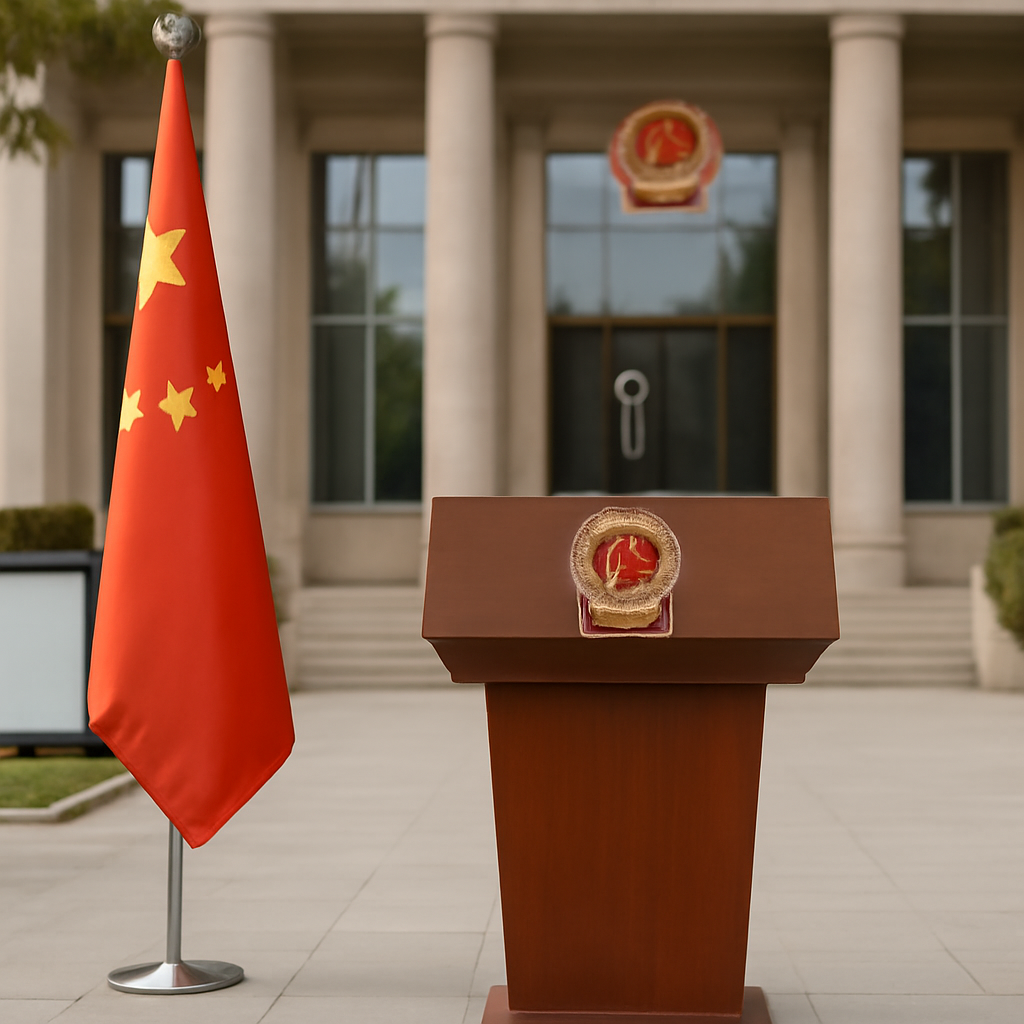
"The award is ‘null and void’," Beijing declared after a tribunal ruling a decade ago — and it has said the same thing ever since.
The 2016 ruling and Beijing’s steady reply
Ten years ago this month, a tribunal constituted under the UN Convention on the Law of the Sea handed China what the tribunal called one of its most significant legal defeats in a generation. The tribunal "rejected the legal basis for China’s claim to historic rights within the nine‑dash line and upheld most of the Philippines’ submissions." Beijing’s public posture following the award has been consistent: the award is, in its words, "null and void," and legal criticism and diplomatic pressure over the subsequent decade have not altered that response.
Sovereignty claims as strategic assets
That sustained refusal to accept the ruling is not mere stubbornness, the source argues; it is a deliberate strategy. A sovereignty claim, the argument runs, functions as a strategic asset rather than merely a legal stance awaiting adjudication. By keeping claims alive — through repetition in statements, maps, domestic laws, diplomatic notes, administrative practice and operations at sea — Beijing preserves a set of legal, diplomatic, political and military options that can be drawn upon if circumstances change.

Audit-ready is a season. It shouldn't be.
Evidence in spreadsheets, controls drifting between audits, frameworks multiplying on flat headcount. Nubivance runs continuous compliance on Rapid7 Cyber GRC - SOC 2, HIPAA, ISO 27001, PCI, CMMC.
End the scrambleMechanisms: maps, laws and repetition
The practical instruments of this approach are explicit in the record. Official maps and the Coast Guard Law are cited as examples of tools that reinforce sovereignty claims through legal, administrative and political instruments. The point is not necessarily to persuade other governments immediately. It is to prevent the dispute from reaching strategic closure: to normalise repetition, to ensure the narrative does not fade through neglect, and to create a continuous record that can be invoked later as evidence China never accepted rival positions.
Tactical patience: why never conceding matters
Beijing’s calculus relies on patient hedging. If a powerful government abandons a claim today, it forecloses options that might be valuable tomorrow. The source lays out three kinds of future change that make preserving claims valuable: shifts in the economic and military balance that raise the cost of resisting China; political or diplomatic change in claimant states, including weakened alliances or shifting national priorities; and major crises or conflicts that can alter facts on the ground and diplomatic language rapidly. Any of those changes could make resistance more costly or less feasible, and continuous assertion keeps the claim available as a bargaining position, a justification for future action and a narrative to revive.
Geographic breadth: South China Sea, East China Sea, Taiwan, Batanes
The method is applied beyond the South China Sea. In the East China Sea Beijing continues to assert its position despite little prospect of near‑term agreement with Japan. Research institutes and state‑linked commentary have begun testing historical arguments concerning the Batanes Islands in the northern Philippines. And Taiwan — under the one‑China principle that asserts Taiwan is part of China and that the government of the People’s Republic of China is the sole legal government representing China — is singled out as the most consequential example. Many governments maintain "different one‑China policies" that do not endorse Beijing’s sovereignty claim over Taiwan, but Beijing seeks not only formal recognition; it seeks to narrow the practical space between its principle and other governments’ policies through repeated diplomatic, institutional and even corporate usage of its preferred account.
What this means for Australia, the Philippines, and the United States
- Australia: Statements reaffirming the 2016 award are framed not as an expectation that China will change its formal position, but as measures to maintain legal clarity, to support affected states and to prevent Beijing’s interpretation from becoming the regional default through fatigue or silence.
- The Philippines: The tribunal’s decision strengthened the Philippines’ legal position by clarifying maritime entitlements; continued support from other governments preserves that legal clarity and keeps diplomatic options open.
- The United States: The source notes that a future reduction in US regional engagement is one plausible shift that could alter claimant states’ calculations; by implication, US posture affects the cost calculations of states now resisting Beijing’s claims.
International law and diplomatic pressure matter: the 2016 ruling "clarified maritime entitlements, strengthened the Philippines’ legal position and denied legitimacy to expansive claims based on historic rights." But the central lesson of the record is strategic patience. Beijing does not need to predict which change will create an opening; it needs only to ensure the legal and political arguments remain intact so they can be used when conditions become more favourable.
That leaves Canberra and other supporters of the rules‑based order with a long‑term problem, not a short‑term puzzle. Freedom‑of‑navigation activity, sustained support for affected states and resistance to efforts that blur Beijing’s one‑China principle with other governments’ policies are necessary and should be treated as enduring commitments. China, the source concludes, is not simply refusing to admit it lost an argument; it is ensuring that the argument never closes.