"He was ‘in no position to talk about cross-strait exchanges and cooperation’," the Taiwan Affairs Office said of Puma Shen's offer to attend the Taipei–Shanghai Twin City Forum if elected.
The Taipei–Shanghai Twin City Forum and the political flashpoint
Puma Shen, the Democratic Progressive Party (DPP) challenger in Taipei’s 28 November mayoral election, told voters he would attend the Taipei–Shanghai Twin City Forum next year if China set no political preconditions and the forum delivered practical benefits to Taipei. Under the current mayor Chiang Wan-an’s policy, Taipei hosts the forum every other year; it is the only remaining official channel of dialogue after China cut all others in 2016. Beijing has rejected Shen’s conditions and the Taiwan Affairs Office publicly dismissed him, a move Shen and Taiwan’s Mainland Affairs Council characterised as election interference.
Overt pressure: media accusations and sanctions
Overt pressure surfaced on 13 October, when two Hong Kong state-run newspapers accused Shen’s father of using a second company to evade Chinese sanctions previously imposed on another of his businesses. The next day the Taiwan Affairs Office repeated the allegation and sanctioned the firm. Taiwan’s Mainland Affairs Council called that sequence election interference. The allegation’s targeting of Shen by way of his father leverages a social norm the source calls “filial piety,” making the accusation both politically charged and difficult to rebut without amplifying it.

This site is the portfolio.
OSINTSights runs on Cloudflare Workers, D1, R2, and Vectorize, with an AI pipeline on Hetzner ARM. Nubivance designed, built, and operates it. We do the same for clients.
See what we buildPressure on associates and the use of distancing tactics
Pressure extended beyond Shen. After television host Kevin Tsai attended Shen’s campaign launch on 4 October, several Chinese businesses distanced themselves: electric-vehicle manufacturer Leapmotor removed promotional content featuring Tsai, and all content on his Weibo account disappeared overnight. On 6 October Jun Zhengping, a media account affiliated with the Chinese armed forces, indirectly criticised the attendance without naming Tsai. The source notes this pattern as familiar, pointing to a recent Chinese reaction to French footballer Kylian Mbappe—sponsors dropped him and broadcasters suspended La Liga after his comments about “a Chinese dictator,” prompting a public apology—showing how corporate and media pressure can follow political signalling.
Hidden pressure: deepfakes, fake pages, and cyberattacks
Shen’s campaign faced covert and technical operations. In June, a Facebook page circulated manipulated images purporting to show Shen using drugs; Watchout, an independent Taiwanese outlet, found the page listed at least one administrator in China and that the page had paid to promote posts about Mazu, with advertising records identifying funders in China. A second synthetic attack was an audio deepfake that purported to capture Shen admitting to taking a bribe. Taiwan’s Ministry of Justice Investigation Bureau confirmed the audio was synthetic and identified a man in Taoyuan, Taiwan, as having posted it on Threads; legal action was taken. The campaign’s servers were also targeted: hackers breached a campaign server and flooded a supporter sign-up platform with more than 70,000 fake registrations in an hour, a surge the campaign said it contained and then restored normal operations.
Pro-Chiang online activity and cross-border account links
By contrast, Chiang Wan-an, the incumbent mayor and Kuomintang (KMT) candidate who favours closer links with the mainland, saw a wave of favourable posts. In September at least six Facebook pages—several with Hong Kong-based administrators—published sympathetic stories portraying Chiang as a caring father amid allegations concerning his son’s student exchange program; two pages misspelt his wife’s name in the same way, suggesting a common information campaign source. In October, 22 accounts on Threads, several linked to Hong Kong telephone numbers, posted graphics crediting the KMT with securing access to Chinese markets and urged voters to act on 28 November. No link to Chiang’s campaign has been verified, and Chiang has publicly opposed foreign influence.
Taiwan’s security picture and the scale of disputed posts
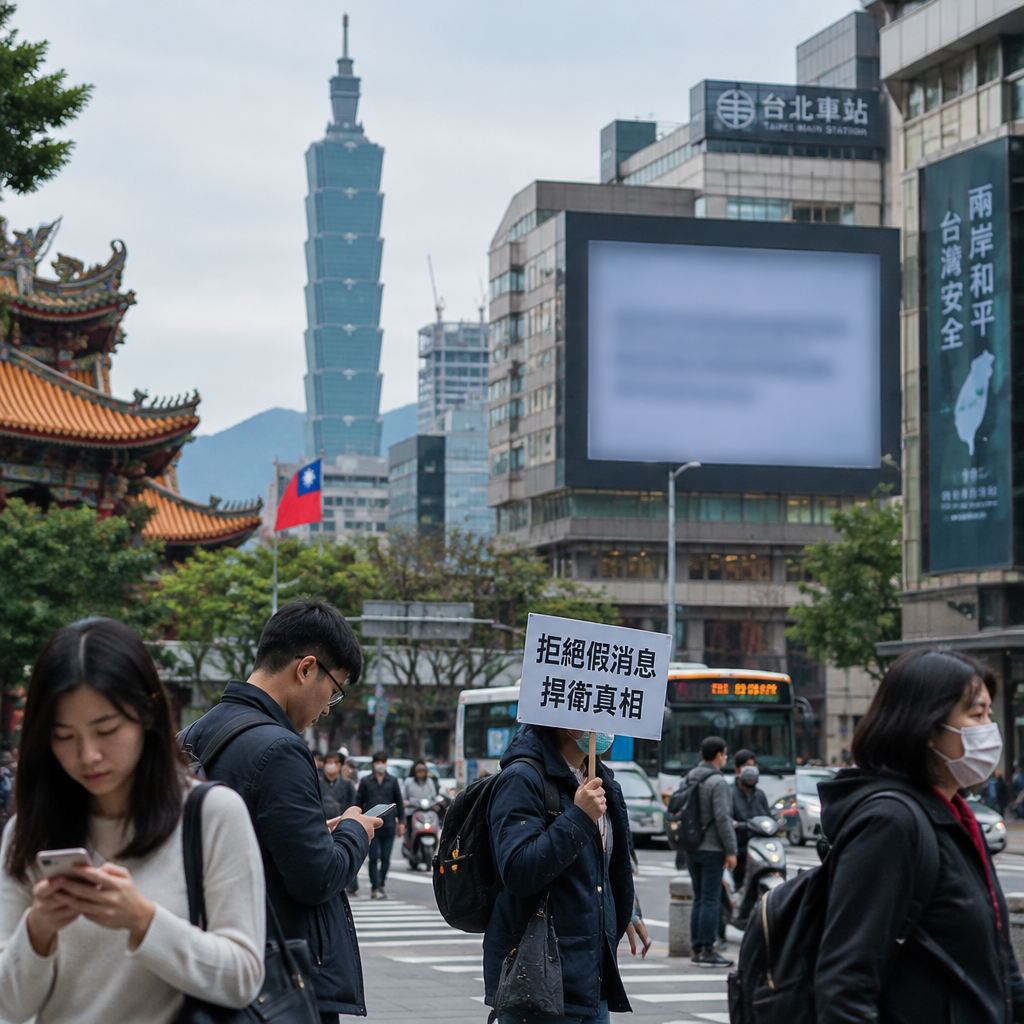
Beijing denies interfering in Taiwan’s affairs. Taiwan’s National Security Bureau says China has been using fake accounts and AI-generated material to influence public opinion: by tracking suspicious online accounts it recorded about 2.5 million disputed posts in the first nine months of 2026—48 percent more than a year earlier—on topics including energy, food safety and defence. How many voters were swayed through information operations is unknown.
What this means for technologists, policymakers, and voters
- Technologists and security teams: expect to prioritise detection of synthetic audio and image manipulation, account-origin tracing, and mitigation of automated sign-up and flooding attacks after the campaign’s experience with deepfakes and 70,000-plus fake registrations.
- Policymakers and regulators: will confront politically sensitive choices about cross-strait forums, sanctions and public responses after the Taiwan Affairs Office repeated media allegations and sanctioned a firm tied to Shen’s family.
- Voters and civic groups: must weigh how allegations that leverage filial piety and synthetic content affect personal reputations and electoral choices at a scale the National Security Bureau’s 2.5 million disputed posts suggests is substantial but opaque in impact.
China’s mix of overt sanctions claims, corporate distancing, coordinated favourable posts for one candidate, and covert deepfakes and server attacks aimed at another presents a composite playbook: tie reputational blows to cultural vulnerabilities, amplify praise for a preferred figure, and use synthetic media and automation to muddy the information environment. How many ballots that approach moves on 28 November is the central unknown—and one Taiwan’s authorities, campaigns and voters will carry into the polling booths.