The Merkury and the Benghazi port strike
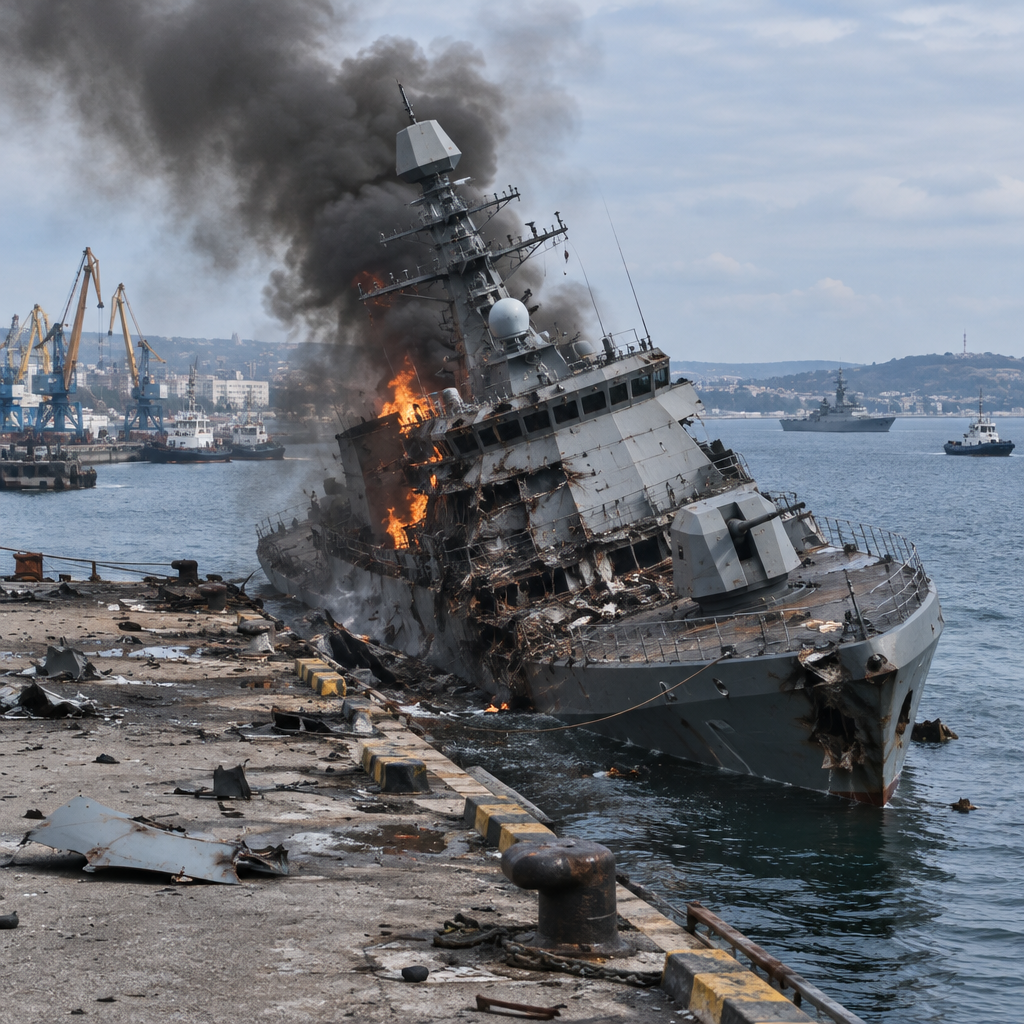
Satellite imagery and commercial photography collected by TWZ, Vantor and Planet Labs show the Project 20380 Steregushchiy‑class corvette Merkury engulfed in flames, rolled over and capsized at a quay in the port of Benghazi. The images show smoke rising, debris scattered around the dock and only the forward bow remaining above water after the vessel sank. Video circulated on social media purported to show a catastrophic explosion aboard the Merkury as the ship burned and overturned.
The Associated Press reported that “several Ukrainian sea drones were launched at the ship from a base run by Ukrainian forces in western Libya,” and that four drones were intercepted while two struck the warship. TWZ separately reported that a Ukrainian source confirmed the Merkury was struck by sea drones launched by the Security Service of Ukraine (SBU); the SBU has not commented publicly to date. Local sources quoted by Al Jazeera said residents saw three drones attack the vessel and claimed the ship was carrying weapons, ammunition and drones in its cargo.
TWZ also reported that an “unknown number of Libyan and Russian nationals were killed in the attack at dawn.”
The Merkury’s characteristics and operational notes
United24, the official Ukrainian media outlet, noted that Merkury was commissioned in 2023 and carries a crew of approximately 90. The Steregushchiy‑class corvettes are described in the reporting as relatively modern surface combatants closer in size to frigates, with a standard displacement of 1,800 tons, a length of 343 feet and a flight deck for a helicopter. Primary weapons listed in the reporting include two quadruple Uran anti-ship missile launchers, a 12‑cell Redut vertical launch system for air‑defense missiles, and two quadruple Paket‑NK anti‑torpedo/anti‑submarine torpedo tubes. TWZ noted the Merkury was assigned to Russia’s Black Sea Fleet but had been operating from Northern Fleet bases in the Arctic amid the war in Ukraine.

The cyber insurance questionnaire just landed. Now what?
SOC 2, HIPAA, insurance renewals - someone has to own security strategy. Nubivance provides fractional CISO leadership without the full-time salary.
Get a security leadAscalon and the Mediterranean pattern
TWZ reported that a second ship, the Ro‑Ro cargo vessel Ascalon (styled ASCALON in some coverage), was struck by Ukrainian uncrewed surface vessels (USVs) while operating off Benghazi. UNN, a Ukrainian outlet cited by TWZ, reported that Ascalon was used to transport weapons and has been considered part of the so‑called “Syrian Express” — a route for transporting military cargo from Russian ports to Syria via the Bosporus. UNN added that the ship belongs to M Leasing LLC, an entity the outlet said is under U.S. sanctions for involvement in transporting military cargo, and that Ascalon itself was placed under U.S. restrictions.
Sky News Arabia published imagery it said depicted one of the boats used in the Benghazi attacks, and Libyan National Army video footage circulating on social media showed forces firing on USV targets. TWZ cited maritime security firm Ambrey, which linked the Benghazi strikes to a pattern of unexplained explosions and attacks against Russian‑linked vessels in the Mediterranean — naming Ursa Major, Seajewel, Vilamoura and Arctic Metagaz among earlier incidents.
The Baltic Sea and a three‑theater campaign
TWZ placed the Benghazi strikes in a broader pattern extending beyond the Black Sea into the Mediterranean and the Baltic. The report cites Finnish officials confirming an attack on a Russian corvette in the Gulf of Finland on Nov. 11, which the BBC reported at the time. TWZ quoted Ukrainian SBU claims that the ship Naro‑Fominsk was targeted as part of a broader drone operation against Russia’s Ust‑Luga oil export depot.
The article also recalled earlier incidents: in April 2024 a fire aboard the Buyan‑class corvette Serpukhov in Baltiysk, Kaliningrad, caused damage to communications and electronic systems — a Ukrainian military intelligence official later claimed the blaze was the result of a covert operation. In June 2024, TWZ reported a strike on the Steregushchiy‑class corvette Boikiy in the Baltic, a sister ship to Merkury. More recently, the cargo ship Sparta II was struck by suspected Ukrainian drones in the Baltic and was being towed out of Finnish waters after firefighting, Reuters reported and TWZ cited, with Finland’s coast guard handling the rescue effort after the vessel drifted into Finnish territorial waters.
Vantor, Planet Labs and social video as evidence sources
Imagery used by TWZ and partners included satellite photos from Vantor showing the capsized Merkury and an earlier shot of the ship at berth, and Planet Labs imagery showing the vessel ablaze before it rolled over. TWZ also cited social‑media video posts and open‑source accounts — including OSINTtechnical and several regional outlets — that circulated stills and clips of the explosions and of Libyan forces engaging unmanned boats. Maritime security analysts quoted by TWZ emphasized that Russia’s naval assets and logistics face an expanding threat across both the Baltic and Mediterranean.
What this means for the SBU, Libyan authorities, and the Russian Navy
- Security Service of Ukraine (SBU): TWZ’s reporting indicates the SBU is operating or directing USV strikes far from Ukrainian shores — the agency will likely continue to refine long‑range sea‑drone operations given the reported successes against high‑value naval targets.
- Libyan authorities and the Libyan National Army: Local forces were shown engaging sea drones and have opened investigations, per Sky News Arabia and Libyan statements noted by TWZ; they will be managing both security at port facilities and domestic political fallout from attacks on foreign warships in Benghazi.
- Russian Navy and logistics operators: The loss of a modern Steregushchiy‑class corvette and repeated strikes on cargo and logistics vessels underscore growing vulnerability of vessels operating outside the Black Sea, the reporting concluded; recovery, rescue and asset‑protection efforts are already under way in multiple theaters.
Three high‑profile strikes in rapid succession — a sunk corvette in Benghazi, a struck cargo vessel off Libya, and earlier attacks in the Baltic — mark what TWZ frames as a new phase in Kyiv’s campaign to target Russian naval capability far beyond the Black Sea. The publicly available imagery, local accounts and statements by maritime analysts combine to show not a single isolated incident, but a widening operational reach that will be watched closely by the forces and authorities named in the reporting.