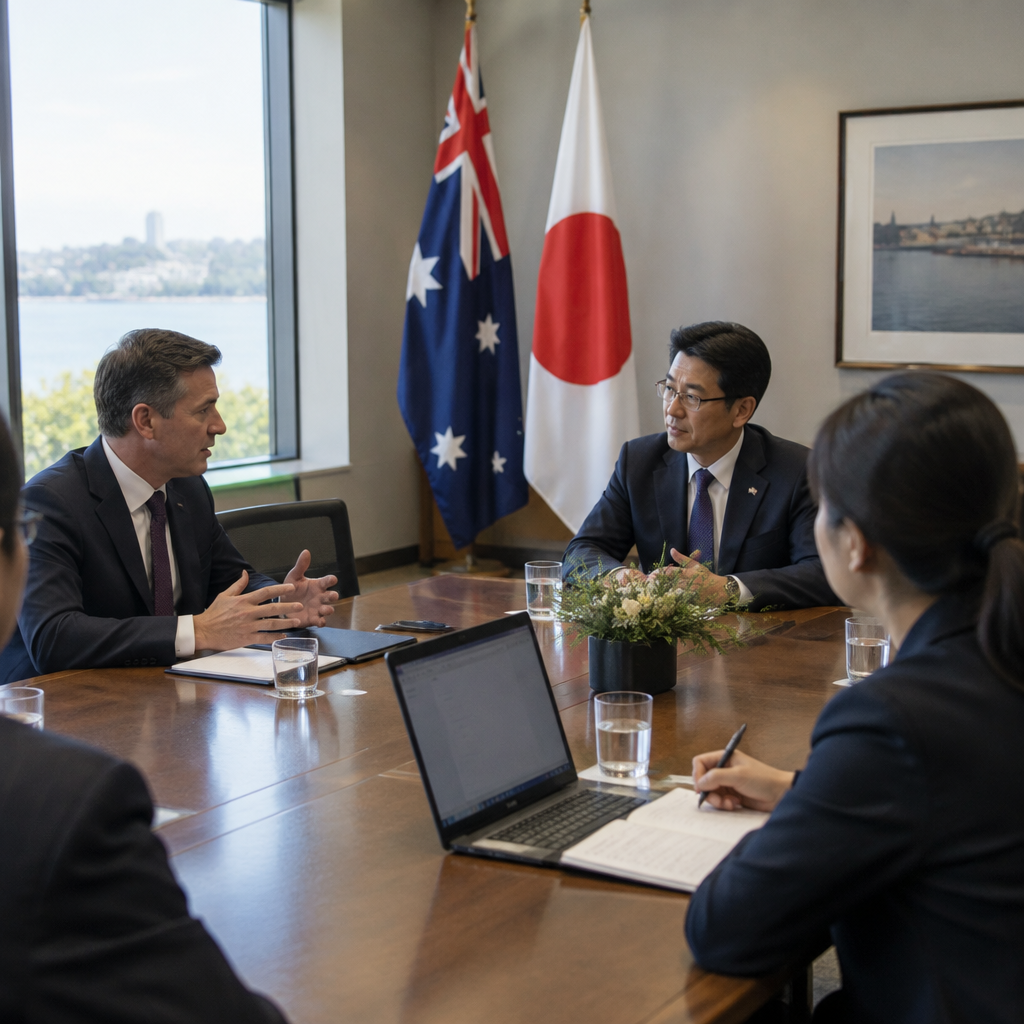
"Japan has no energy provider more loyal than Australia," Treasurer Jim Chalmers told the Australia–Japan Joint Business Conference — a confident line that sits uneasily beside a fragmented domestic posture on another low‑carbon fuel many of Australia’s partners are now seeking: uranium.
Tokyo assurances and the gas play
Federal and state officials have been publicly aligned in recent weeks: the message to Tokyo is that "Australia’s gas will keep flowing." Treasurer Jim Chalmers pledged continued work with Tokyo as the Domestic Gas Reservation Scheme took effect, and Western Australia Energy Minister Amber‑Jade Sanderson travelled to Japan while Japanese companies increased stakes in two Australian gas projects. Those diplomatic and commercial moves underpin a straightforward selling point: Australia as a dependable gas supplier.
Western Australia’s contradictory posture
That selling point contrasts with Western Australia’s approach to uranium. The state’s ban on new uranium mines, introduced in 2017, leaves only one project with a clear path to development; approvals of two others have lapsed. At the same time, Western Australia has been deployed emergency fuel‑security measures at home — running a formal fuel state of emergency since April 2026 that requires weekly supplier reporting, extended on 16 September to March 2027, paired with a 20 million litre diesel stockpile and a $100 one‑off payment to every driver. Premier Roger Cook has argued that the state’s liquefied natural gas exports help importing countries cut emissions, yet that logic has not been applied to uranium within the state.

Audit-ready is a season. It shouldn't be.
Evidence in spreadsheets, controls drifting between audits, frameworks multiplying on flat headcount. Nubivance runs continuous compliance on Rapid7 Cyber GRC - SOC 2, HIPAA, ISO 27001, PCI, CMMC.
End the scramblePolicy balkanisation across nine governments
Australia holds more than a quarter of the world’s known recoverable uranium resources but ranks only fourth in production — a gap the source attributes to policy rather than geology. State‑by‑state rules vary: South Australia and the Northern Territory allow uranium mining; Queensland permits exploration only; Western Australia permits neither. In New South Wales, a bill to repeal the state’s ban passed the upper house in May 2026 but stalled in the lower house ahead of a procedural deadline in late November. Canberra’s position complicates the picture further: the country’s Critical Minerals List, last updated in February 2024, excludes uranium, leaving national and subnational policies out of sync across nine governments.
International comparisons and the Critical Minerals omission
Other countries have moved differently. The United States and Japan have added uranium to their critical‑minerals lists, and China treats it as a strategic mineral. Canada listed uranium as a critical mineral in 2021 despite holding barely a tenth of the world’s recoverable resources compared with Australia’s quarter; Canada produced 14,309 tonnes in 2024 — 24 percent of world output — while Australia produced 4,598 tonnes, or 8 percent. Officials have argued privately that uranium does not meet Geoscience Australia’s criticality test — defined as being essential to modern technology with vulnerable supply chains — but rising demand from new nuclear construction from France to India and restarts of plants in Japan is making that argument harder to sustain. The U.S. 2024 ban on Russian uranium imports is also described in the record as being widely ignored: Russia still supplied 26 percent of U.S. reactor operators’ enrichment purchases in 2025.
What this means for Japan, Western Australia, and Canberra
- Japanese energy buyers: They receive direct reassurance on gas supply and are deepening equity stakes in projects, but they face a supplier whose uranium policy is harder to read — even as their own governments treat uranium as a strategic input.
- Western Australia government: It is simultaneously reassuring abroad on gas, enforcing a decades‑old uranium ban at home, and managing domestic fuel‑security stress through emergency powers, weekly reporting and a diesel stockpile.
- Canberra policymakers: They have established institutional architecture with three partners — including consultation clauses, disruption‑notification mechanisms and safeguards agreements — to underwrite long‑term supply ties, but leaving uranium off the Critical Minerals List makes the domestic policy map inconsistent with those diplomatic commitments.
The disconnect is not a simple accusation of unreliability; it is a problem of clarity. Australia asks customers to treat it as a dependable long‑term supplier and has built new intergovernmental procedures with partners to make that credible, yet its state‑level bans, national exclusions and emergency domestic measures send a mixed signal. The source's prescription is direct: add uranium to the Critical Minerals List at the next review rather than waiting for a supply shock, and recognise that reciprocity is not a concession only other countries should make. Reassurance tours to Tokyo and elsewhere will remain necessary — they will be more convincing if Australia’s own policy house is in order first.
https://www.aspistrategist.org.au/australias-uranium-policy-undercuts-its-energy-diplomacy/