"We also need the people using them to understand how their partners will make the legal and operational decisions that follow," the article warns.
Australia's parallel investments: military AI and partner interoperability
Australia is investing heavily in two related but separate agendas: incorporating artificial intelligence into military capabilities and strengthening the capability and interoperability of Indo‑Pacific partners. The investments range from AI applied to intelligence analysis, decision‑support systems, targeting, and autonomous systems, to long‑standing regional engagement work under programs such as the Pacific Step‑up. That second effort includes infrastructure development, equipment donations, regional exercises and defence cooperation designed to ensure partner forces can operate effectively alongside the Australian Defence Force and one another.
Where the agendas collide: legal and operational friction in coalition decisions
The core problem is not merely technical interoperability — whether platforms, data and communications can link — but legal and operational interoperability: do partner militaries understand the permissible limits of AI‑enabled warfare in comparable ways? The article sketches a targeting scenario in which an AI system identifies a potential target, synthesises multiple information sources and recommends engagement. One partner accepts the recommendation because its legal and operational framework treats available human oversight as sufficient. Another requires further human verification of underlying intelligence. A third insists the system explain how it reached its conclusion. Even when machines can “talk” to one another, those differences in how human judgment and legal thresholds are applied can create delay, disagreement, or post‑action dispute.

Audit-ready is a season. It shouldn't be.
Evidence in spreadsheets, controls drifting between audits, frameworks multiplying on flat headcount. Nubivance runs continuous compliance on Rapid7 Cyber GRC - SOC 2, HIPAA, ISO 27001, PCI, CMMC.
End the scrambleThe law, the manual, and why guidance alone is not enough
International humanitarian law (IHL) continues to govern the use of force even as AI is embedded in decision‑making; it was not written with AI in mind, but existing rules still apply. Expert initiatives, notably the Manual on International Law Applicable to Artificial Intelligence in Warfare produced by West Point, are beginning to clarify how IHL applies to AI. The article notes this manual brings together international experts to anticipate and solve the friction AI introduces to the battlespace. But it cautions that publishing guidance is not equivalent to building regional capacity to apply it in the messy realities of coalition operations.
Universities and the Indo‑Pacific Centre for Military Law as practical bridges
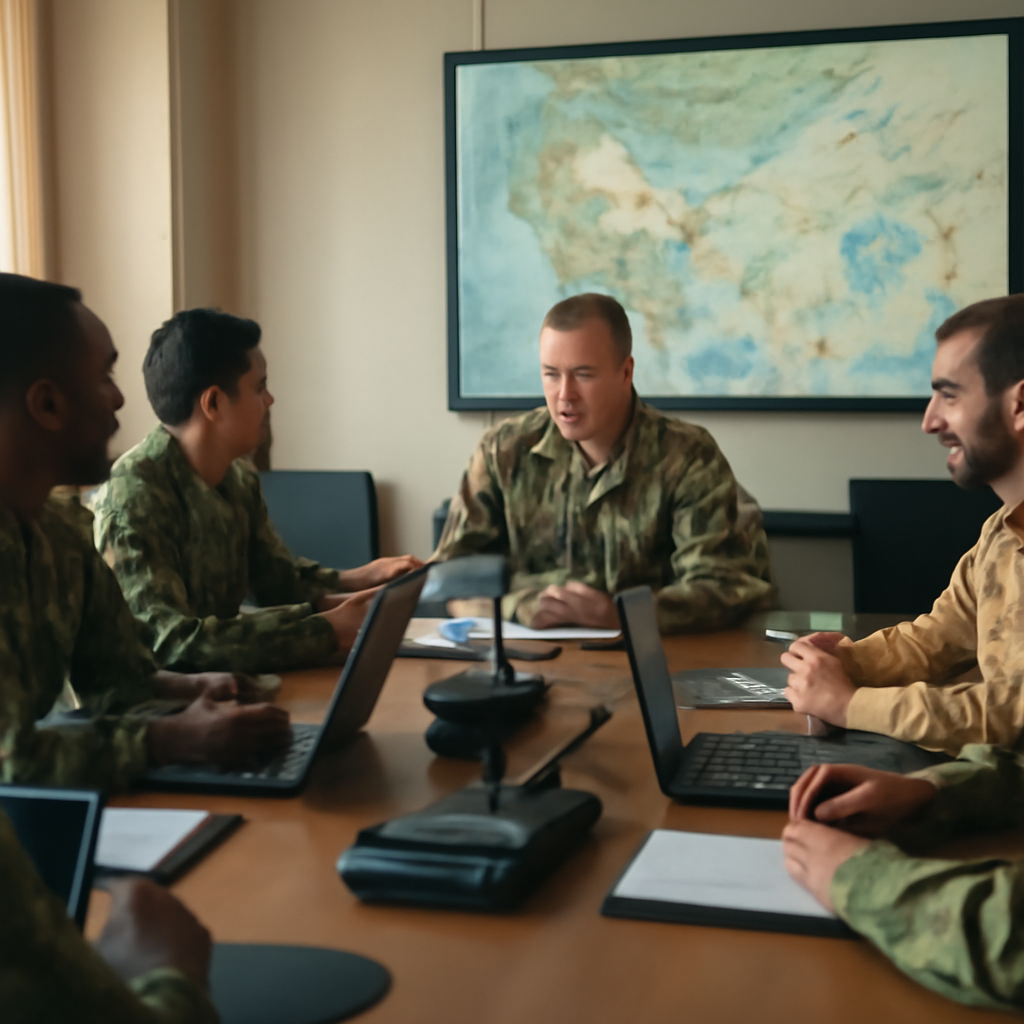
Australia is described as unusually well placed to support the operational translation of legal guidance because the Department of Defence already invests in regional engagement and partner capacity, including through the Indo‑Pacific Centre for Military Law. The article proposes that universities can complement defence efforts: they bring together disciplines rarely co‑located inside a single military organisation — lawyers who can explain IHL, computer scientists who can explain technical limits of AI systems, and military and strategic studies specialists who can convert those abstractions into realistic operational dilemmas. Universities also offer a comparatively neutral environment where officers and officials from different Indo‑Pacific states can debate interpretations without those discussions immediately becoming statements of national policy.
What this means for militaries, universities, and the Department of Defence
- Militaries: Expect pressure to define not only technical interoperability but shared approaches to human oversight, standards for verification of AI‑produced intelligence, and requirements for explainability in targeting decisions.
- Universities: Can serve as convenors and trainers, hosting practitioner‑focused courses that combine IHL scenarios with realistic AI capabilities so participants must explain both what they would decide and why.
- The Department of Defence: Already investing in regional legal capacity, it can prioritise AI–IHL education as a defence‑engagement objective and fund a sustained Indo‑Pacific programme to turn emerging legal principles into shared operational language.
From manual to muscle: training now to avoid disputes at machine speed
The practical model the article outlines is deliberately modest: a standing programme of short, practitioner‑focused courses delivered with priority Indo‑Pacific partners that focus on IHL–AI friction points in operationally relevant scenarios. The goal would not be to export an Australian legal interpretation, but to develop a shared vocabulary, identify genuine differences and build habits for resolving them. In other words, interoperability will increasingly depend less on whether our machines can exchange packets and more on whether the people operating them can anticipate and reconcile one another’s legal and operational decisions before those decisions are enacted at machine speed.
Read the original article: https://www.aspistrategist.org.au/australias-next-interoperability-challenge-is-military-ai/