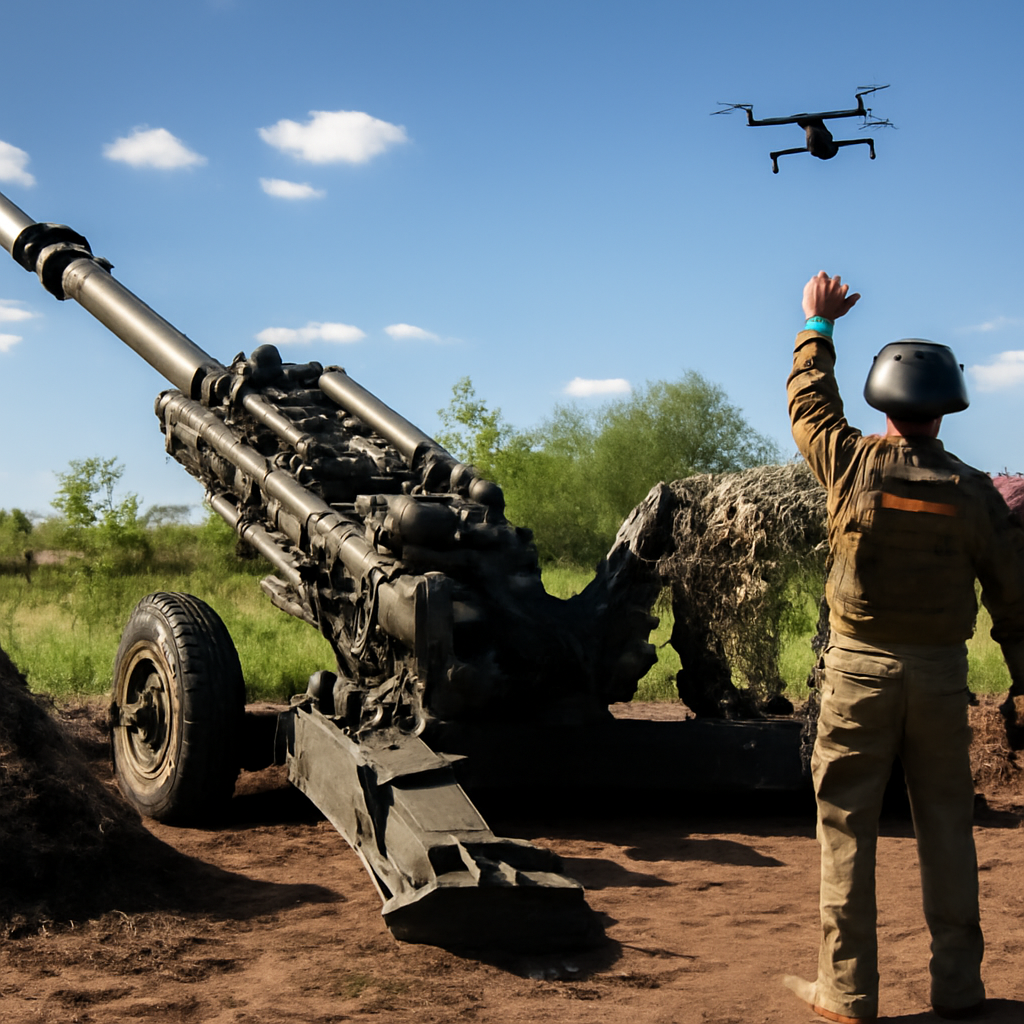
“Guns used to be massed at positions to create an ‘artillery wall’ and a barrage of fire. That practice is gone now.” — Lt. Col. Vitalii Korniienko, commander, 7th Artillery Brigade, Ukrainian National Guard
How Lt. Col. Korniienko describes the battlefield shift
In a recent interview with the Ukrainian Oboronka outlet, Lt. Col. Vitalii Korniienko laid out a blunt assessment: drones have taken over most strike roles, but cannons remain essential for tasks drones cannot perform. He said 95% of strikes are currently carried out by drones and noted the comparative economics: a 20-drone FPV mission costs roughly $20,000, whereas individual artillery shells cost “at least $2,000” each. Typical modern fire missions, he explained, consist of up to 10 shots—commonly three to five ranging rounds followed by targeting fire—so even a minimum mission can consume several thousand dollars’ worth of ammunition and risk the gun’s survivability.
The combined drone-artillery brigade concept
Korniienko described an approved operational concept that integrates drones and guns within a single brigade. Under that model, drones hunt enemy artillery and logistics while artillery “provides cover for the infantry, destroys targets, and pins the enemy down in their dugouts.” He said primary operations focus on positions 10 kilometers deep or farther behind enemy lines, though brigades will engage closer targets when requested. The brigade is also shifting some logistics from pickup trucks to ground-based robotic systems that transport ammunition and supplies to drone and artillery positions.

This site is the portfolio.
OSINTSights runs on Cloudflare Workers, D1, R2, and Vectorize, with an AI pipeline on Hetzner ARM. Nubivance designed, built, and operates it. We do the same for clients.
See what we buildWhere artillery still outperforms drones
Despite the drone predominance, Korniienko highlighted clear limits of aerial systems. He pointed to targets in the Kupyansk sector that drones cannot reach because of electronic warfare interference, and to slow fiber-optic drones that are “simply shot down.” In those cases, artillery remains the reliable option: “Nothing affects its shells. Fog, strong winds, snow, or headwinds—it makes no difference to artillery; it will operate regardless.” He added that the role of guns has shifted from massed barrages to destroying, suppressing, and halting assault groups and armored columns—tasks he said “only artillery can handle.”
Positioning, protection, and low-signature fires
Korniienko described a careful operational posture: guns are rarely left in exposed clusters. Deployment is prepared in advance with anti-aircraft drone teams clearing the sky and positions constructed as underground dugout caponiers with camouflaged access routes. He recounted using 105mm howitzers on the Kharkiv axis where the weapon could fire 10–12 km from a concealed eight-to-nine-kilometer position with “almost no muzzle flash.” That low-signature approach contrasts with long-range charges that, he warned, produce “a massive burst of flame from the muzzle—visible for kilometers at dusk or dawn,” compromising concealment.
Ammunition choices: M107, M795, and quality concerns
Korniienko set out a pragmatic view on rounds. The M107 155mm “short” shell is inexpensive, mass-produced, and has a range of about 14–18 km depending on propellant—he said Ukraine has sufficient stocks. Long-range options such as the M795 can reach roughly 30 km or further with base-bleed units but are “in short supply,” and they accelerate barrel wear. His suggested mix for most brigades is about 60% long-range shells and 40% M107s. He also warned about inconsistent quality in some Asian-produced shells: reported weights of 46 kg sometimes measure 46.9 or 45.4 kg, and those half-kilogram variances materially affect impact points. Because of that, Korniienko said his crews discard standard firing tables and instead weigh each batch, sort by weight, and compile bespoke firing tables. He further noted instances where shells from “one specific country” damaged equipment—tearing off muzzle brakes or causing barrel bursts—prompting wariness among his crews.
Domestic manufacture, Western donations, and maintenance realities
Korniienko praised domestic systems and rapid local support. His brigade was among the first to test the Bogdana 155mm system; they provided feedback that refined its design, and he said a broken Bogdana can be repaired and back in position within a day or two thanks to manufacturer support. By contrast, he described delays for donated Western systems like the U.S.-made M777: replacement parts can take months to arrive, and he noted repair attempts by crews themselves may be restricted by warranty rules.
What this means for brigade commanders, Western partners, and manufacturers
- Brigade commanders: will balance low-signature, prepared positions and mixed ammunition stocks—aiming for roughly 60% long-range and 40% M107 rounds while protecting guns from drone detection and electronic warfare.
- Western partners and donors: face pressure to supply consistent, high-quality munitions and timely spare parts; delays in parts can leave guns idle for months, per Korniienko’s account.
- Domestic manufacturers: gain operational advantage through rapid repair cycles and iterative design feedback; the Bogdana’s battlefield evolution and quick turnaround for repairs were singled out as operationally decisive.
Artillery has ceded the title “king of battle” to drones in the journeyman sense of who strikes most, but Lt. Col. Korniienko’s account makes plain that guns remain indispensable where endurance, heavy effect, and resistance to electronic or environmental denial matter. The practical next steps he describes—mixing shell types, hardening positions, integrating anti-drone teams, and sustaining fast manufacturer support—are precise, tactical answers to the conditions he says Ukraine faces today. Whether production of long-range shells, propellants, and reliable munitions can scale to sustain that balance will shape how well the combined drone-artillery brigade performs in the months ahead.
Original story — TWZ: The Evolving Role Of Ukraine’s Artillery In The Age Of Drones