Abraham Lincoln departs Guam, continuing her journey home
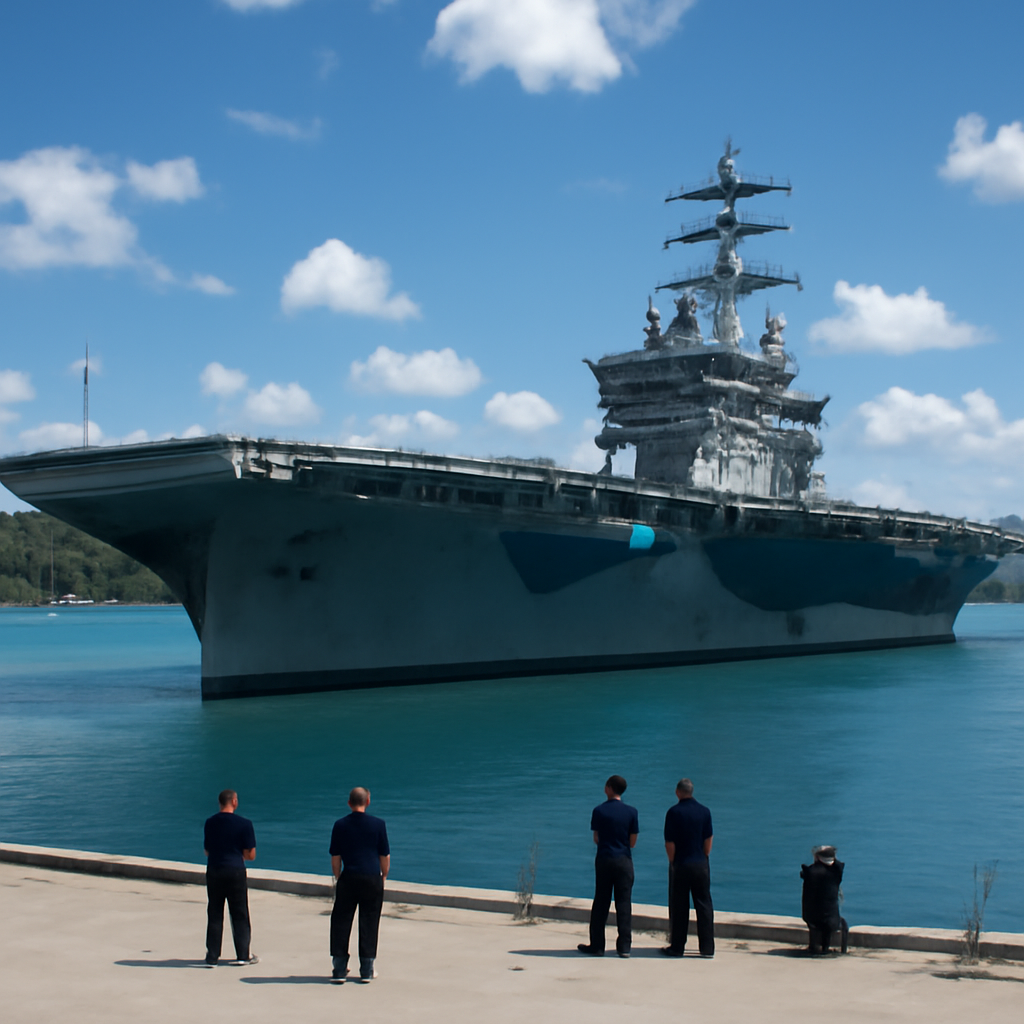
The USS Abraham Lincoln (CVN 72) paused in Apra Harbor, Guam, on Sept. 19 for a short logistics stop and on-base liberty before leaving the next day. The carrier is 307 days into her deployment—19 days short of the record set earlier this year by the USS Gerald R. Ford—and is reported to be conducting routine operations in the U.S. 7th Fleet area of responsibility as she transits east toward Naval Air Station North Island in San Diego.
Publicly available flight-tracking and movement data in TWZ’s reporting show Lincoln left Thailand on Sept. 6 after a five-day liberty call, topped off the guided-missile destroyer USS Frank E. Petersen Jr. in the Gulf of Thailand, and conducted joint training with two Royal Australian Navy frigates in the South China Sea. The carrier transited the Balabac Strait eastbound around Sept. 13 and the Surigao Strait northbound around Sept. 15 before going dark for several days and then resurfacing in Guam to moor at Kilo Wharf.
Barker said the ship “took on stores, mail, and equipment” and that 13 Fleet and Family counselors are aboard to run return-and-reunion classes while “the crew and ship remain focused and ready.” No official homecoming date has been announced; TWZ notes that, barring further stops or en route training, Lincoln’s return to San Diego would likely fall in early October. The Chief of Naval Operations, Adm. Daryl Caudle, told reporters in June that Lincoln would likely shift her homeport to Naval Base Kitsap‑Bremerton and is expected to begin a Drydocking Planned Incremental Availability (DPIA) after returning, though the DPIA timeline is unclear.
George Washington and George H.W. Bush project power in the Middle East
Two U.S. carriers remain on station in the Middle East supporting blockade operations. The USS George Washington (CVN 73) hosted reporters from Sept. 11–14, when Fox News’ Trey Yingst and CBS News’ Tom Hanson reported live from the flight deck as F-35C Lightning IIs and F/A-18E/F Super Hornets launched. Those reports included on‑deck footage and commentary from Washington’s commanding officer, Capt. Nicholas DeLeo: “We’re pretty much employing all our capabilities right now.”
Yingst reported that the carrier “came under Iranian missile attack; the first of three attacks on US warships in the last week alone,” attributing the strike to the USS George Washington. When TWZ asked the Navy which carrier was targeted after Iranian state media claimed success, the service declined to comment.
Destroyer USS Shoup, identified publicly as part of Carrier Strike Group 5, was observed off Washington’s starboard side during reporting. Shoup’s commanding officer, Capt. William Buford, described his ship’s role as coordinating defense among group units and allocating defensive assets—missiles or aircraft—to protect the formation. TWZ reports additional destroyers operating in the U.S. Central Command (CENTCOM) area of responsibility are escorting Washington, but a U.S. official declined to identify them.
The USS George H.W. Bush (CVN 77) has been operating nearly six months in the Arabian Sea in support of the blockade. As of CENTCOM’s social media update on Sept. 21, U.S. forces had redirected 110 commercial vessels to ensure “total compliance” with the blockade and allowed more than 50 ships “supporting humanitarian efforts” to pass. CENTCOM has recently stopped publishing the number of ships boarded, seized, or disabled kinetically.

Audit-ready is a season. It shouldn't be.
Evidence in spreadsheets, controls drifting between audits, frameworks multiplying on flat headcount. Nubivance runs continuous compliance on Rapid7 Cyber GRC - SOC 2, HIPAA, ISO 27001, PCI, CMMC.
End the scrambleUSS Ronald Reagan returns to the fleet
The Navy has confirmed the USS Ronald Reagan “returned to the fleet capable and mission-ready” after a Drydocking Planned Incremental Availability at Puget Sound Naval Shipyard that began in March 2025 and four days of sea trials in early September 2026. While the Navy will not comment publicly on future deployments for operational security, current speculation points to a possible spring 2027 deployment, which the Navy has not confirmed.
Reagan is the carrier homeported at Naval Base Kitsap‑Bremerton. TWZ notes the ship previously served as the forward-deployed carrier in Yokosuka, Japan, until swapping hulls with the USS George Washington in 2024. TWZ also reports that USS Nimitz circumnavigated South America to Naval Station Norfolk this summer and is being used primarily for training prior to deactivation in 2027, and that the yet-to-be-commissioned PCU John F. Kennedy is slated to homeport in Washington state no earlier than 2029.
U.S. Navy big-deck posture and near-term questions for CENTCOM, carrier crews, and commercial shipping
TWZ’s tally of the big-deck fleet places three U.S. carriers deployed (one of them heading home), one preparing to deploy soon, three working up in various states of readiness, three in current or upcoming maintenance, and one being used primarily for training before deactivation next year. On the amphibious front, one amphibious ready group is deployed, one is forward-stationed and in port, four are working up or in port, and three are in maintenance; non‑deployed LHA/LHD amphibious warships were not shown in the listing.
For CENTCOM, the principal operational action has been traffic control: redirecting 110 commercial vessels and permitting more than 50 humanitarian shipments while ceasing public reporting of the number of ships boarded or seized. For U.S. carrier crews, operational tempo includes sustained flight operations and defensive coordination with nearby escorts—Washington is reportedly “surrounded by four to five guided-missile destroyers at any moment,” according to reporting aboard the strike group. For commercial shippers and humanitarian actors, the practical effect is active rerouting or screening under the blockade regime.
Three concrete open items stand out from TWZ’s reporting: Lincoln’s unannounced homecoming date and the unclear DPIA timing that follows; the precise composition of destroyer escorts and air‑defense coordination in the CENTCOM AOR beyond the publicly identified USS Shoup; and CENTCOM’s decision to stop publishing counts of kinetically boarded, seized, or disabled vessels.