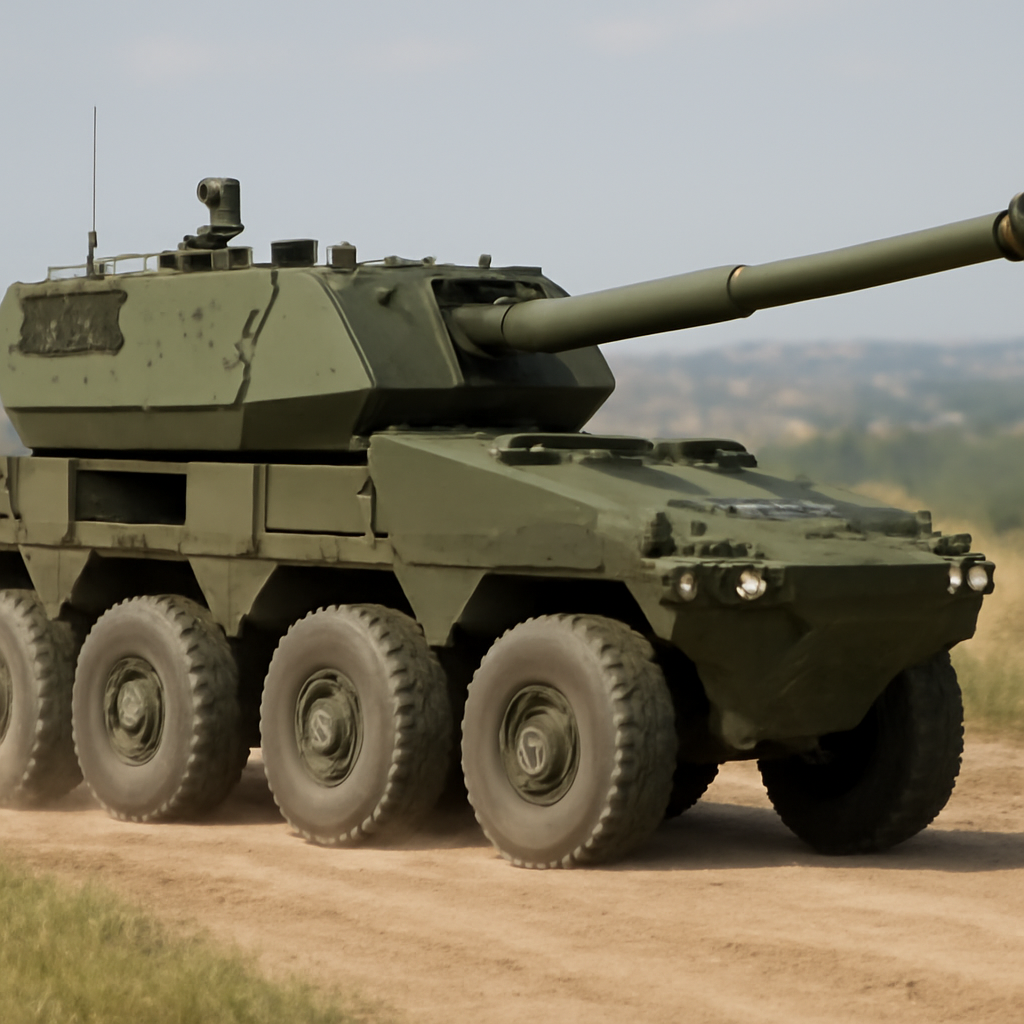
"Eight wheels. Six-wheel steering. One 105mm gun. Definitely not your average ride."
That was the Ministry of National Defense’s curt description as Taiwan gave the first public demonstration of its domestically developed 105mm 8×8 mobile gun system on September 23, 2026. The Republic of China Army (ROCA) live-fire event in Tainan showed the vehicle engaging moving and stationary targets, firing on the flank while on a slope, and practicing multi-target engagement with its coaxial machine gun — while also recording one round that initially failed to fire.
What the live-fire demonstration showed
During the Tainan exercise the vehicle engaged a moving target at roughly 0.75 miles and a stationary target at about 0.6 miles. It also fired at targets positioned 90 degrees to the vehicle’s side while operating on a gentle slope, demonstrating lateral engagement capability on uneven terrain. The crew simultaneously fired the vehicle’s 7.62mm coaxial machine gun with the 105mm main weapon in a scenario intended to represent multiple-threat engagement, including simulated amphibious assault vehicles.
An apparent weapon malfunction occurred when one 105mm round initially failed to fire. According to reports, the crew followed safety procedures, waiting approximately two minutes before reloading; after reload the vehicle fired normally. Maj. Gen. Chen Chien-chung, head of Arsenal 202 (the Production and Manufacturing Center of the Armament Bureau), said an investigation would be conducted into the misfire.
Design changes and mobility tailored to Taiwan
The vehicle’s production configuration has changed materially since its public debut as a Clouded Leopard direct-fire variant in 2023. Height has been reduced by about 12 inches to bring overall vehicle height below 9 feet 10 inches. Turning radius has been cut from 36 feet to 26 feet by adding steering to three pairs of wheels instead of two, enhancing maneuverability in constrained environments.
Taiwanese officials emphasized these modifications for a reason: the island contains restrictive terrain, dense urban areas, narrow roads, drainage channels and mountainous eastern stretches such as Hualien and Taitung. The wheeled 8×8 layout is presented as a way to rapidly reposition along road networks and access areas where heavier tracked vehicles might struggle.

The cyber insurance questionnaire just landed. Now what?
SOC 2, HIPAA, insurance renewals - someone has to own security strategy. Nubivance provides fractional CISO leadership without the full-time salary.
Get a security leadMain armament, ammunition commonality, and roles
The vehicle’s principal weapon is a 105mm gun capable of firing general-purpose tank ammunition as well as rounds developed specifically for the system. During the demonstration ROCA displayed armor-piercing, anti-personnel and training ammunition. The gun shares ammunition compatibility with Taiwan’s existing M60A3 and CM11 tanks, potentially giving the new system access to an existing ammunition ecosystem while allowing the development of specialized munitions.
Operationally, the ROCA positions the 105mm 8×8 as mobile direct-fire support: a platform to engage amphibious vehicles, armored personnel carriers, fortifications and other ground targets that complement heavier tanks and anti-armor weapons.
Counter-drone adaptations and evolving threats
Officials say additional counter-drone capabilities are planned before mass production. Proposed measures include an anti-drone cage and, more ambitiously, installation of a larger-caliber automatic weapon such as the 30mm M230 chain gun. That weapon option was described as able to employ canister-type ammunition dispersing numerous fragments against small drones.
Those planned changes reflect an operational environment in which armored units would face persistent surveillance and attacks by uncrewed systems. Adding organic anti-drone capability would broaden the vehicle’s role beyond conventional direct-fire engagement to include survivability and protection within a drone-contested battlespace.
How the ROCA, Arsenal 202, and the PLA are positioned
- ROCA commanders: Gain a mobile source of direct firepower optimized for Taiwan’s roads and restrictive terrain, able to respond quickly to amphibious landings and to operate in urban and mountainous zones while integrating anti-drone measures.
- Arsenal 202 and the Armament Bureau: Will investigate the misfire, finalize counter-drone modifications, and move toward scheduled production — 178 series examples are planned to begin production in 2027.
- The Chinese People’s Liberation Army (PLA): Faces a wheeled, rapidly repositionable direct-fire asset that is intended to complicate amphibious and mechanized approaches, while the system’s ammunition commonality with older tanks affects logistic considerations on both sides.
Comparisons, limits and next steps
The 105mm 8×8 sits in the same broad category as Italy’s Centauro family and Japan’s Type 16 Mobile Combat Vehicle. The article notes prior wheeled 105mm efforts elsewhere: the U.S. Stryker Mobile Gun System (divested in 2021) and the M10 Booker (canceled in 2025). A wheeled system trades some protection and off-road mobility compared with tracked main battle tanks for greater road mobility and potentially lower logistical burden — a trade-off the ROCA appears to have accepted for Taiwan’s particular geography.
With production slated to begin in 2027 and 178 series vehicles planned, the program is moving from prototype and testing toward fielding. The announced investigation into the misfire and the planned counter-drone additions will be concrete early markers of how reliably and how resiliently the platform will enter service.