Australia imports more than 50 billion litres of refined petroleum products annually and domestic production meets only about 20 percent of liquid‑fuel demand.
Why Defence as an anchor customer could change the calculus
Can a demanding, technically exacting buyer speed the birth of new green industries? The argument presented in the source is straightforward: Defence need not be a heavy-handed climate purchaser. Instead, by qualifying promising low‑carbon fuels and materials against military standards and committing to limited early purchases, Defence can reduce the demand risk that now prevents investors and producers from building commercial scale.
The value lies in signalling. A supplier that satisfies military specifications and demonstrates an Australian supply chain could obtain a time‑limited multi‑year offtake. That credibility helps the same facility supply airlines, mining and freight companies, or export markets — turning a nascent plant into a diversified commercial operation while preserving a priority military supply line.
Low‑carbon liquid fuels: the clearest case
The clearest application is low‑carbon liquid fuels. The Commonwealth Scientific and Industrial Research Organisation (CSIRO) estimates a domestic low‑carbon liquid‑fuels industry could deliver $6 billion to $12 billion a year in direct economic benefits. Government estimates place potential export revenue from green iron and steel at up to $96 billion a year by 2040. Those figures measure different outcomes — economic benefit versus export revenue — and are not additive forecasts of GDP. Still, together they suggest a headline opportunity exceeding $100 billion a year across two adjacent industries.
Defence has already taken preparatory steps. It has certified all military aviation and land assets for low‑carbon liquid fuels, began a sustainable aviation fuel pilot in 2024 at the Royal Australian Air Force’s East Sale base, and opened the Defence Fuels Qualification Centre to test fuels domestically. The missing element is commercial: Australian producers need customers willing to sign the longer contracts required to finance production.

Audit-ready is a season. It shouldn't be.
Evidence in spreadsheets, controls drifting between audits, frameworks multiplying on flat headcount. Nubivance runs continuous compliance on Rapid7 Cyber GRC - SOC 2, HIPAA, ISO 27001, PCI, CMMC.
End the scrambleMaterials, bases and the nature of "defence" products
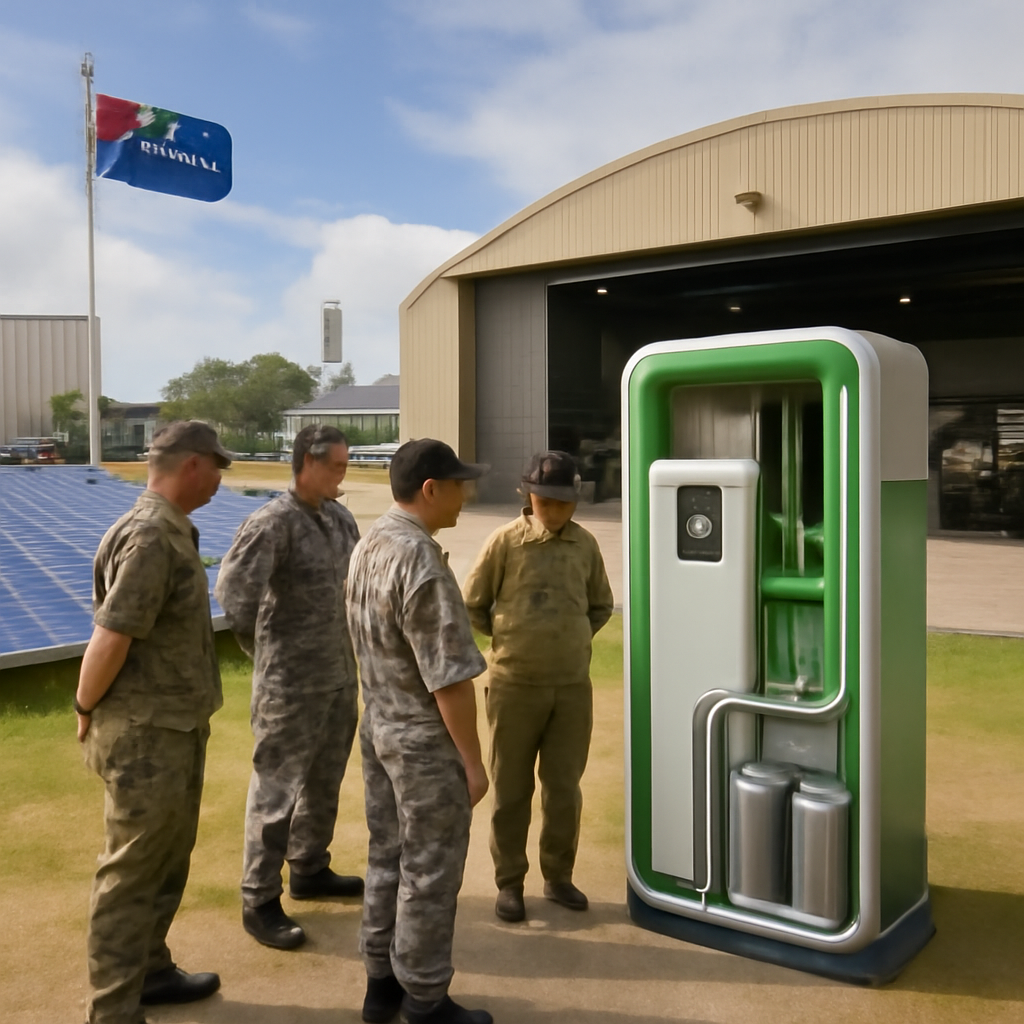
The model extends beyond fuels to materials and energy technologies where domestic processing or redundancy matters for continuity. Lower‑emissions steel gains defence relevance when it creates an additional qualified source for shipyards or sustainment. New cement binders become useful if they reduce reliance on external inputs rather than merely lowering emissions. On bases, solar, batteries and microgrids can cut dependence on a single grid connection and support critical loads during outages — precisely the continuity problem militaries prioritise.
In short, green products become defence products when they improve continuity, substitution or replenishment. Defence’s purchases would be selective: the aim is to pay for the strategically useful slice of production while civilian demand provides scale.
Lessons from Quad partners: India and Japan
Equivalent experiments already exist in Quad partner countries. India’s defence ministry has approved a 250 MW solar‑plus‑battery project on its land to improve energy security and reduce costs at defence facilities; separately, the Indian Army and a state‑owned Indian electricity company developed a 200 kW solar‑hydrogen microgrid designed to replace diesel generators in an off‑grid location. These investments are being justified in military terms — continuity of capability.
Japan’s approach is national in scale: renewable electricity is expected to provide about 77 percent of the Ministry of Defense’s electricity procurement in the 2026 financial year, and the government supports domestic sustainable aviation fuel production through capital assistance and tax incentives. The shared lesson is that government demand and standards can help industries build for larger markets without making defence the only customer.
What this means for Australian producers, the Australian Defence Force, and airlines, mining and freight
- Australian producers and investors: A Defence offtake that follows qualification would reduce early demand uncertainty and create bankable contracts that help secure finance and attract further customers.
- The Australian Defence Force: Defence would gain assured access to domestic production that meets its specifications and improve resilience — a second source of fuel or materials and distributed power options for bases.
- Airlines, mining and freight: These civilian customers would inherit scale and qualification credentials from suppliers that have met military standards, easing their own procurement and decarbonisation plans.
Australia has already funded much of the supply side through the government’s Future Made in Australia agenda; the remaining task, as set out in the source, is disciplined demand. Every Defence green‑industry trial should name the military customer, the performance standard, the dependency it will reduce and the contract that will follow success. Where qualification and resilience are proven, Defence can use minimum purchases, multi‑year offtakes or capacity contracts to buy only the strategically useful slice of production.
There is a pragmatic final test embedded in the proposal: Defence should not ask how many green products it can buy, but which Australian industries become commercially stronger and militarily useful when Defence becomes a customer. Get that choice right and procurement can do two jobs at once — turn clean‑industry investment into a larger Australian market, and turn that market into national resilience.