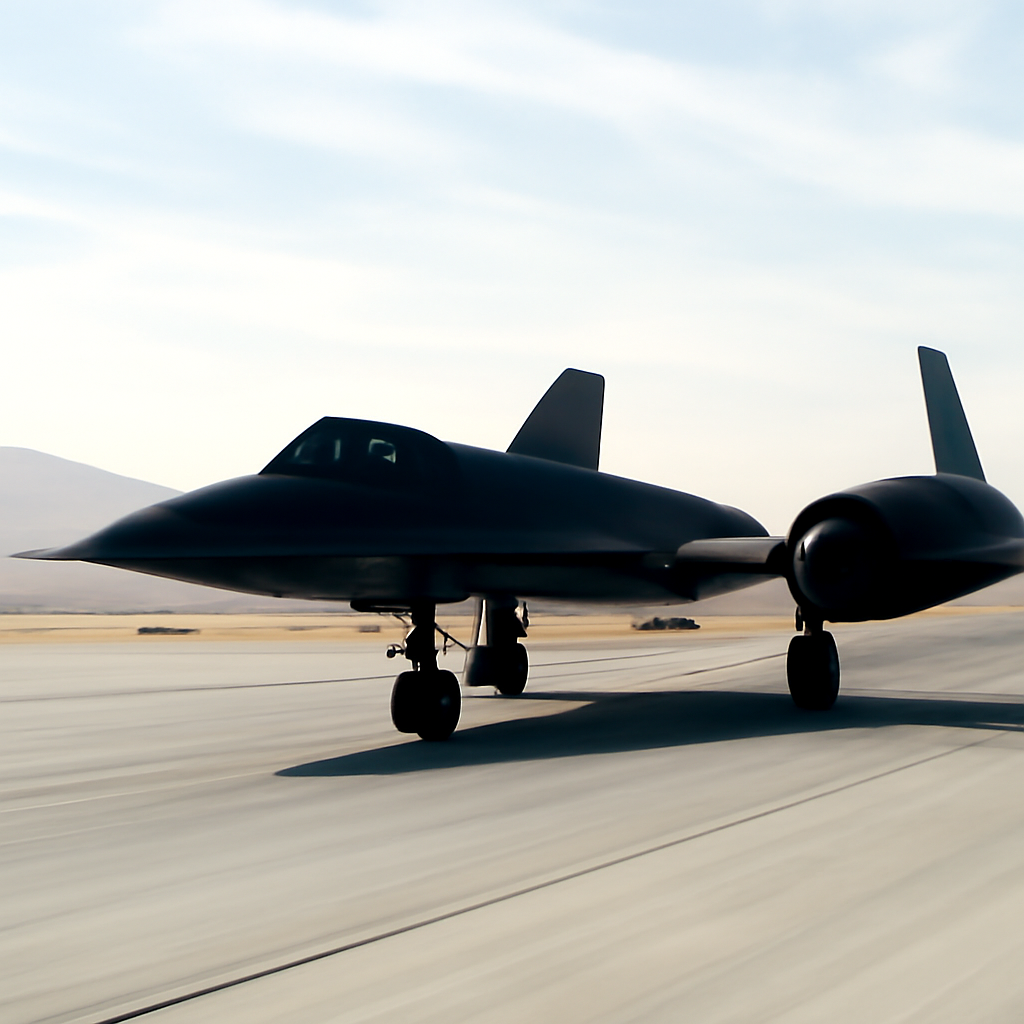
“The world record for any crewed jet-powered aircraft is officially Mach 3.3, or 2,193 mph.” That 1976 straight‑line run over Edwards Air Force Base is the hard baseline Tim Conners used when, in the early 1990s at NASA’s Dryden Flight Research Center, he explored whether the SR‑71 Blackbird airframe could be pushed toward Mach 4 — roughly 2,660 mph at altitude — for brief, experimental excursions.
Tim Conners’ Dryden study: stagnation temperature and the right edge of the envelope
Conners, who led propulsion for SR‑71 work at Dryden, described his study as “purely conceptual.” He focused on the aircraft’s operational limits at altitude, centering on stagnation (compressor inlet) temperature. The SR‑71 “flew a trajectory that was usually operationally limited to 450 knots equivalent airspeed,” he said, while “the engines … were optimized to fly at about 500 knots equivalent airspeed, 475 to 500.” That mismatch meant the aircraft’s flight‑envelope right‑hand limit swept up in Mach number with altitude — and with Mach comes higher stagnation temperature. Conners said the limiting factor was “primarily the material strength of the engine front frame,” a constraint that set the practical speed ceiling in the jet’s original configuration.
Spray cooling as a stopgap: brief Mach excursions, big risks
Rather than proposing active coolant loops through structure, Conners told TWZ he examined “spray cooling of the incoming airflow to lower the bulk temperature,” to be used only when accelerating beyond about Mach 3.4. The concept’s conops was explicit: short, carefully controlled speed excursions followed by a return to lower Mach numbers. He warned of operational danger if the system clogged or froze — “if it fails while you’re at higher speed, you have to decelerate in a hurry to protect the assets.”

Audit-ready is a season. It shouldn't be.
Evidence in spreadsheets, controls drifting between audits, frameworks multiplying on flat headcount. Nubivance runs continuous compliance on Rapid7 Cyber GRC - SOC 2, HIPAA, ISO 27001, PCI, CMMC.
End the scrambleEngines: the J58’s material limit and the argument for reengining
Conners identified the Pratt & Whitney J58 as a “weak link.” While the engine had the performance, he said, “not the material strength.” Dryden feedback about the remaining J58s was, in Conners’ words, “discouraging” because they are “indeed unserviceable” based on inspection after having “sat idle … for 27 years.” That reality has shifted discussion toward reengining the airframe: installing modern, high‑Mach bypass systems or combined‑cycle propulsion could both remove the old hardware’s material limits and reduce inlet temperature exposure — potentially turning the SR‑71 into an engine test bed instead of attempting to revive the original J58s.
Compressor inlet temperature and shock‑wave geometry: Crickmore and Peters on limits
Aviation author Paul F. Crickmore noted the SR‑71 was designed around a sustained cruise of Mach 3.2, with the critical operational limitation being compressor inlet temperature (CIT). He quoted a CIT damage threshold of 427 degrees Celsius (about 800°F); above that the engines would be damaged. Crickmore added that colder outside air lets the aircraft go slightly faster before hitting that limit — which in practice produced measured speed up to Mach 3.3.
Former SR‑71 pilot David Peters (recounted on the Habubrats SR‑71 account on X) described how outside air temperature affected speed limits in specific missions: at times he was limited to less than Mach 3 because high ambient temperature pushed the CIT limit to 427°C by about Mach 2.95; on other occasions he reached above Mach 3.4 (3.49 in one flight) without approaching that temperature limit. Peters estimated “the limiting speed as configured would be about 3.55 so long as you don’t exceed 427C,” citing inlet spike geometry and overflow shock interaction with the wing and flight controls as the mechanistic cause. Conners observed that inlet shock effects “can be accommodated through rescheduling the inlet spike movement and perhaps making changes to the bypass schedules,” but stressed such changes would require careful envelope expansion.
What this means for NASA, propulsion developers, and restoration teams
- NASA: An unclassified airframe that “could be used as an engine test bed” offers a visible platform to study the turbojet→ramjet/scramjet handoff in the Mach 3–4 transitional regime — a capability Conners said could be valuable if the agency wants “back in the business of flying high and fast again.”
- Propulsion developers: Successful reengining would demand “high‑Mach bypass systems” or combined‑cycle concepts; the SR‑71’s payload capacity and airframe could provide a practical, non‑classified flight testbed for dual‑cycle handoffs akin to concepts behind the Lockheed SR‑72.
- Restoration teams and maintainers: Inspections indicating the J58s are “unserviceable” after decades of inactivity mean that bringing any Blackbird back to flight is likely to hinge less on airframe preservation and more on securing viable propulsion — whether by reconditioning, replacement, or new test engines.
Conners recalled that his early work “never got beyond me just sizing tank volume, considering different fluids that might work as a coolant, and then just gauging the relative appetite of NASA hierarchy.” At the time, “They weren’t interested in the risk. Nobody was asking for that Mach range.” Today, with growing interest in high‑speed flight, the mix of thermal limits, shock‑wave geometry, unserviceable legacy engines, and the possibility of modern engines or combined‑cycle systems frames a narrow but plausible path: brief, carefully controlled Mach‑4‑range excursions on a restored SR‑71 are technically imaginable, but would require reengining, new thermal mitigation, and rigorous envelope expansion to manage the very real risks Conners and others outlined.
Source: TWZ — Could NASA’s SR‑71 Blackbird Be Modified To Reach Mach 4?