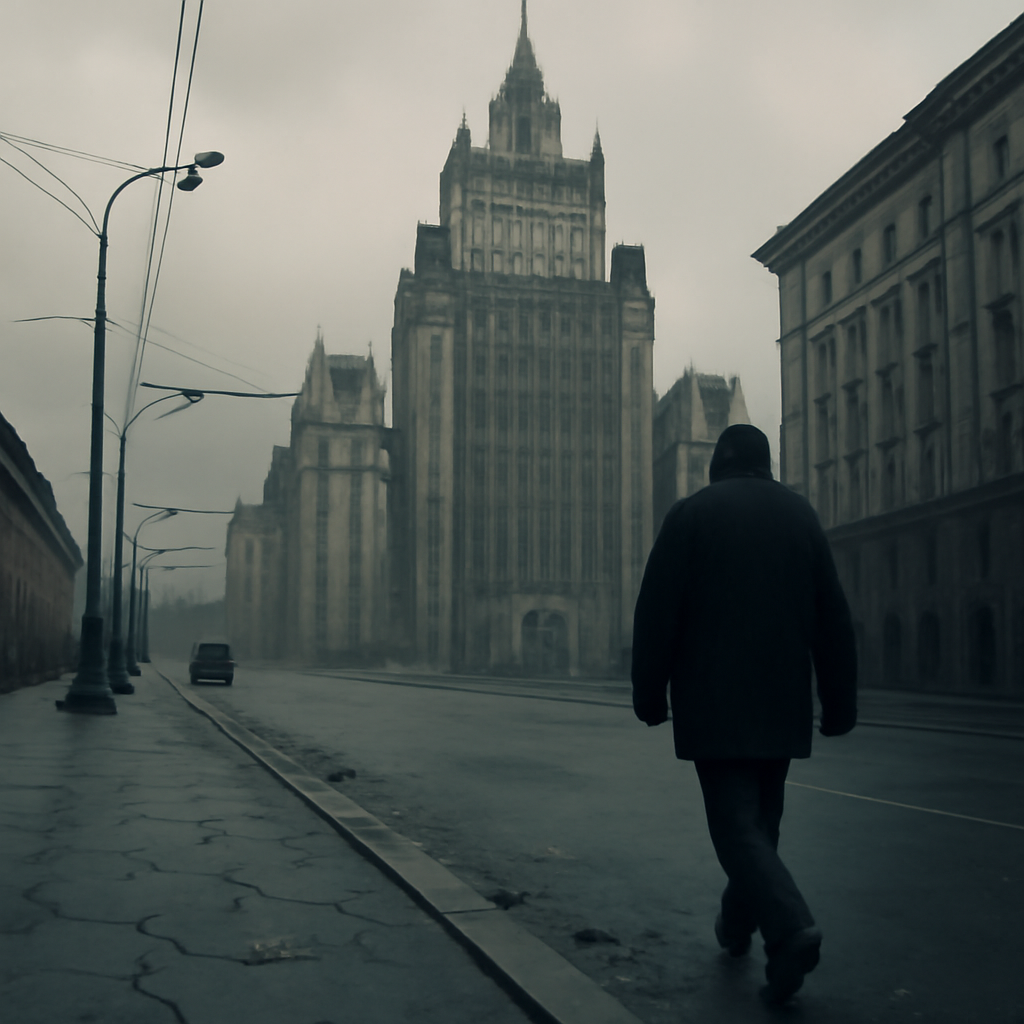
"In Russia you have to live a long time to see the dawn of the return of freedom. And if you live even longer, you may again witness the advent of despotism." — an old saying cited by Andrei Kolesnikov
Andrei Kolesnikov’s diagnosis of Putinism
Andrei Kolesnikov, a Russian journalist and former senior fellow of the Carnegie Moscow Center, argues that what he calls Putinism has radicalised the Russian population into a form of “chauvinistic neo‑imperialism” enforced by totalitarian methods. He traces a shift from the competitive authoritarianism of Vladimir Putin’s first two presidential terms (2000–2008), when “there was a modicum of open elections,” to what Kolesnikov labels “hybrid totalitarianism” after Putin returned in 2012 and the constitution was amended to allow him to serve until 2036. Under that later phase, Kolesnikov says, elections are tightly controlled and the state uses nationalism, religion and mysticism as central pillars of legitimacy.
The evolution of the "Russian idea"
Kolesnikov maps the ideological roots he calls “the Russian idea” across centuries: a belief in Russia’s unique history and civilisation, and in a traditionally close cooperation between the state, the Russian Orthodox Church and Russian society. He highlights two further foundations — Russia’s possession of nuclear weapons and a popular pride in national history that embraces even periods of violent repression — as integral to modern state patriotism and to how the Kremlin frames its global role.

This site is the portfolio.
OSINTSights runs on Cloudflare Workers, D1, R2, and Vectorize, with an AI pipeline on Hetzner ARM. Nubivance designed, built, and operates it. We do the same for clients.
See what we buildEducation, historical continuity and the war narrative
To sustain its international agenda, Kolesnikov writes, the Kremlin has forged a narrative continuity between the Great Patriotic War — Russia’s term for its role in World War II — and the current “special military operation.” That continuity, he argues, helps justify the war on Ukraine by placing today’s combatants alongside wartime veterans. Kolesnikov also describes a deliberate use of education as a tool: history books and school and university curricula have been rewritten to reinforce nationalism and xenophobia.
Public attitudes: Levada Center polling and the politics of enemies
Kolesnikov points to rising anti‑Western sentiment as a product of state incitement. He cites the Levada Center, a Russian polling and research organisation, reporting that in 2023 more than two‑thirds of Russians held a negative view of the United States and European Union countries, while less than 20 percent had a positive view. He also quotes former president Dmitry Medvedev’s enumeration of Russia’s enemies — “Ukrainian and European neo‑fascists, the United States, other Anglo‑Saxons and their vassals” — which Kolesnikov notes is meant to encompass about 50 “unfriendly” countries. On leadership cult and historical memory, Kolesnikov points to changing evaluations of past leaders: he cites Levada polling in which “In 2016, 28 percent of respondents ... agreed with the statement ‘Stalin is a great leader’. In 2013, the figure had almost doubled to 54 percent.”
How Russia analysts, the Russian population, and Ukrainian forces are responding
- Russia analysts: The source says analysts are “busy mapping out future scenarios” as they anticipate an eventual leadership change, but Kolesnikov is sceptical that leadership change alone will produce broader political renewal without profound political regeneration.
- The Russian population: Kolesnikov describes a generational shift from Homo sovieticus to “Homo putinus” — a post‑Soviet Russian who is a consumer in the capitalist sense, less inclined to prioritize human rights or rotation of political power, and generally not empowered to press for change.
- Ukrainian forces: The account notes that Ukrainian drones are “penetrating ever deeper into the heartland” of Russia and causing popular unrest, a military pressure that has helped create the current political tensions Kolesnikov examines.
Kolesnikov’s verdict is sober: he does not expect the war in Ukraine to end anytime soon, and he warns that even if Putin leaves office political change will be hampered by an ingrained mentality shaped over the past quarter century. He allows some scope for post‑Putin normalisation, “possibly towards a milder form of authoritarianism,” but insists the larger obstacle is the mindset of the people themselves. He closes by invoking the old saying that began this piece — a reminder, in his view, that the road between freedom and despotism in Russia remains long and uncertain.