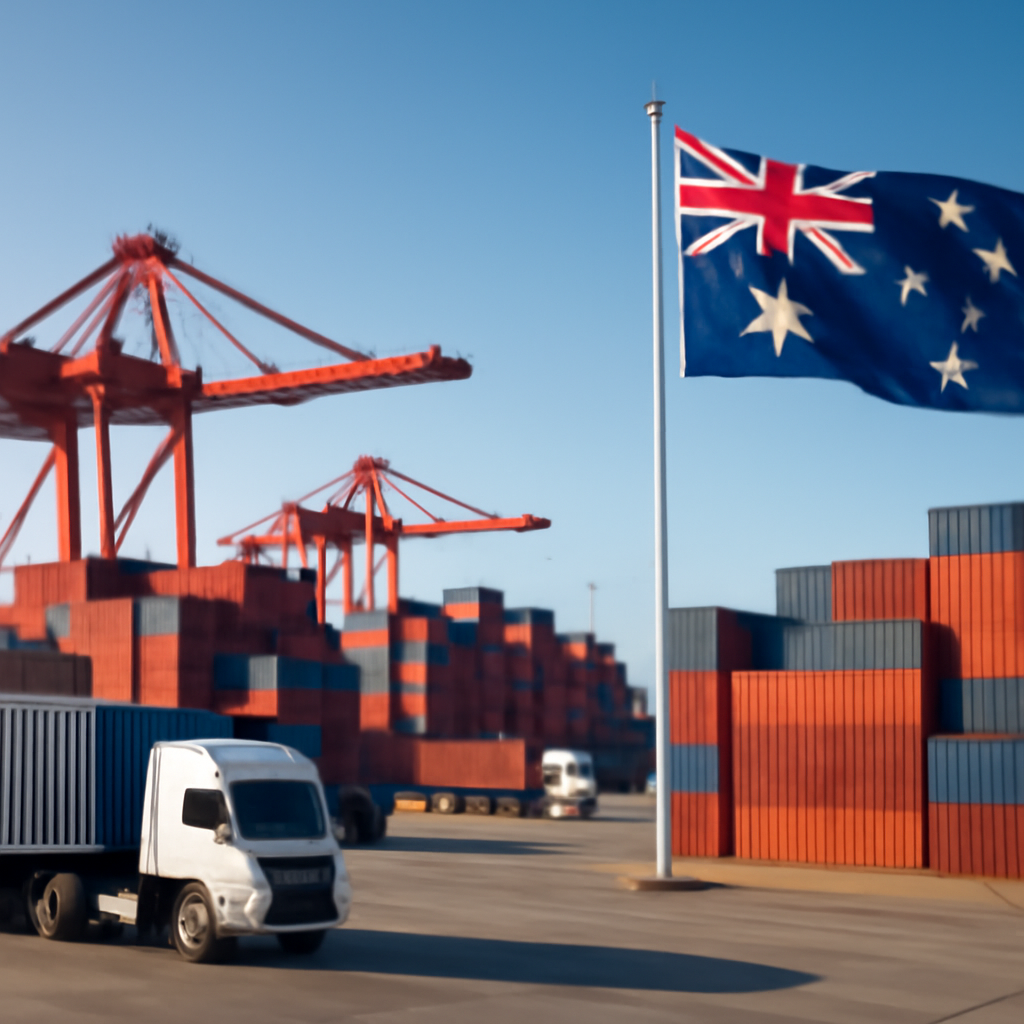
"Australia’s next fight will be won or lost in the logistics battlespace," the speaker said in an address to the ADM Contested Logistics Forum at NT Defence Week in Darwin on 29 April 2026.
From just‑in‑time to just‑in‑case logistics
For decades, logistics in advanced economies were optimised for efficiency: lean inventories, centralised hubs and finely tuned global supply chains built to minimise cost and maximise speed. The article argues that era is over for Australia. Instead, Canberra and commercial actors must adopt a just‑in‑case posture — reserves, redundancy and options that accept higher peacetime costs and complexity in order to endure coercion, disruption and, at worst, armed conflict.
This is not nostalgia for warehouses and fuel caverns. The shift entails deliberate policy choices: larger fuel reserves positioned to support both the Australian Defence Force and the economy under stress, munitions stockpiles, surge manufacturing capacity and forward repair and maintenance capabilities rather than dependence on distant southern depots.
Supply chains as the new front lines: physical, digital, financial
The piece reframes ports, airfields, fuel farms, data links, software platforms, customs systems, undersea cables, commercial contracts and insurance markets as not just enablers but as targets and levers. An adversary in a contested region can interfere "from factory to foxhole" — physically, digitally, financially, legally and in the information domain. Disruption may be temporary delays, but in a serious conflict the more damaging scenarios are prolonged severance: blockade, mining, physical damage, cyberattack or regulatory coercion.
Geography remains central. The article cites the Strait of Hormuz, the Taiwan Strait and the Strait of Malacca as obvious chokepoints, and adds that the Sunda and Lombok Straits to Australia’s immediate north and west provide alternative corridors that are narrower, deeper and easier to monitor or disrupt. These sea lanes are presented as a connected system that any serious adversary would study closely.

This site is the portfolio.
OSINTSights runs on Cloudflare Workers, D1, R2, and Vectorize, with an AI pipeline on Hetzner ARM. Nubivance designed, built, and operates it. We do the same for clients.
See what we buildRare earths, offshore processing, and industrial depth
Supply security is not only about shipping lanes. The article uses rare earths as a concrete example: Australia is resource‑rich in rare earths, but processing and downstream manufacturing remain concentrated offshore. A crisis affecting those nodes would not only disturb prices but could cut access to essential inputs for advanced weapons systems, electronics and energy technologies.
That risk underpins the argument that sovereignty must be practical: some functions should exist domestically or within trusted coalitions so that the nation can absorb shocks while alliances and markets adapt. The author suggests dispersing and diversifying industrial capacity across trusted partners rather than every state attempting a full national production chain.
The Northern Territory as an operational frontage: RAAF Darwin, RAAF Tindal and Darwin Harbour
The article places Australia’s north on the "forward edge of that contest." The Northern Territory is described as more than a remote support zone: RAAF Darwin, RAAF Tindal, training areas, Darwin Harbour and associated infrastructure enable dispersal, regeneration and sustained air‑maritime operations. To function as a genuine multi‑user logistics hub for Defence, resources, energy and regional partners, the north needs more resilient airfields, additional fuel storage, improved road and rail connectivity, greater intermodal transfer capacity, upgraded port and repair facilities, secure data infrastructure and a more deeply trained workforce — and these upgrades must come sooner than currently scheduled.
Additive manufacturing and sustaining complex capabilities
The article highlights additive manufacturing as a practical tool to increase resilience. Properly integrated, distributed additive manufacturing hubs could produce critical components closer to the point of need, support rapid battle‑damage remediation in theatre and reduce dependence on long, fragile resupply chains for low‑volume, high‑consequence items. The author discloses being a non‑executive director of one such company in Australia while noting that additive manufacturing still depends on secure digital designs, reliable materials, skilled technicians and quality assurance.
Perhaps the most uncomfortable policy implication is that some complex industrial and logistics capabilities must exist in peacetime: maintained workforces, equipment, viable business models and regulatory familiarity that cannot be improvised once crisis arrives. Governments may need to underwrite the mere existence of capabilities that appear inefficient in normal market conditions.
What this means for federal, state and territory governments, Defence, and ports, miners and telcos
- Federal, state and territory governments: Build common pictures of risk and accept higher peacetime costs to sustain surge capacity; plan for shared logistics hubs, common data standards and pre‑agreed access arrangements for ports, airfields and maintenance facilities.
- Defence: Move sustainment and repair capability forward, size and site fuel reserves to support both operational and economic needs, and treat the Northern Territory as an operational frontage requiring earlier upgrades.
- Ports, freight operators, miners, energy companies and telcos: Coordinate on resilient intermodal transfer capacity, secure data infrastructure and diversified processing chains; recognise that commercial contracts, insurance markets and payment systems are part of the contests to be defended.
Contested logistics, the article concludes, is ultimately about time — time to detect, move, repair, reroute, surge and endure. "If the country can build physical, digital and financial logistics systems that function under pressure, recover quickly and sustain action over time, contested logistics will become not only a vulnerability to manage but also a source of national strength."