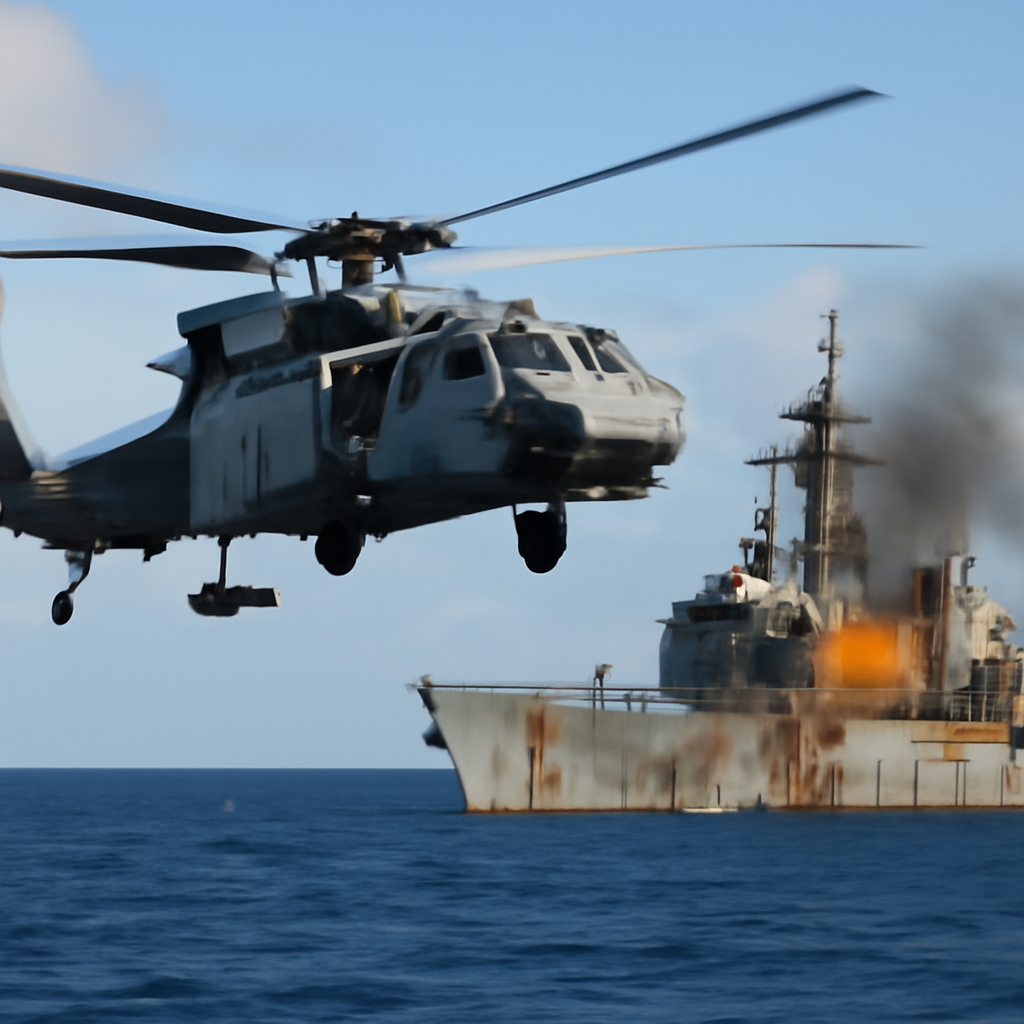
At least three allied rotorcraft types employed weapons against retired U.S. Navy vessels during RIMPAC 2026’s sinking exercises, with U.S. Army AH‑64 Apaches firing Spike NLOS missiles at the former guided missile cruiser ex‑USS Mobile Bay and a Royal New Zealand Navy SH‑2G(I) Seasprite using an AGM‑119 Penguin against the amphibious assault ship ex‑USS Peleliu.
U.S. Army AH‑64 Apache and the Spike NLOS at sea
On July 11, AH‑64 Apaches assigned to the 16th Combat Aviation Brigade, 7th Infantry Division, Multi‑Domain Command–Pacific engaged the decommissioned Ticonderoga‑class cruiser ex‑USS Mobile Bay during the RIMPAC live‑fire SINKEX. The helicopters fired Rafael’s Spike NLOS (Non‑Line‑Of‑Sight) missile, a system the article identifies as offering an operator‑in‑the‑loop datalink that permits mid‑flight course corrections and aimpoint refinement — a capability described as valuable against moving or time‑sensitive maritime targets. Rafael lists the latest Spike NLOS maximum range at roughly 20 miles, considerably extending Apache stand‑off compared with the Hellfire and JAGM variants currently fielded on U.S. Army Apaches, which the source says have maximum ranges of less than 10 miles.
Royal New Zealand SH‑2G(I) Seasprite and the AGM‑119 Penguin
Imagery released by the New Zealand Defense Force showed a Royal New Zealand Navy SH‑2G(I) Seasprite, embarked aboard the ANZAC‑class frigate HMNZS Te Mana, launching an AGM‑119 Penguin anti‑ship missile at the ex‑USS Peleliu. According to the NZDF, the Penguin penetrated the hull before detonating inside the vessel, inflicting significant internal damage and compromising the ship’s integrity. The ex‑USS Peleliu was one of two decommissioned U.S. warships used as targets during the SINKEX events.

The cyber insurance questionnaire just landed. Now what?
SOC 2, HIPAA, insurance renewals - someone has to own security strategy. Nubivance provides fractional CISO leadership without the full-time salary.
Get a security leadRoyal Australian MH‑60R, Italian SH‑101 and the helicopter weapons mix
A Royal Australian Navy MH‑60R Seahawk embarked in USS Wayne E. Meyer conducted a live AGM‑114N Hellfire engagement against a target ship, illustrating the Seahawk’s surface‑warfare role using Hellfire despite that weapon’s shorter stand‑off compared with Spike NLOS. The Italian Navy disclosed that an SH‑101 helicopter embarked aboard the multirole combat ship Giovanni delle Bande Nere launched a Marte anti‑ship missile during RIMPAC, although Italy did not specify the target for that shot. Collectively, the Apache, Seahawk, Seasprite, and SH‑101 demonstrated a diverse set of helicopter‑launched anti‑ship weapons — Spike NLOS, Hellfire, Penguin, and Marte — optimized for different targets and mission profiles.
Integration with fixed‑wing, land, and subsurface fires
Helicopter strikes were one layer in a broader SINKEX strike package. Published imagery showed a U.S. Navy F/A‑18F Super Hornet carrying AGM‑158C LRASM, live launches from U.S. Army M142 HIMARS and Japan Ground Self‑Defense Force Type 12 coastal defense missile batteries, and U.S. Navy P‑8 Poseidon maritime patrol aircraft supporting the event. The report also notes that submarines were involved in the strikes. Video and imagery indicate the ex‑USS Mobile Bay sank on July 12 and the ex‑USS Peleliu on July 17, more than 50 nautical miles off Kauai, and TWZ has asked officials for additional information about which weapons and platforms ultimately accounted for the sinkings.
What this means for the U.S. Army, Royal New Zealand Navy, and coalition maritime strike
- U.S. Army: The Apache engagements reflect an expanding maritime role tied to the Army’s Multi‑Domain Operations concept, with Spike NLOS identified as a key enabler of maritime strike because of its datalink and extended range.
- Royal New Zealand Navy: The successful Penguin engagement, which the NZDF said penetrated and detonated inside the ex‑USS Peleliu, demonstrates the Seasprite’s lethality against large hulls and provides operational evidence of anti‑ship effectiveness in a coalition live‑fire setting.
- Coalition maritime forces: The range of helicopter‑launched weapons shown — from Hellfire to Marte to Spike NLOS — highlights how rotorcraft are being integrated alongside fighters, warships, submarines, and coastal batteries to produce layered, distributed maritime strike packages during coalition exercises.
RIMPAC 2026, running June 24 through July 31, brought together 30 nations, more than 30 surface ships, five submarines, 15 national land forces, over 206 aircraft, and roughly 30,000 personnel. Live‑fire SINKEX events remain prized for allowing coalition forces to observe weapon effects against full‑sized ships, refine targeting procedures, and integrate air, sea, and land fires. This year’s sequence of helicopter‑launched strikes underscored a shift: rotorcraft are no longer just force multipliers for littoral operations, but active, precision elements of the anti‑surface kill chain across a distributed maritime battlefield.
Original story: https://www.twz.com/news-features/helicopters-just-took-center-stage-in-rim-of-the-pacific-sinking-exercises