"These cables are, in the most literal sense, the arteries of modern civilisation." — Defence Minister Richard Marles.
Subsea cables under attack: scale, geography, and exposure
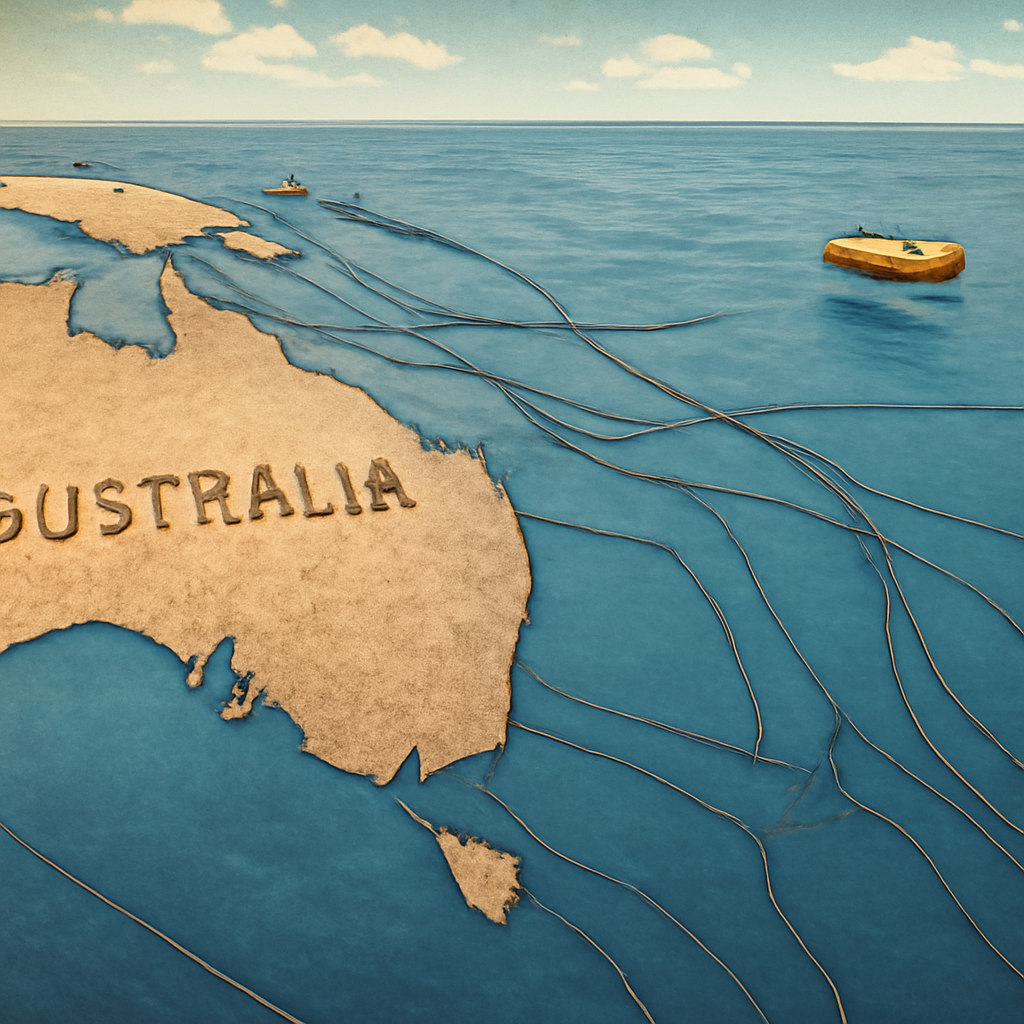
Since November 2024, vessels have severed fibre optic cables across the Baltic Sea, dragging anchors for nearly 100 km across the ocean floor, and Taiwan reported five separate incidents of seabed cable damage in 2025. Those incidents matter to Australia because roughly 99 percent of the nation’s internet traffic flows through just 15 subsea cables. Defence Minister Richard Marles described the pattern as “historically unprecedented” in scale and frequency — a succinct framing of why the damage to undersea infrastructure has moved from hypothetical to strategic vulnerability.
Cheap, commercial autonomy: drones and the new battlefield
Recent conflict in the Middle East has illustrated how commercial autonomous platforms reshape combat dynamics. The source describes drones costing as little as A$20,000 destroying armoured vehicles, striking airbases hundreds of kilometres from the front, and overwhelming air-defence networks designed for a smaller number of high-value threats. The same autonomy that powers agricultural surveying or film production can be repurposed: the United Nations’ counterterrorism office has warned that the weaponisation of commercial drones by non-state actors is accelerating. The point drawn in the analysis is clear: autonomous systems are not only sophisticated legacy platforms such as submarines — they are inexpensive, widely available, and potent.

This site is the portfolio.
OSINTSights runs on Cloudflare Workers, D1, R2, and Vectorize, with an AI pipeline on Hetzner ARM. Nubivance designed, built, and operates it. We do the same for clients.
See what we buildAUKUS Pillar Two, the 2026 National Defence Strategy, and budgeted bets
The AUKUS Pillar Two announcement at the Shangri-La Dialogue was presented in the source as a confirmation among allies that autonomous systems are core to regional security. Australia’s 2026 National Defence Strategy aligns with that assessment and allocates up to A$15 billion for uncrewed and autonomous systems over the next decade, including A$4.5 billion specifically for maritime capabilities. That funding signals a shift from debate to deliberate resourcing, but the source stresses that money alone will not close the gap if acquisition and deployment are slow.
Sovereign manufacturing, open architectures, and the race against time
The analysis argues Australia needs not only capability but speed: systems designed for rapid adoption, with open architectures in intelligence, surveillance and reconnaissance (ISR) and electromagnetic warfare that slot into existing Australian Defence Force infrastructure without lengthy integration programs. The author insists the industrial base must be local: “to ensure a Defence future made in Australia, by Australians,” Defence Industry Minister Pat Conroy said. The source warns that the “enemy of capability” in this era is delay — systems that take too long to acquire and integrate risk being out of date before they are operational.
Industry proof-points and procurement benchmarks
The source cites an industry example directly: “The AEGIR uncrewed surface vessel from my company, SNC, is one example. It’s in service today, can be produced from design to deployment in under a year and is shipped in standard containers. It’s also already proven in live combat environments.” That example is offered as a template for procurement benchmarks: speed, modularity and operational validation. The overarching prescription is a comprehensive, rapid sovereign manufacturing response so Australia can build, maintain and replace autonomous and counter‑autonomous systems from domestic supply chains at the pace the threat environment demands.
What this means for technologists, policymakers, and procurement leaders
- Technologists and security teams: push for open‑architecture ISR and electromagnetic-warfare components that integrate quickly with existing Australian Defence Force infrastructure and can be fielded without prolonged bespoke integration.
- Policymakers and regulators: prioritise investment and policy that grow domestic manufacturing capacity for uncrewed and autonomous systems, aligning with the 2026 Integrated Investment Program’s goal for “a resilient and secure” sovereign defence industrial base.
- Procurement leaders and defence planners: set acquisition benchmarks emphasizing speed, modularity and operational validation so that funded programs — including the A$15 billion allocation for autonomous systems and the A$4.5 billion maritime tranche — do not become legacy costs before they enter service.
The picture the source paints is stark and specific: maritime cables are under attack, affordable autonomous weapons have reshaped conflict, and Australia has budgeted to respond. The unresolved question the piece leaves at the centre of policy is whether the nation can translate the A$15 billion commitment and the rhetoric of sovereignty into locally produced, rapidly deployable systems before evolving threats make today’s plans obsolete.
Source: Autonomous, sovereign, ready: what Australia’s defence moment demands — The Strategist