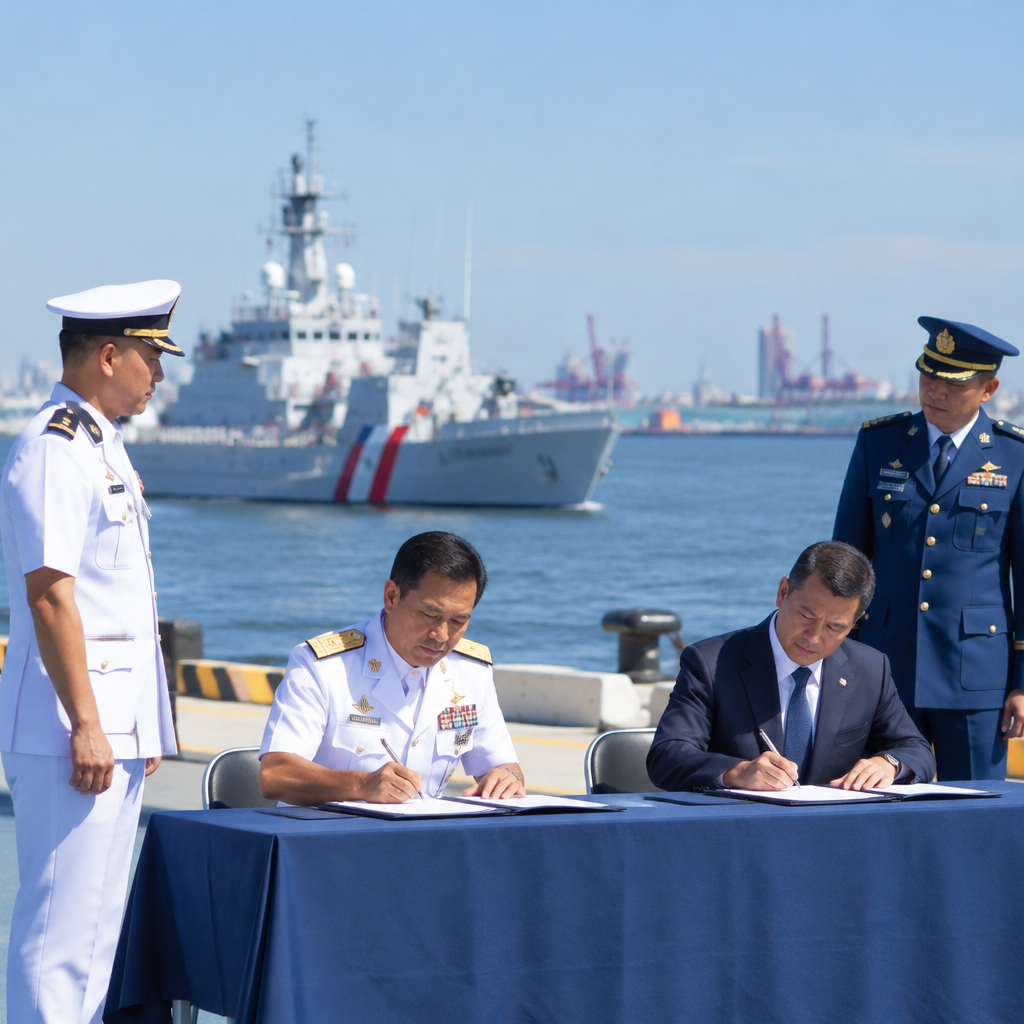
“More than 99 percent of Australia’s international trade by volume moves by sea.” That stark figure frames the logic behind a Defence Co‑operation Arrangement signed in Manila on Sunday: Canberra is treating the Philippines not as a peripheral partner but as a strategic node in the protection of Australia’s lifelines.
Defence Co‑operation Arrangement signed in Manila
The new Defence Co‑operation Arrangement replaces and expands a 1995 memorandum of understanding and reflects a deeper relationship between Australia and the Philippines. The agreement, signed in Manila on Sunday, affirms that defending Australia — particularly given its dependence on maritime trade — requires a network of regional partnerships and the capacity to push back against China’s actions in the South China Sea.
The arrangement follows the 2023 Strategic Partnership between the two countries and builds on decades of closer cooperation. In recent years that cooperation has moved from counter‑terrorism in the southern Philippines to a stronger maritime focus, including amphibious military Exercise Alon and Australia’s provision of aerial and underwater drone capabilities to the Philippine Coast Guard.
Maritime trade dependence and national vulnerability
Australia’s vulnerability is not theoretical: more than 99 percent of its international trade by volume moves by sea, and roughly two‑thirds of Australia’s goods trade by tonnage passes through the South China Sea. The source material highlights specific categories of goods — fuel, fertiliser and pharmaceuticals — as examples of the critical supplies that keep Australia’s economy functioning and enable its defence.
Framing the country as “a living organism with some of its vital organs outside its body,” the analysis argues an adversary need not invade the mainland to threaten Australia; cutting maritime supplies would inflict strategic harm. That logic underpins the push for both a capable navy and durable regional relationships.

Audit-ready is a season. It shouldn't be.
Evidence in spreadsheets, controls drifting between audits, frameworks multiplying on flat headcount. Nubivance runs continuous compliance on Rapid7 Cyber GRC - SOC 2, HIPAA, ISO 27001, PCI, CMMC.
End the scrambleChina’s maritime posture in the South China Sea
The article sets out two frontline strategic challenges. The first is the increasingly contested South China Sea, where China has continued to expand the operations of its coastguard, militarised fishing vessels described as a maritime militia, and increasingly its navy. Those expanded operations are said to extend into the Philippines’ exclusive economic zone, a zone that, under the United Nations Convention on the Law of the Sea, extends up to 200 nautical miles from the Philippine coast.
Despite the clarity of international law and a 2016 international arbitral tribunal ruling, the piece notes China’s ongoing assertions of sweeping claims across much of the South China Sea, including waters within the EEZs of Southeast Asian coastal states. The source lists increasingly aggressive measures attributed to China: ramming of Philippine government vessels within the Philippines’ EEZ, the use of water cannons against vessels, and harassment of Australian military assets over several years in the South China Sea and Northeast Asia. Those actions are described as having serious implications for regional maritime stability and the security of Australia’s maritime trade.
The Philippines’ position on the first island chain and the Luzon Strait
The second frontline challenge, the article argues, is geographic and historical. The Philippines’ location along the first island chain and its control of the strategically important Luzon Strait between Luzon and Taiwan place it at the heart of the balance of maritime power in Southeast Asia and the Western Pacific. The source says a strong Philippines, “capable of restricting the ability of China’s navy, the largest in the world by number of ships, to dominate maritime Southeast Asia and operate freely in the Western Pacific,” would be critical to Australia’s defence in a crisis or conflict.
The piece invokes World War II as a cautionary precedent: Japan’s advance through Southeast Asia, including its capture of the Philippines, helped place Australia under direct threat. That historical lesson underwrites the strategic emphasis on ensuring the Philippines can contest access to maritime approaches.
What this means for Australian defence planners, the Philippine Coast Guard, and maritime trade operators
- Australian defence planners: The arrangement signals a policy choice to invest in regional partnerships and maritime cooperation rather than rely exclusively on geographic distance or external guarantees. The article emphasises that Australia needs not only a strong navy to project force but also allies and partners able to secure key maritime approaches.
- Philippine Coast Guard: The Philippines’ maritime security forces are a primary recipient of cooperation — Australia has already provided aerial and underwater drones and taken part in exercises such as Exercise Alon. The new arrangement intends to deepen those practical capabilities within the Philippines’ EEZ.
- Maritime trade operators and the Australian economy: With two‑thirds of goods trade by tonnage transiting the South China Sea, shipping companies, supply chains and national economic planners have a direct interest in a stable maritime environment and in arrangements that aim to deter or respond to coercive maritime tactics.
The Defence Co‑operation Arrangement is presented in the source as more than a formal update: it is a strategic statement that Australia’s defence calculations extend well beyond its shorelines. By tying deeper capabilities and exercises to the Philippines’ role in the first island chain and the security of the South China Sea, the agreement frames the Philippines as central to protecting the maritime arteries on which Australia depends. The immediate test will be how the expanded cooperation translates into on‑the‑water capacity and whether that capacity alters calculations about control of key sea lanes in moments of heightened tension.