“The Littoral Manoeuvre Group is a radical organisational design concept for Australia which reflects a significant reorientation towards being able to rapidly deploy and support forces operating over considerable distances alongside partners,” John Blaxland, professor of international security and intelligence studies at Australian National University, told Breaking Defense.
Littoral Manoeuvre Group: purpose and policy roots
The Littoral Manoeuvre Group (LMG) was stood up by the Australian Army in March to bolster “the service’s ability to move, deploy and support land forces across coastal and island regions,” according to Australian planning documents and officials cited in reporting. The formation answers a directive in Australia’s 2024 National Defence Strategy for an army “optimised for littoral manoeuvre with a long range land and maritime strike capability.”
Experts quoted in the reporting portray the LMG as a deliberate reorientation of ground forces toward combined land‑and‑maritime operations across the archipelagic spaces that surround the country. John Blaxland linked the design to historical precedents in combined arms littoral warfare, while independent naval commentator Alex Luck framed it as a practical response to Australia’s geographic realities.
Planned structure and landing craft capability
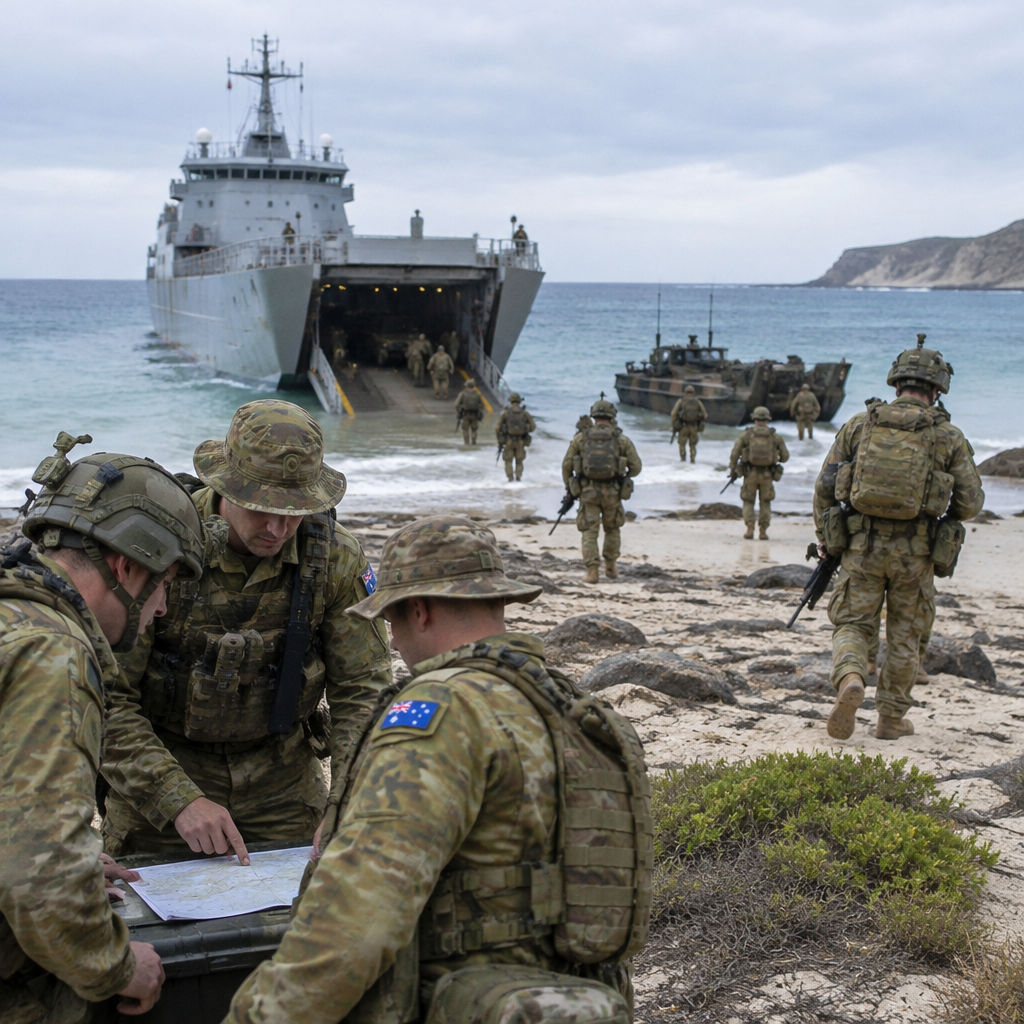
The group will include three landing craft battalions, each scheduled to operate four medium and two heavy landing craft. Those new platforms are central to the concept: the Land Craft Medium (LCM) has a cargo capacity of 80 tonnes (88 tons), while the Landing Craft Heavy (LCH) will be able to transport 200 soldiers and either six M1 Abrams tanks or nine Redback infantry vehicles, per the procurement descriptions cited.
Australia awarded contracts to Austal Australia for the LCM in December 2025 and for the LCH in February. Both John Blaxland and Alex Luck stressed that outfitting the LMG with these landing craft is crucial; Luck noted that the LCH, together with the Royal Australian Navy’s amphibious assets, “represents an unprecedented new resource the Australian Army will need time to further refine and develop.”

This site is the portfolio.
OSINTSights runs on Cloudflare Workers, D1, R2, and Vectorize, with an AI pipeline on Hetzner ARM. Nubivance designed, built, and operates it. We do the same for clients.
See what we buildExercises and partner work: Indonesia and beyond
Last month, the Littoral Manoeuvre Group completed a large‑scale amphibious exercise during a training event with Indonesia. Blaxland said such activity suggests Australia envisages deploying forces alongside allies and partners to observe and safeguard key littoral sites and to control maritime chokepoints in a conflict. Luck also stressed the need to work with neighbours and partners such as the US and New Zealand “in securing maritime features around Australia, but particularly across Pacific Island spaces.”
Fiscal constraint: AUKUS, nuclear submarines, and a budget review
Experts cautioned that the LMG’s potential will depend on adequate resourcing as Canberra reallocates funds to meet commitments under the trilateral AUKUS agreement. The country is conducting a budget review aimed at freeing funds for the acquisition of nuclear submarines, even as it pledges to bring defence spending up to three percent of gross domestic product in the coming years. The reporting warned that budget cuts to some programs could be needed to make room for AUKUS spending, and Blaxland observed that the LMG’s planned expansion “is not likely to reach full operational capacity for some years yet” if funding constraints persist.
What this means for the Australian Army, Indonesia, and partner navies
- The Australian Army: Will need time and resources to mature new amphibious capability sets around the LCM/LCH platforms and to integrate those capabilities with naval amphibious assets and doctrine.
- Indonesia and regional partners: Can expect increased interoperability and training opportunities with Australian littoral forces, as demonstrated by the recent large‑scale exercise.
- Allies such as the US and New Zealand: Are signalled as intended partners in securing maritime approaches and island spaces; coordinated deployments and chokepoint control were identified as operational aims for the LMG.
The Littoral Manoeuvre Group sets a clear direction: transform ground forces to operate over water, islands and coastal seascapes rather than merely along shorelines. Its success will hinge on delivering the landing craft capability already contracted and on whether Canberra sustains funding through competing AUKUS commitments and the planned budget review. The recent exercise with Indonesia was an early test; the question now is whether finance and time will allow the conceptual promise to become an operational reality.