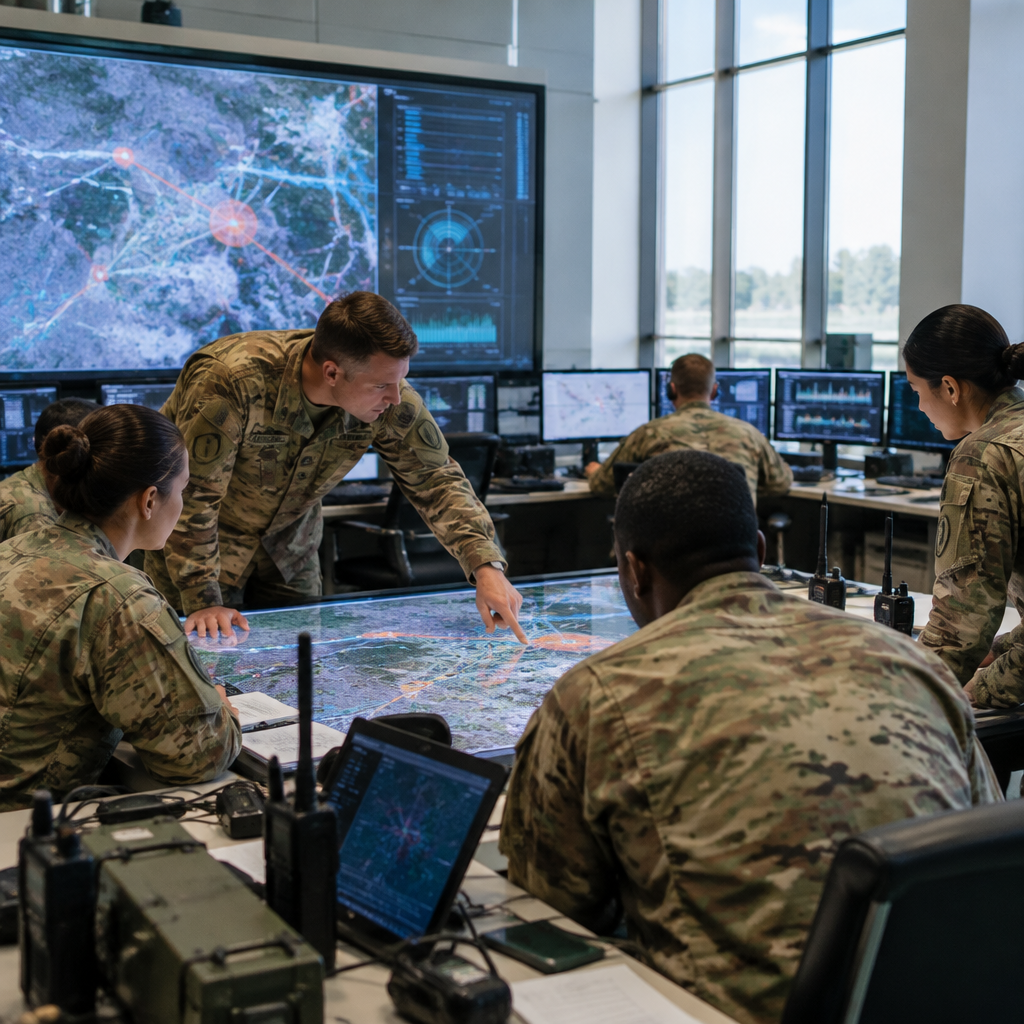
"You’re going to have to constantly be passing data between a bunch of different nodes to keep them synchronized," said Josh Wallin, Defense Program fellow at the Center for a New American Security, summarizing the technical strain driving the Army’s Next Generation Command and Control (NGC2) push.
Why the electromagnetic spectrum and emissions are central
Wallin frames one core driver for NGC2 as the intensifying contest over the electromagnetic (EM) spectrum. He points to "jamming and interference and tracking emissions in Ukraine by the Russians" as a concrete demonstration that emissions are now primary attack and sensing vectors. That operational reality, he argues, makes spectrum resilience a foundational design requirement: systems must operate when adversaries are targeting communications, data links, and the emissions that reveal or disrupt them.
Distance and infrastructure: the Pacific challenge
NGC2 is being driven not only by spectrum threats but by geography. Wallin contrasts recent conflicts and contingencies — the GWOT era, Iran, and Ukraine — with the Indo‑Pacific, where forces "may be located potentially thousands of miles apart from each other." That distance complicates synchronization, reduces the viability of centralized massed nodes, and stresses bandwidth. While Wallin acknowledges that commercial infrastructure exists in the region and cites Starlink terminals as a hypothetical example, he cautions that reliance on commercial cellular networks will be "less able" to meet military needs in contested environments.

Audit-ready is a season. It shouldn't be.
Evidence in spreadsheets, controls drifting between audits, frameworks multiplying on flat headcount. Nubivance runs continuous compliance on Rapid7 Cyber GRC - SOC 2, HIPAA, ISO 27001, PCI, CMMC.
End the scrambleMission-level change: cross-functional data and faster targeting
At the mission level, Wallin describes NGC2 as an effort to break down stovepipes. The intent is to let systems across functions — air defense, fires, logistics, intelligence — share data in near real time so that information valuable to one function can be used by another. He points to recent developments in air-defense networking where "a THAAD radar is able to control a Patriot interceptor" as the kind of interoperability the Army wants to generalize. Faster, cross‑functional data flows matter because targeting cycles are accelerating; in Ukraine, Wallin notes, the cycle from acquisition to servicing a target can be "on the order of minutes."
Data centralization, AI, and getting to usable analysis
NGC2 emphasizes centralizing disparate data to enable correlation across functions. Wallin lays out the analytics aspiration plainly: employ artificial intelligence and other automated techniques to analyze portions of the enormous volumes of collected data and "present it usefully and quickly to operators." He frames realistic expectations around automation — describing a goal of getting a "60 percent solution on something that was 100 percent manual before" to free operator time for higher‑value decisions. The underlying point is practical: automation need not be perfect to materially speed response and reduce operator burden.
Modularity and the separation of hardware, compute, and software
To preserve adaptability, NGC2 is being architected around modularity. Wallin explains the approach: separate physical transmission layers (what cable, radio, or satellite terminal is in use) from compute and from the data-management and application layers that soldiers interact with. The payoff he describes is operational agility — if an adversary jams or degrades a particular terminal or radio, forces can "quickly swap that out for some less vulnerable piece of hardware without having to change all of the things that sit above that."
What this means for technologists, policymakers, and commanders
- Technologists and security teams — Will need to prioritize modular interfaces, resilient telemetry, and bandwidth-efficient data handling so nodes thousands of miles apart can remain synchronized and survivable against spectrum threats.
- Policymakers and procurement leaders — Face a shift away from decades‑long platform acquisitions toward faster, software‑centric refresh cycles; Wallin notes the Army "is really trying to be able to adapt quickly" and is not buying with a 60‑year horizon in mind.
- Frontline commanders and operators — Stand to gain cross‑functional situational awareness and faster targeting cycles, but only if centralized data and automation tools deliver usable, timely outputs rather than new stovepipes.
NGC2, as Wallin describes it, is a systems‑level attempt to reconcile three interlocking constraints: contested electromagnetic environments, vast operational distances, and exploding data volumes. The program’s success will hinge on whether modular architectures, centralized data, and pragmatic automation can be fielded fast enough to meet minutes‑level targeting tempos — and whether those architectures remain useful when commercial connectivity is unreliable or denied. The Army’s commitment to agility is clear; the hard work will be in translating that design philosophy into resilient, interoperable systems across thousands of miles.