AFRICOM’s Morocco demonstration: what is scheduled
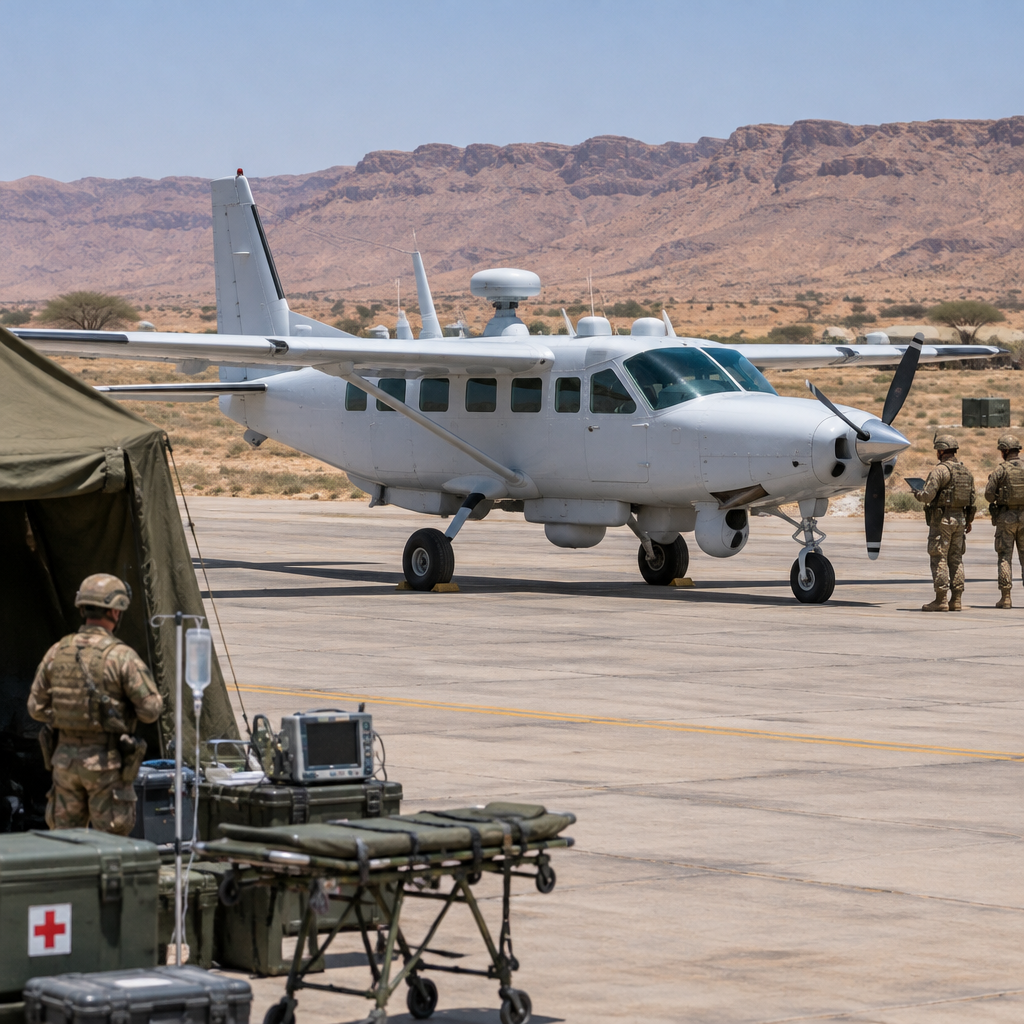
U.S. Africa Command (AFRICOM) has selected a Merlin Labs-equipped Cessna Model 208B Grand Caravan for a demonstration of an autonomous casualty evacuation (CASEVAC) capability in Morocco. The exercise, part of the initial phase of AFRICOM’s Autonomous Casualty Evacuation (CASEVAC) Industry Technology Challenge, is slated for some time in "early U.S. government fiscal year 2027" (the fiscal year began on October 1). AFRICOM awarded Merlin a $500,000 contract to support the demonstration.
Merlin’s public description states the mission will run end-to-end: tasking and flight planning, autonomous departure and en route flight to an austere casualty collection site, simulated patient loading, and an autonomous return and landing at the designated location.
Cessna Model 208B Grand Caravan and Merlin Pilot autonomy
Merlin Labs will use its Merlin Pilot autonomy package on the Grand Caravan. Merlin describes Merlin Pilot as scalable and configurable to enable pilot-optional flight capability. For the AFRICOM demonstration, Merlin says the system is intended to "bring onboard autonomy to aircraft supporting CASEVAC missions, managing flight planning, navigation, contingency response and mission completion without relying on a remote ground station or flight crew."
Merlin adds that the system is designed to plan an optimal route from an operator’s tasking, replan dynamically around hazards, communicate with air traffic control using natural language processing, and continue safely along its authorized plan if a communications link is lost. Merlin also notes Merlin Pilot can reduce task burdens for onboard humans during crewed operations and help alert them to technical faults.

This site is the portfolio.
OSINTSights runs on Cloudflare Workers, D1, R2, and Vectorize, with an AI pipeline on Hetzner ARM. Nubivance designed, built, and operates it. We do the same for clients.
See what we buildAirframe fit and follow-on platforms
Merlin highlighted why the Grand Caravan was chosen: its large cargo door and flat-floor cabin allow ground-level litter loading without rotor wash, winching, or special equipment. The Caravan’s cabin for the test will be fitted with an air ambulance medical module providing oxygen, power, and mounting for patient monitoring equipment.
Merlin pointed to a clear follow-on path using a Beechcraft King Air variant to provide twin-engine redundancy, greater payload capacity, additional cabin space for multiple litter patients and medical equipment, and space for an in-flight attendant. Merlin also said the same autonomy architecture could support autonomous logistics and personnel movement across dispersed operating locations.
Funding and related contracts: SOCOM, C-130s, KC-135s, and SkyCourier
Beyond the $500,000 AFRICOM award, Merlin has received millions from the U.S. military for separate autonomy efforts. Merlin disclosed a new deal with U.S. Special Operations Command (SOCOM) valued at $8.9 million "yesterday" for continued C-130 autonomy work. The company has also pursued autonomy for C-130-type aircraft for SOCOM and similar efforts in support of the U.S. Air Force’s KC-135 tanker fleet.
In September, Merlin and Textron announced a partnership to develop a cargo-carrying drone derived from the Cessna 408 SkyCourier, underscoring concurrent work on larger, cargo-focused autonomy projects.
What this means for AFRICOM, SOCOM, and the U.S. Air Force
- AFRICOM: Autonomous CASEVAC could shorten time to higher-level medical care across vast distances and reduce the number of personnel exposed to risk during casualty retrieval, addressing AFRICOM’s cited operational and security challenges.
- SOCOM: Merlin’s ongoing C-130 autonomy work and the recent $8.9 million deal suggest Special Operations is pursuing larger-platform autonomy in parallel, which may inform how CASEVAC concepts scale beyond single-patient Caravan missions.
- U.S. Air Force: Work on autonomy for tanker-type KC-135s and exploration of distributed logistics align with the Air Force’s experiments using partially autonomous Caravans as a path to new distributed logistics capabilities.
International context: China’s cargo drones and Ukraine’s uncrewed CASEVACs
Merlin and the article’s analyst observers draw a contrast with global peers. The article states China has been "surging forward" in fully uncrewed logistics aircraft development, with several Chinese cargo drone designs currently flying that are "significantly larger and more capable than a Cessna Grand Caravan." It also notes that in recent months Ukraine demonstrated uncrewed CASEVAC capabilities in combat using large multi-rotor drones, while those platforms are designed for more localized operations compared with what AFRICOM seeks to demonstrate.
The piece characterizes the AFRICOM demonstration and its modest $500,000 funding as evidence that U.S. military efforts on autonomous aeromedical and logistics platforms remain limited despite these external developments.
Whether the Morocco demonstration proves Merlin Pilot can reliably execute a full CASEVAC cycle without crewed aircraft or persistent ground control will matter to planners balancing life-saving urgency—the so-called "golden hour" medical imperative highlighted by medical professionals—against investment and risk. The test will also provide data on whether the Caravan-and-Merlin combination can scale to twin-engine King Air variants or to larger platforms pursued elsewhere.