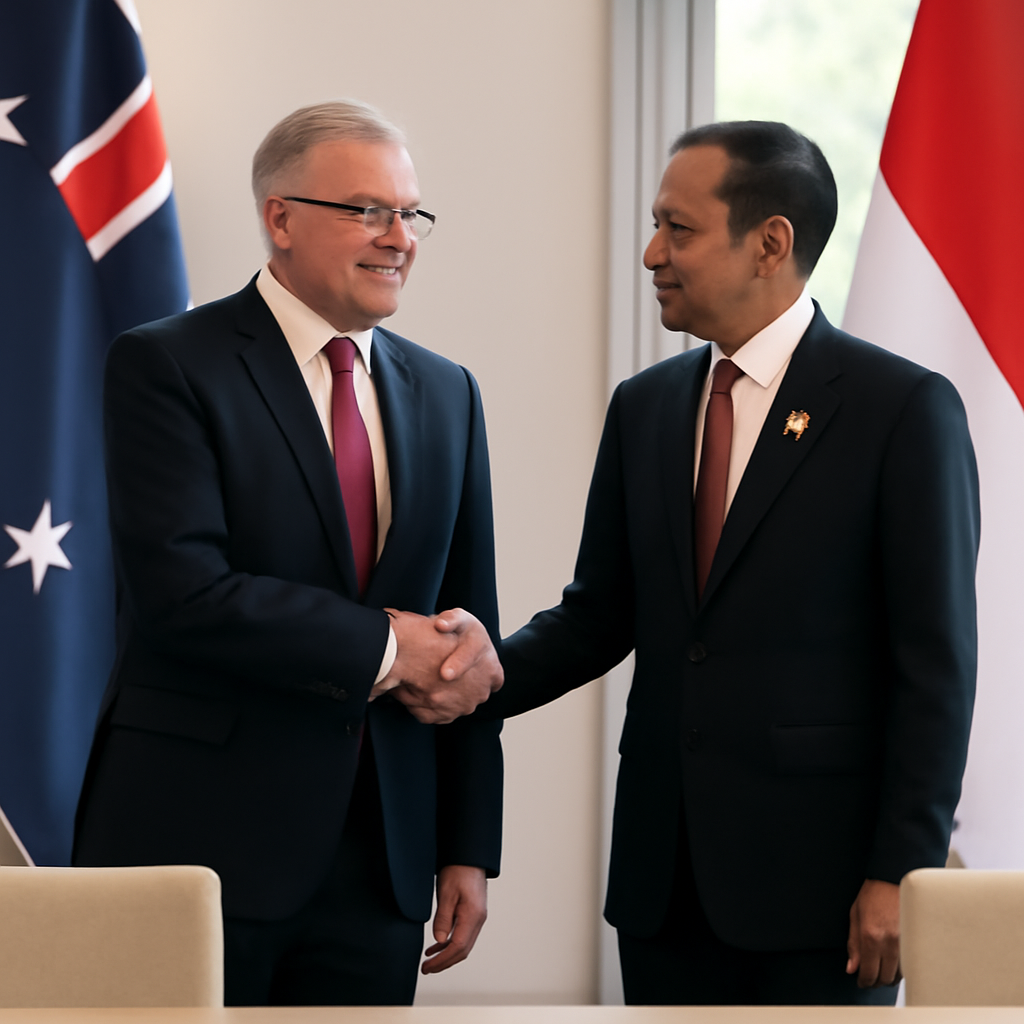
"The relationship being built from the Jakarta Treaty is critical for ‘future generations of Indonesians and Australians,’" Foreign Minister Penny Wong said, underscoring what the Melbourne meeting aimed to turn from paper into practice.
From the Jakarta Treaty to the Implementation Arrangement
The Australia–Indonesia Foreign and Defence Ministers’ Meeting in Melbourne on 26 August was the first major ministerial engagement since the Treaty of Common Security was signed in Jakarta in February. Both sides remain in a holding pattern on ratification, but ministers advanced negotiations on an Implementation Arrangement. According to the meeting record, technical elements such as travel and visa arrangements for military personnel participating in joint exercises are “progressing,” while more substantive matters remain under negotiation and are expected to be finalised later this year.
Exercises and emerging institutional links: Kakadu, Pitch Black, Cassowary, Keris Woomera
Practical defence cooperation has stepped up visibly since the previous ministerial meeting. In April the Indonesian Navy deployed a Martadinata-class frigate to Exercise Kakadu; four Indonesian T-50i Golden Eagle combat aircraft took part in Exercise Pitch Black in northern Australia; and in early August both navies completed joint drills as part of Exercise Cassowary. Both militaries are preparing for the major scenario exercise Keris Woomera, to be held in Indonesia later this year and to include a cyber component.
Those exercises have already produced concrete operational lessons — on maritime awareness, logistical readiness, crisis recovery and communications — and ministers framed institutionalising those lessons as a priority. A concrete example of that institutional push: Defence Minister Richard Marles announced that an Indonesian colonel will be appointed deputy commander of the Australian Army’s 1st Brigade in Darwin from 2027, a step described as turning episodic exercises into a standing institutional link.

This site is the portfolio.
OSINTSights runs on Cloudflare Workers, D1, R2, and Vectorize, with an AI pipeline on Hetzner ARM. Nubivance designed, built, and operates it. We do the same for clients.
See what we buildMorotai Island as a reciprocal training hub
Canberra and Jakarta are exploring deeper reciprocity in training locations. Australian defence officials plan to send a survey team to assess Morotai Island’s World War II–era training facility as a potential site for Australian Defence Force training and joint activities. The source material frames Morotai as geographically useful: facilities there would support Australia’s northern approaches and strengthen Canberra’s ability to support partners beyond Indonesia, including Timor‑Leste, the Philippines, Japan and Papua New Guinea.
For Indonesia, hosting an international training facility on Morotai would increase capacity to lead practical regional cooperation, including through ASEAN-plus mechanisms. The source notes a clear caveat: eastern Indonesia’s infrastructure lags compared with Java — where Keris Woomera took place — meaning Australia would need to invest to bring Morotai’s facilities up to standard.
Economic and industrial threads: Danantara, JBS, and competing offers
The Melbourne discussions were framed against recent ministerial contacts between Indonesia and China. At a meeting earlier this month between Indonesian and Chinese foreign and defence ministers, China offered to help expand Indonesia’s defence industry in exchange for increased joint military exercises. Ministers in Melbourne flagged that Australia can respond by building longer-term engagement outside of defence to deepen economic and disaster resilience — notably through fostering two-way investment channels and humanitarian support.
President Prabowo Subianto has urged Australian investment in Indonesia’s sovereign wealth agency, Danantara, while also pressing Indonesian companies to invest in Australian critical minerals to expand Indonesia’s role in the global electric-vehicle supply chain. As a concrete deal already in motion, Danantara will pay A$3.6 billion to acquire a 25 percent stake in Australian meat processing company JBS, with plans for further expansion.
Disaster resilience, Siap Siaga, and public perception after Flores
Australia’s long-standing disaster partnership with Indonesia through the Siap Siaga disaster‑risk management program has entered what ministers described as a new phase, one that includes support for resilience infrastructure. The Melbourne record stresses that Canberra’s contributions go beyond symbolic statements of solidarity.
Yet the meeting also acknowledged that other partners’ visible assistance can shape Indonesian public perception: the source notes Beijing’s visible offer of assistance following the 15 August magnitude 7.7 earthquake in Flores may influence public views, even as Australia expands practical resilience support.
What this means for the Australian and Indonesian militaries, Danantara, and regional partners
- Australian and Indonesian militaries: Continue to convert discrete exercises into sustained interoperability and institutional links — evidenced by personnel exchanges, shared lessons on maritime awareness and logistics, and the 2027 deputy‑commander posting in Darwin.
- Danantara and the Indonesian economic agenda: Expect to pursue outward investment and strategic stakes (the A$3.6 billion JBS acquisition is a current example) while seeking reciprocal Australian capital for infrastructure and critical‑minerals projects.
- Regional partners (Timor‑Leste, the Philippines, Japan, Papua New Guinea): Benefit indirectly from increased Australian ability to operate through Indonesia’s northern approaches if Morotai is developed as a training hub.
The Melbourne meeting aimed to translate the Jakarta Treaty’s commitments into durable mechanisms: an Implementation Arrangement expected to be finalised later this year, a Morotai survey and investment decisions to follow, and Keris Woomera to test cyber and joint operations in Indonesia. Those steps will also be judged in the court of public opinion — not least after China’s visible disaster assistance in Flores — leaving a central question: can Australia convert defence cooperation into broader economic and resilience ties that match competing offers and cement the treaty’s promise for “future generations of Indonesians and Australians”?