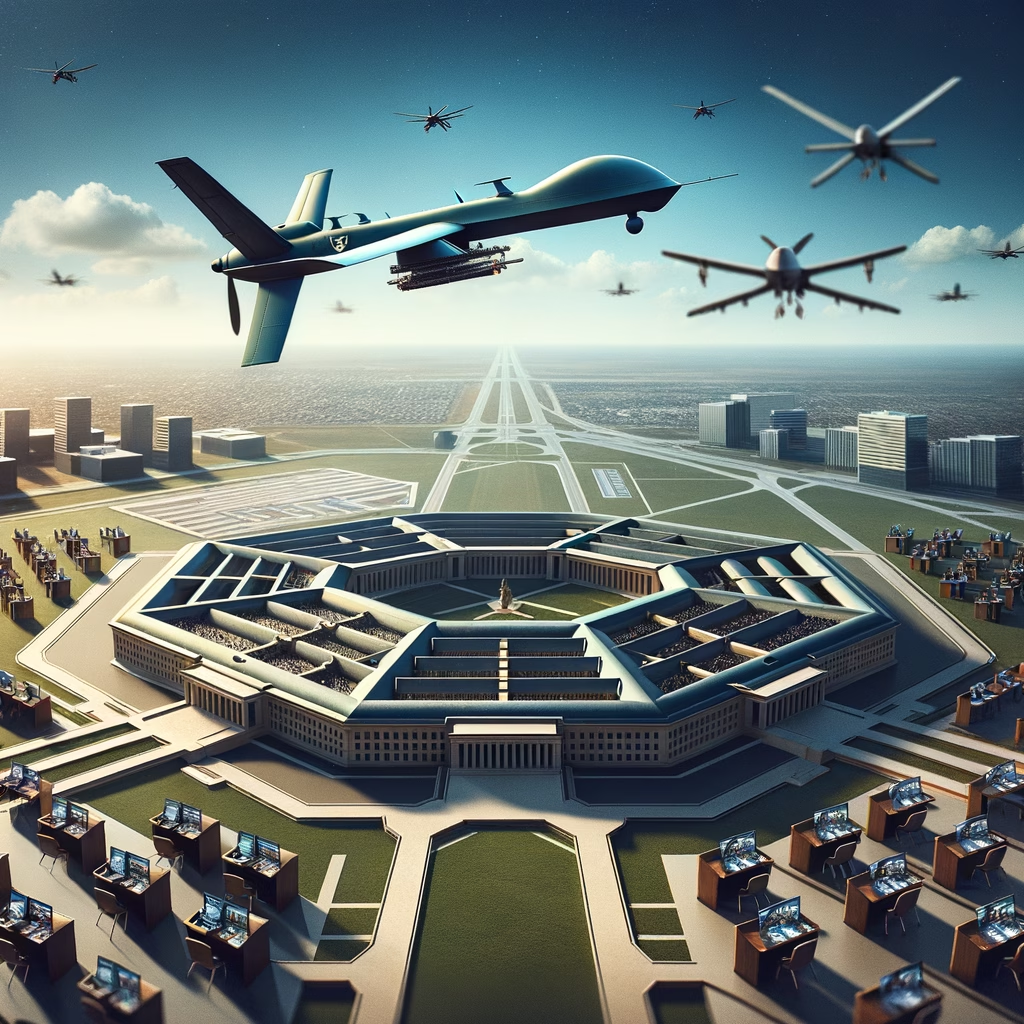
Pentagon to Launch Top Gun School for Attack Drones
Can a military institution long defined by high-performance jets absorb, teach and scale the gritty, improvisational tactics of low-cost attack drones? The Pentagon thinks so—and its new effort to create a “Top Gun” school for attack drones aims to turn battlefield improvisation into repeatable doctrine. The initiative seeks to capture the lessons of Ukraine’s battlefield experiments and translate them into training, procurement and operational concepts for U.S. and allied forces.
Why a Top Gun school for attack drones matters
The battlefield reality is stark: inexpensive unmanned aerial systems (UAS) and loitering munitions have allowed Ukraine to strike high-value targets, probe defenses and impose attrition at scale. Those effects have forced U.S. military leaders to rethink force structure, tactics and the relationship between manned platforms and unmanned systems. A formal school promises to move the services from ad hoc tinkering to a routinized capability that trains pilots, sensor operators and commanders to employ swarms, coordinate beyond-line-of-sight control and integrate drones into combined-arms operations.
The plan is not merely about flying lessons. It seeks to teach mission planning and execution; command-and-control protocols for semi-autonomous systems; integration of drones with artillery, electronic warfare and intelligence; and defensive measures when opponents deploy counter-drone technologies. By packaging real-world tactics into doctrine, the Pentagon hopes to speed adoption, standardize procedures and make “drone tactics” a learned competency across services and allied partners.
Operational, technological and industrial hurdles for attack drones
Turning improvised tactics into doctrine is harder than it sounds. Operationally, small attack drones are inexpensive and expendable, which changes how militaries calculate acceptable risk and losses. That shift calls for new rules of engagement and altered command philosophies—decisions that carry both tactical advantage and strategic risk.
Technologically, effective use depends on robust communications, resilient autonomy and sensors that work in contested electromagnetic environments. Autonomy, AI-driven target recognition and modular payloads are attractive, but engineers caution that autonomy must be paired with secure, jam-resistant communications and human-in-the-loop safeguards to prevent unintended engagements.
Industrial capacity is another constraint. The U.S. defense industrial base remains optimized for large platforms. Scaling to tens of thousands of small systems requires new suppliers, incentives for domestic manufacturing, and regulatory adjustments. Critical components—microprocessors, sensors, batteries—often come from global supply chains beyond U.S. control. Without targeted industrial policies, plans for mass-produced attack drones risk being hollow.

The cyber insurance questionnaire just landed. Now what?
SOC 2, HIPAA, insurance renewals - someone has to own security strategy. Nubivance provides fractional CISO leadership without the full-time salary.
Get a security leadEthical, legal and policy implications of institutionalizing attack drones
Semi-autonomous weapons systems raise unresolved questions about targeting responsibility, accountability and compliance with international law. A school that trains operators on complex autonomy and human-machine teaming must also codify legal frameworks and ethical safeguards. Export controls, foreign military sales and partner training create further policy levers: spreading tactics to allies enhances interoperability, but it also raises proliferation and escalation concerns.
Policymakers must balance rapid capability adoption with the strategic consequences of normalizing strike-capable drones. Sustained investment in legal review, export policy reform and international norms will be necessary if the U.S. seeks “drone dominance” without eroding long-established legal and ethical standards.
What soldiers and commanders stand to gain—and lose
For field users, the promise is practical: better tactics, reduced friction, and training that reflects contemporary battlefields. A formal curriculum can improve mission planning, unit coordination and cross-domain effects. But operational realities remain stark: maintaining battery-charged fleets, handling consumable munitions, and operating amid dense signals and countermeasures create logistical headaches that training alone cannot eliminate.
Adversaries are not static. Russia and China are investing in counter-UAS technologies, electronic warfare, and integrated air defenses designed to blunt the effectiveness of small drones. Institutionalizing drone tactics will trigger further adaptations—hardened command-and-control, cheaper swarm tactics, and new signature-masking techniques.
Culture change: from manned supremacy to unmanned integration
A successful school must do more than teach tactics; it must change incentives and career paths. Services built around manned platforms will need to adapt officer development, promotions and doctrine to reward unmanned proficiency. Modeling the program after an elite fighter weapons school could create doctrinal champions who drive institutional change, but resistance inside bureaucracies and cultures oriented toward piloted aviation remains a real barrier.
Conclusion: attack drones as capability—and challenge
The Pentagon’s plan to create a Top Gun school for attack drones signals recognition that lessons from recent conflicts must be institutionalized. If done well, the effort could produce interoperable standards, sharpen combined-arms employment and create a resilient industrial base for mass-produced systems. If done poorly, it risks accelerating proliferation, escalating conflicts, and normalizing semi-autonomous lethal tools without adequate legal or ethical guardrails.
Ultimately, success will depend on building an ecosystem—training, acquisition, doctrine, legal review and industry working in coordination—rather than a single center of excellence. The question before policymakers and military leaders is whether they can achieve a form of dominance that preserves alliances, norms and stability, or whether the rush to field attack drones will reshape those very norms. The stakes are high, and the lessons of the present should guide the institutions of tomorrow.



