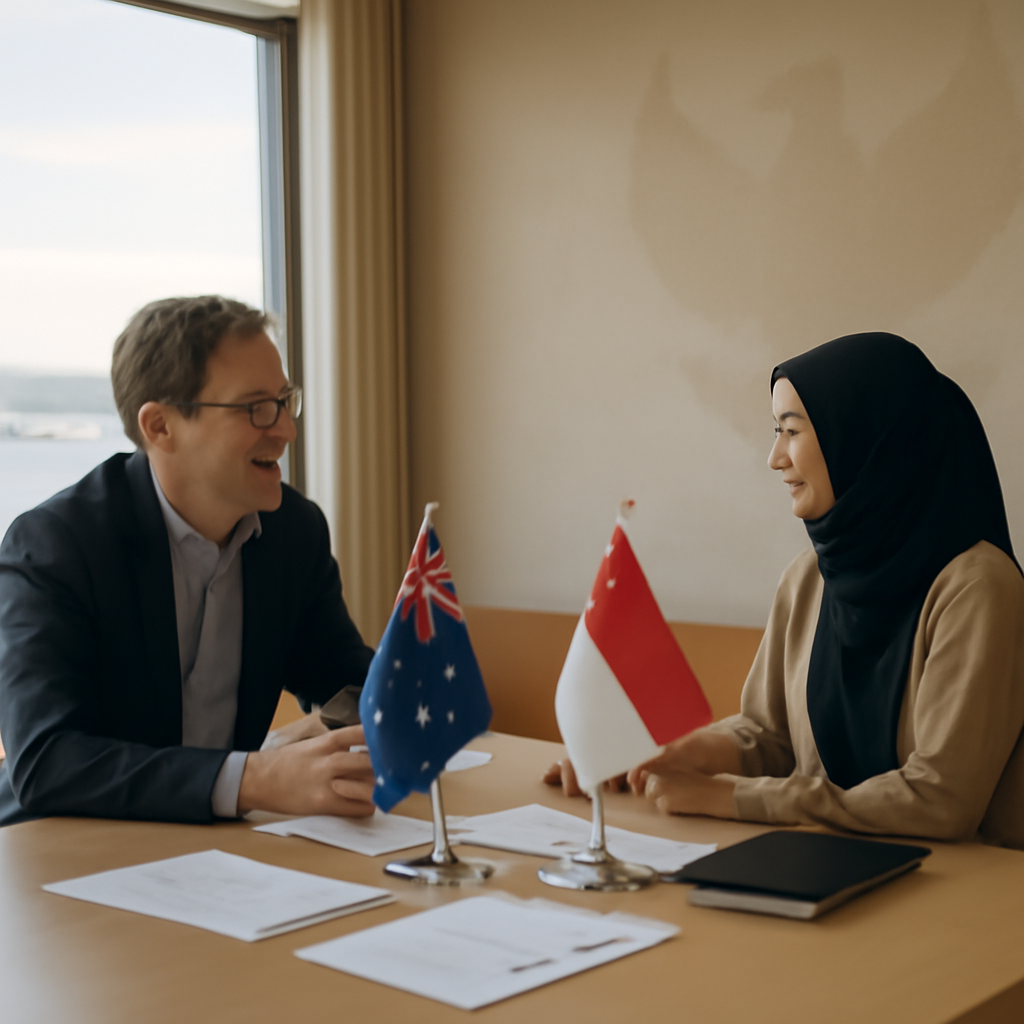
"no more important partner for Australia than Indonesia," declared Foreign Affairs Minister Penny Wong — a blunt assessment that frames a quarter-century of changing ties and the role a single think tank has played in them.
Penny Wong and the centrality of Indonesia
The quote captures a diplomatic reality ASPI's work has both reflected and shaped: few bilateral relationships matter more to Australia than the one with Indonesia. Across 25 years ASPI has positioned itself as an interlocutor between Canberra and Jakarta, preserving dialogue "even when official relations faltered" and pressing Australian policymakers to see Indonesia as a complex, sovereign partner rather than a recurrent crisis story.
ASPI’s early work: post‑Suharto era, Bali bombings, and perception
In its first decade ASPI concentrated on understanding Indonesia after Suharto. The 2002 Bali bombings redirected and intensified security cooperation, but ASPI argued that counterterrorism was only a limited response. The think tank highlighted deeper wounds — notably tensions around Timor‑Leste that had ruptured defence ties and seen the 1995 Agreement on Maintaining Security unravel — and sought to broaden the conversation by publishing work that gathered Indonesian and Timorese perspectives alongside Australian ones.
ASPI’s ideational contribution was best exemplified by the 2008 report Seeing Indonesia as a normal country: implications for Australia, launched by then foreign affairs minister Stephen Smith. The report confronted what ASPI described as Australia’s tendency to view Indonesia through "episodes of instability, terrorism and crisis" and helped lay an intellectual basis for deeper cooperation across defence, development and trade.

Audit-ready is a season. It shouldn't be.
Evidence in spreadsheets, controls drifting between audits, frameworks multiplying on flat headcount. Nubivance runs continuous compliance on Rapid7 Cyber GRC - SOC 2, HIPAA, ISO 27001, PCI, CMMC.
End the scrambleManaging crises: Snowden revelations, executions, and rebuilding ties
The relationship was tested in the 2010s. Edward Snowden’s 2013 disclosures that Australian intelligence had wiretapped president Susilo Bambang Yudhoyono and other senior officials produced a diplomatic crisis, and the 2015 executions of Australians Andrew Chan and Myuran Sukumaran added further strain. ASPI’s analysis in this period focused on how Canberra might rebuild trust without abandoning its positions, drawing on earlier work that showed police cooperation could evolve beyond counterterrorism.
ASPI paired analysis with practitioner engagement: the 2013 Australia–Indonesia Next Generation Defence and Security Forum deepened ties among experts and the 2016 Lombok Dialogue — co‑convened with the Foreign Policy Community of Indonesia and timed with the inaugural defence and foreign ministers’ meeting — showcased that networked approach. The restoration of relations was underscored when Yudhoyono, whose phone had been tapped three years earlier, delivered the keynote at ASPI’s 2016 Defence White Paper conference.
From understanding to shared problem‑solving: defence, cyber and the Jakarta Treaty
From 2017 onward ASPI shifted from explaining Indonesia to solving shared problems. Defence remained central: staff pressed for practical cooperation on capacity‑building, joint exercises and maritime security in the run‑up to February’s Jakarta Treaty. ASPI also broadened its portfolio to climate security, cybersecurity and hybrid threats. Its collaboration with the University of Indonesia, supported by the Department of Foreign Affairs and Trade, produced Indonesia’s first virtual cyber diplomacy course.
ASPI reinforced capability building through workshops, professional development and private engagements with officials on both sides. It produced detailed analysis — including a 2015 report on Indonesian military modernisation — and used public platforms such as the annual Defence Conference and the Sydney Dialogue to host prominent Indonesians and Australians alike.
What this means for Australian and Indonesian policymakers, defence practitioners, and researchers
- Australian and Indonesian policymakers: ASPI’s sustained dialogue and policy outputs have provided continuity during diplomatic ups and downs, offering practical options for cooperation in defence, maritime security and cyber capacity building that can be folded into formal frameworks such as the Jakarta Treaty.
- Defence practitioners and militaries: ASPI’s push for feasible, operational cooperation — joint exercises, capacity building and maritime security work — means planners on both sides have an external source of ideas and networks to translate into training, interoperability and shared maritime operations.
- Researchers and think tanks: ASPI’s role in convening roundtables, the Lombok Dialogue and partnerships with Indonesian institutions demonstrates how non‑government networks can sustain policy continuity and feed evidence into bilateral agreements and professional development programs.
People‑to‑people engagement has remained a throughline: ASPI has hosted former vice foreign minister Dino Patti Djalal, former National Resilience Institute head Andi Widjajanto, defence thinker Curie Maharani, former presidential candidate Anies Baswedan, former defence minister Linda Reynolds and Special Envoy for Indian Ocean Affairs Tim Watts. The organisation has hosted Indonesian fellows, including an army fellow, employs four staff members of Indonesian descent, and has produced podcasts such as SBY’s Tears (2021) and What’s in a Name? (2022).
Across 25 years ASPI has acted as both translator and bridge — reframing perception, convening practitioners and pressing for practical cooperation. Following February’s Jakarta Treaty, ASPI is positioned to continue supplying the ideas, personal links and institutional knowledge that underpin the relationship; the next questions are procedural and practical: how the ideas will be operationalised inside defence ministries, ministries of foreign affairs and the treaties’ implementation mechanisms.