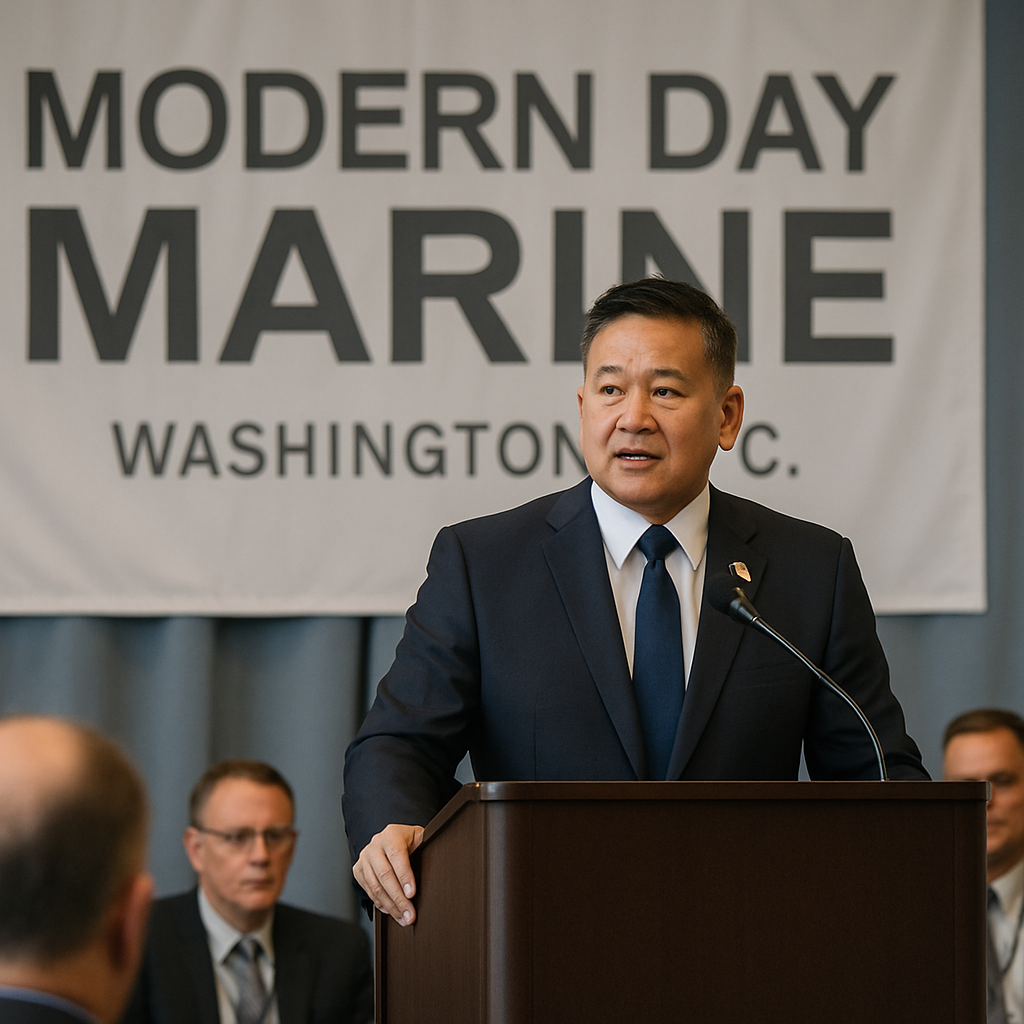
Cao’s remarks were his first public appearance as the civilian head of the Navy since the Pentagon announced that John Phelan would be leaving the role he’d held for about 13 months. Cao — a retired Navy explosive ordnance disposal officer and a two‑time candidate for Virginia congressional seats — took the time slot at the conference that Phelan had originally agreed to fill before his departure. Cao said he learned of Phelan’s swift ouster when a Pentagon spokesman posted on X.
Acting Navy Secretary Hung Cao at Modern Day Marine
Cao framed his address directly to Marines in the audience and kept his prepared remarks unusually brief for a conference keynote. After a short scripted portion, he spent the remainder of his time answering screened questions from attendees. His opening lines acknowledged the abrupt personnel shift in the department and emphasized readiness: “Because in combat, you lose people, and the fight goes on,” he said.
Comments on the Global War on Terror and force readiness
Speaking of equipment and past conflicts, Cao referenced being under‑equipped during the Global War on Terror. He said that experience informs his view of future procurement and training: “So think about this, as we're developing equipment for our Marines out there, that what you're producing right now is going to save the lives of America's sons and daughters,” he told the crowd.

This site is the portfolio.
OSINTSights runs on Cloudflare Workers, D1, R2, and Vectorize, with an AI pipeline on Hetzner ARM. Nubivance designed, built, and operates it. We do the same for clients.
See what we buildPersonal stakes: his son and lessons from Iraq
Cao made the issue personal. He noted that his son is to be commissioned a Marine Corps second lieutenant in the coming weeks, and explained how that family tie motivates his approach: “That's why I do what I'm doing, because I'm not going to have my son go to war the way I did when we were invading Iraq,” he said.
Shipbuilding, acquisitions reform, and the Golden Fleet
On naval shipbuilding, Cao signaled alignment with the policy approach associated with his predecessor. He said the Golden Fleet concept “is not just about ships. It's the whole concept of reforming acquisitions, getting ships out there, from high to low, right?” He added a practical admonition: “You can't use a destroyer for everything.” The comment referenced the nascent Trump‑class battleship as part of a wider fleet plan discussed at the conference.
How Marines in the audience, industry representatives, and shipbuilders are affected
- Marines in the audience: Cao’s remarks directly addressed them, stressing that current equipment decisions will affect their survivability in future conflicts and invoking past shortfalls from the Global War on Terror.
- Industry representatives at Modern Day Marine: He explicitly called on industry to help prevent the Pentagon from repeating earlier procurement mistakes, framing vendor output as life‑saving for “America's sons and daughters.”
- Shipbuilders and acquisition reformers: By tying the Golden Fleet to acquisition reform and a mix of vessel classes “from high to low,” Cao signaled continuity in emphasis on getting a range of ships into service rather than relying on a single class for all missions.
Cao’s remarks struck a pragmatic chord: brief, personal, and centered on equipment and procurement. He used his first public forum as acting secretary to press industry partners and acquisition officials alike to focus on producing the right tools for Marines and sailors, citing both his own combat experience and his son’s imminent commissioning as reasons to avoid past mistakes. His public alignment on shipbuilding with the Golden Fleet concept, and his juxtaposition of acquisition reform with ship mix, together define the yardsticks by which his early tenure will be judged.