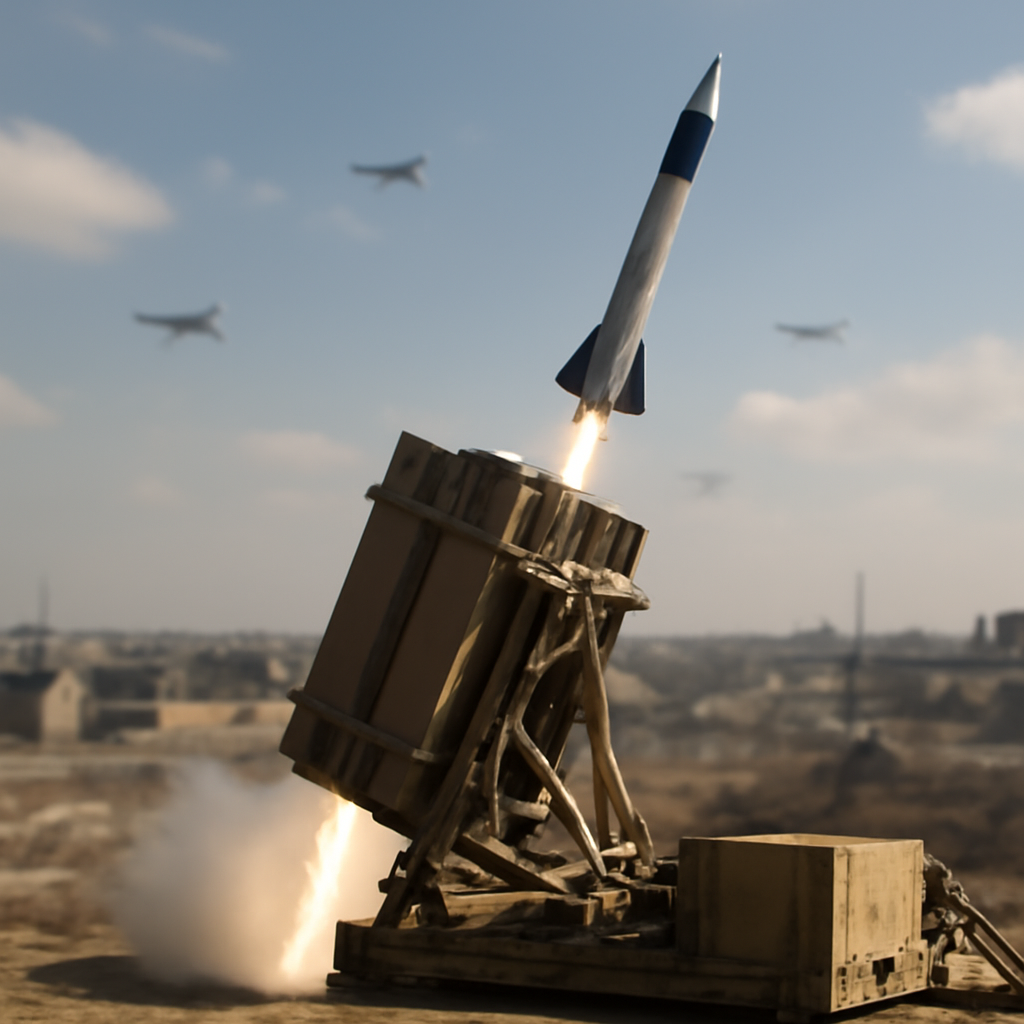
Can a laser bolted to the rear of an armored vehicle reliably stop incoming rockets, drones and mortars before they reach soldiers? That question, once an academic curiosity, is now a pressing operational dilemma as the U.S. Army moves toward production contracts. The debate has shifted: it’s no longer whether directed energy can work, but how quickly a vehicle-mounted directed-energy system can be ruggedized, maintained, and tactically integrated so it performs consistently under combat conditions. If that transition succeeds, maneuver forces could gain a fundamentally different kind of air-defense layer; if it fails, promises of lightning-fast, low-cost defenses may collapse under logistical and environmental realities.
Vehicle-mounted directed-energy system: what changes if it works
A reliable vehicle-mounted directed-energy system would reshape assumptions about layered air defense. Modern forces depend heavily on interceptor missiles and kinetic guns—solutions that are expensive, logistics-heavy, and limited in magazine depth. Add dependable lasers on maneuver platforms and forward operating bases, and commanders gain a complementary capability optimized for high volumes of small, low-cost threats: reconnaissance and attack drones, rocket-propelled munitions, and certain loitering weapons. Operational planning shifts, resupply burdens ease in some respects, and adversaries must rethink attack profiles that previously exploited limited interceptor stocks.
Progress has been steady but incremental. Solid-state and fiber laser architectures have improved electrical-to-optical efficiency, beam quality, and modularity. Better power electronics and compact energy storage let vehicles draw and condition hundreds of kilowatts without devoting the entire platform to power generation. Adaptive optics, advanced beam control, and real-time tracking software help mitigate atmospheric turbulence and platform-induced jitter long enough to disrupt guidance systems or burn through structural components on small moving targets.
Key engineering challenges remain
The dominant constraints are power and thermal management. Producing sustained output powerful enough to neutralize targets while shedding hundreds of kilowatts of waste heat in hot, dusty, or smoky environments is a materials and systems-engineering puzzle. Atmospheric obscurants—dust from convoys, rain, fog, and battlefield smoke—scatter and attenuate beams. Target discrimination and continuous tracking must contend with swarms, ballistic arcs, and decoys. And sustainment in austere theaters demands new maintenance concepts, spare-part inventories, and trained technicians who can work on complex power, cooling, and optical subsystems under stress.
Operational realities vs. expectations
Platoon leaders want the near-infinite “magazine” and rapid engagement lasers promise; vehicle crews want systems that start reliably, require predictable maintenance cycles, and integrate cleanly with existing command-and-control and sensors. Logisticians appreciate fewer missile resupply trips but worry about the burden of power modules, liquid or advanced air cooling, and delicate optical spares. The tension between attractive performance metrics and everyday operability will determine whether the technology is embraced or sidelined.
Policy, doctrine and export concerns
Policymakers must balance acquisition speed, doctrine development, and export controls. Rapid fielding could put immature systems into the field and erode user trust; overly cautious procurement risks leaving forces exposed to evolving threats. Congress will scrutinize costs as prototypes transition to production. Internationally, export rules and norms may need updates: directed-energy weapons carry distinctive safety, identification, and escalation risks. Clear doctrine, robust rules of engagement, and international coordination will be essential to ensure lawful, responsible, and interoperable use.
Sustainment, testing and battlefield fitness
Engineers signal cautious optimism: progress to production suggests demonstrations have resolved many prior showstoppers—enough confidence in reliability, maintainability, and performance to scale. Yet laboratory metrics do not always equal field durability. Mean time between failures, logistic tails, and the ability to operate amid chemical, biological, and electronic warfare stresses will ultimately determine utility. Testing in realistic, congested environments that include dust, smoke, electronic interference, and high operational tempo is essential before platforms are relied on in combat.
Adversaries adapt—and so must doctrines
No technological advantage remains static. Rival states are accelerating their own directed-energy programs, and adversaries will explore tactics to blunt lasers: low-observable approaches, decoys, salvo attacks, saturation techniques, and exploiting transient vulnerabilities such as power cycling or atmospheric degradation. The result is a technology-driven cat-and-mouse game in which each advance invites countermeasures and necessitates new tactics, techniques, and procedures.
Cost calculus and integration
Economics remain central. Destroying a small drone with a missile can cost tens or hundreds of thousands of dollars; a laser shot costs mainly electricity and wear on components. But lifecycle costs must account for acquisition, cooling systems, specialized spares, and distributed power generation. Cost-effectiveness depends on sortie rates, threat mix, and operating environment. Integration matters as much as raw power: a directed-energy weapon must be linked to radar, electro-optical/infrared sensors, battle-management systems, and hardened cyber protections to avoid spoofing or blinding. Successful fielding will require seamless integration into existing air-defense architectures and revised concepts of operations that exploit rapid engagement and deep magazines.
Ethics, law and safety
Lasers carry risks to noncombatants and civil aviation; their employment must comply with the laws of armed conflict and robust identification protocols. Transparency with allies, clear operational constraints, and stringent safety procedures will reduce misidentification risks in congested or multinational theaters.
Conclusion: practical absorption is the test
The Army’s move toward production is an inflection point, not an endpoint. If science and engineering translate into a resilient, maintainable vehicle-mounted directed-energy system, maneuver forces could gain a durable, low-cost defensive layer. If not, hasty fielding risks wasting resources and undermining confidence while adversaries refine counters. As fielding decisions accelerate, the central question is no longer whether lasers can work in principle—trial data increasingly says they can—but how rapidly and responsibly the military can absorb vehicle-mounted directed-energy system technology into doctrine, logistics, and theater operations so the beam becomes as reliable as the soldier who relies on it.