Hegseth’s visit, the Presidential Unit Citation, and the welcome-home scene
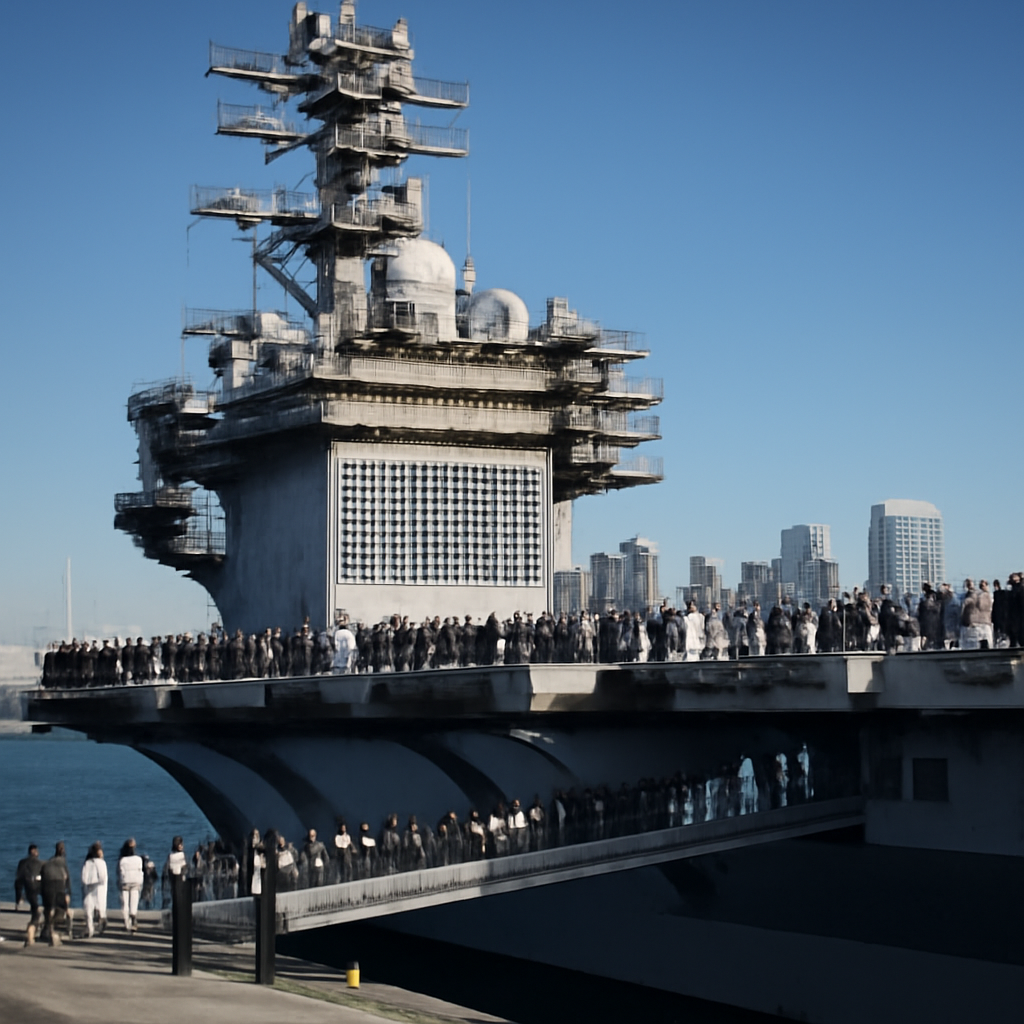
On Oct. 7, 2026, Secretary Pete Hegseth stood on the deck of the aircraft carrier USS Abraham Lincoln and inspected a wall of stenciled "kill marks" on the ship's island superstructure, a photograph on the Pentagon's image distribution site shows. Hegseth read from the Presidential Unit Citation awarded to the Lincoln Carrier Strike Group (CSG) for its role in Operation Epic Fury and formally presented the citation to the crew during the arrival home near San Diego. The citation credited the strike group with 77 one-way unmanned attack drones shot down and 64 Iranian vessels sunk during the period from Feb. 28 until the carrier departed the region on Aug. 22, as well as 3,693 combat sorties, 1.37 million pounds of ordnance delivered, 450 Tomahawk Land Attack Missiles launched, 21 anti-ship cruise missiles destroyed, and defenses mounted against four fast-attack craft and explosive-carrying wooden sailing vessels.
Visible kill marks, photographic counts, and discrepancies
Photographs and a video taken during Hegseth’s visit show extensive stenciling on the Lincoln’s superstructure. By the author’s count from that imagery and supplemental footage, there are 103 one-way attack (OWA) drone kill marks and 34 ship kill marks visible. That tally differs from the unit citation: the stencils display at least 26 more drone marks than the citation’s 77 and 30 fewer ship marks than the citation’s 64. The Pentagon referred inquiries to the Navy, and the Navy had not responded to those questions at the time of reporting.
The stenciled silhouettes are generic: drone shapes resembling Shahed-136s would represent all types of OWA drones shot down, and frigate- or corvette-style silhouettes denote surface-craft kills rather than specific hull types. After the carrier docked, new images published showed additional kill marks, including 10 submarine symbols on the hull.

Audit-ready is a season. It shouldn't be.
Evidence in spreadsheets, controls drifting between audits, frameworks multiplying on flat headcount. Nubivance runs continuous compliance on Rapid7 Cyber GRC - SOC 2, HIPAA, ISO 27001, PCI, CMMC.
End the scrambleAir and sea actions described by the citation and unit photographs
Photographs of embarked aviation squadrons add detail to the carrier strike group’s record. An image provided by aviation photographer Jeff Rojas shows a submarine kill mark on an F/A-18F Super Hornet of VFA-41, the "Black Aces," one of the aviation squadrons aboard Lincoln during Epic Fury. VFA-41 alone launched 421 missiles and bombs while supporting the operation. The Aviationist published an image of a VMFA-314 F-35C with markings that appear to represent an oil tanker, three submarines, a surface combatant, a Shahed-type drone, an artillery piece, and several ground-based launchers.
The U.S. military has previously confirmed that air-launched AGM-114 Hellfire laser-guided missiles—likely fired from MQ-9 Reaper drones—and ground-launched Army Tactical Missile System (ATACMS) short-range ballistic missiles were employed against submarines specifically. The carrier’s escorting Arleigh Burke–class destroyers USS Frank E. Petersen Jr., USS Spruance, and USS Michael Murphy served as critical air-defense platforms for the strike group and also launched Tomahawks and supported potential anti-submarine work.
Crew conditions, family reports, and official responses
The Lincoln’s marathon deployment drew scrutiny over onboard conditions. The carrier departed San Diego on Nov. 21, 2025, and its return closed out a deployment of 321 days by the author’s count, making it one of the longer modern carrier deployments. In August, crew families reported supply shortages and difficult living arrangements; those accounts produced wide media coverage. Acting Secretary of the Navy Hung Cao called the coverage "dishonest" while acknowledging some strains: Cao said "a small number of mental health cases were treated with no loss of life," that meal plans were adjusted when fresh resupply was unavailable "without a single meal being missed," and that calls home were limited when the operational threat was high. A letter from Cao obtained by CNN stated at least eight personnel across the strike group attempted suicide during the cruise.
How the Navy, Crew Families, and Policymakers are responding
- The Navy: The Pentagon referred questions about the discrepancy between visible kill marks and the unit citation to the Navy; no Navy response was noted in the reporting. The Lincoln’s escorts and embarked squadrons are presented in imagery as active participants in both strike and air-defense roles.
- Crew families: Families’ reports of supply shortages and constrained living conditions during the deployment prompted public attention and responses from senior Navy officials acknowledging logistical adjustments and mental-health cases.
- Policymakers and Pentagon leadership: Defense leadership publicly highlighted the strike group's operational tally through the Presidential Unit Citation, while senior Navy officials communicated both pushback against media characterization and acknowledgment of specific onboard health and logistical issues.
The Lincoln’s return combined unmistakable symbols of combat achievement—the painted kill marks and the unit citation’s hard numbers—with unresolved questions about how those symbols map to official tallies and how an extended deployment affected sailors and Marines. New images with additional submarine marks arrived after the carrier docked, and the Navy had not provided a public accounting reconciling the photographic counts with the citation’s figures at the time of this report.