“As part of an overall ‘Black Hawk 2070’ modernization effort we’re developing a number of complementary capabilities, including our U-Hawk uncrewed cargo variant, which we plan to fly later this year,” Jason Wrigley, Sikorsky’s director of business development for Black Hawk, told TWZ at the company’s Stratford plant in Connecticut.
Digital backbone and a reworked nose to enable rapid upgrades
Sikorsky is building what it calls a new “digital backbone” for the UH-60 Black Hawk intended to provide power, data, a network, cooling and “open architecture interfaces that enable the easy integration of new equipment, such as sensors.” The company says that architecture is an explicit attempt to meet the Army’s Modular Open Systems Approach and to permit faster, cheaper insertions of new capabilities — even customization “on a mission-by-mission basis,” according to Wrigley.
Complementing that backbone is a new modular nose for the H-60 family. Sikorsky says the modular nose will provide more than twice the internal volume of the original nose section, house internal electronics and an integrated mount for external sensor pods, and create space for roles including search-and-rescue, drone control and operations in degraded environments. Sikorsky plans to introduce the modular nose on the UH-60M.
MATRIX autonomy, the UH-60MX, and optionally piloted operations
Autonomy is central to the Black Hawk 2070 blueprint. Sikorsky’s MATRIX autonomy software has been matured on a UH-60M variant and was developed initially on an UH-60A fly-by-wire Optionally Piloted Vehicle. Sikorsky reports MATRIX has more than 1,000 flight hours across 500 tests and demonstrations and has been integrated on “over 20 different platforms,” including testing by DARPA and the U.S. Army.
The U.S. Army received its first UH-60MX Optionally Piloted Vehicle on March 20, 2026; Sikorsky says that aircraft marked the first full-authority fly-by-wire and optionally-piloted UH-60 in the Army fleet and is being used “for testing and soldier feedback to develop tactics, techniques and procedures for the autonomous Black Hawk.” Sikorsky also says it has a contract to deliver three more MX aircraft to the Army.
Sikorsky positions MATRIX as workload-reducing rather than pilot-replacing in every case: the company describes scenarios where the Black Hawk can be flown by one pilot, two pilots, or “no pilots at all when that’s the appropriate option,” and highlights the system’s use of sensors, radar altimeter, drift indications and fly-by-wire control to make rapid in-flight adjustments.

This site is the portfolio.
OSINTSights runs on Cloudflare Workers, D1, R2, and Vectorize, with an AI pipeline on Hetzner ARM. Nubivance designed, built, and operates it. We do the same for clients.
See what we buildThe U-Hawk: a pilotless cargo Black Hawk and a dispenser for launched effects
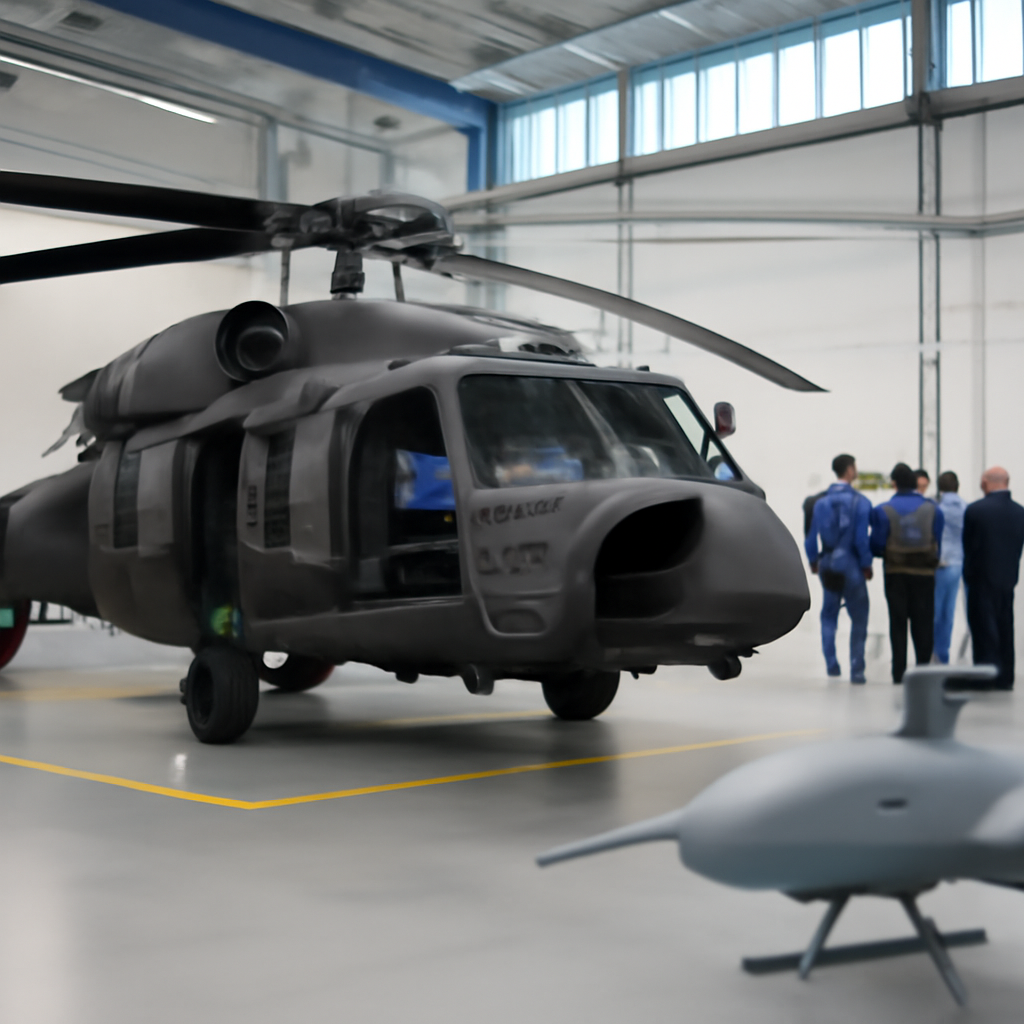
The S-70UAS, or U-Hawk, removes the cockpit and replaces the forward section with clamshell cargo doors to create a large internal cargo bay. Sikorsky says it used a modified UH-60L as the template for the initial U-Hawk, and that the demonstrator shown at AUSA 2025 has since received fly-by-wire and MATRIX autonomy work in its Bridgeport innovations hangar. Sikorsky says the U-Hawk “will make its first flight as a U-Hawk later this year.”
Sikorsky describes the U-Hawk as suited to contested logistics missions and as a platform that can carry “launched effects” — small air-launched drones used for sensing, communications relay, jamming, distraction or strike. The company is pursuing two carriage concepts: stub-wing-mounted launchers and a cabin “mega-pack” or “quiver” to carry large volumes of launched effects. Sikorsky points to Army testing, including Project Convergence Capstone 6 and prior Black Hawk demonstrations that deployed Anduril’s Altius-700 launched effects, as evidence that launched-effect concepts are maturing toward operational introduction.
T901 Improved Turbine Engine, expanded fuel capacity, and test milestones
Sikorsky is pairing autonomy and doghouse-sized cargo concepts with more power. The GE Aerospace T901 Improved Turbine Engine (ITE) is said to provide 50 percent more horsepower than the existing T700 engines in the UH-60M and is intended to create “over 1,000 pounds of increased payload capacity and increased range.” Sikorsky began initial testing of a UH-60M with twin ITEs in January 2025, and reports its first flight with ITE occurred in May 2025. Since that flight the company says it has flown the aircraft with the new engines for more than 50 hours and up to 17,000 ft above sea level.
Alongside the engines, Sikorsky is increasing fuel tank capacity without reducing cabin volume, a change it says will retain the ability to transport 11 combat troops while increasing range by “around 100 nautical miles.” Sikorsky expects a milestone C production decision on ITE “within the next couple of years,” after which the engine would become a core element of the Black Hawk program.
What this means for Army units, procurement leaders, and Sikorsky’s production teams
- Army units: will be able to experiment with optionally piloted and autonomous configurations as service testing proceeds; units will also see incremental upgrades (modular nose, digital backbone, new engines) that Sikorsky says can be fielded as retrofit kits or installed on new-build aircraft.
- Procurement leaders: will face choices between upgrading existing Black Hawks — including converting divested Black Hawks into U-Hawks — or acquiring new-build aircraft with the digital backbone, modular nose and twin ITEs off the production line; Sikorsky notes retrofit kits and new aircraft options will both be available.
- Sikorsky production and test teams: are executing work across Stratford (final assembly and key components), Bridgeport (innovations hangar finishing the U-Hawk), and a West Palm Beach test facility (ITE test program), while also expanding additive manufacturing on the Black Hawk to 11 current parts and pursuing qualification of additional components.
Taken together, Sikorsky’s described upgrades — open-architecture digital backbone, a modular nose, MATRIX autonomy and an optionally piloted pathway, the U-Hawk uncrewed cargo demonstrator, launched-effect carriage concepts, and the T901 ITE — are being presented as interoperable pieces of a “Black Hawk 2070” strategy. The programme’s immediate milestones the source identifies are the U-Hawk’s planned first flight “later this year,” additional UH-60MX deliveries for Army testing, and a milestone C decision on the T901 ITE within the next couple of years.