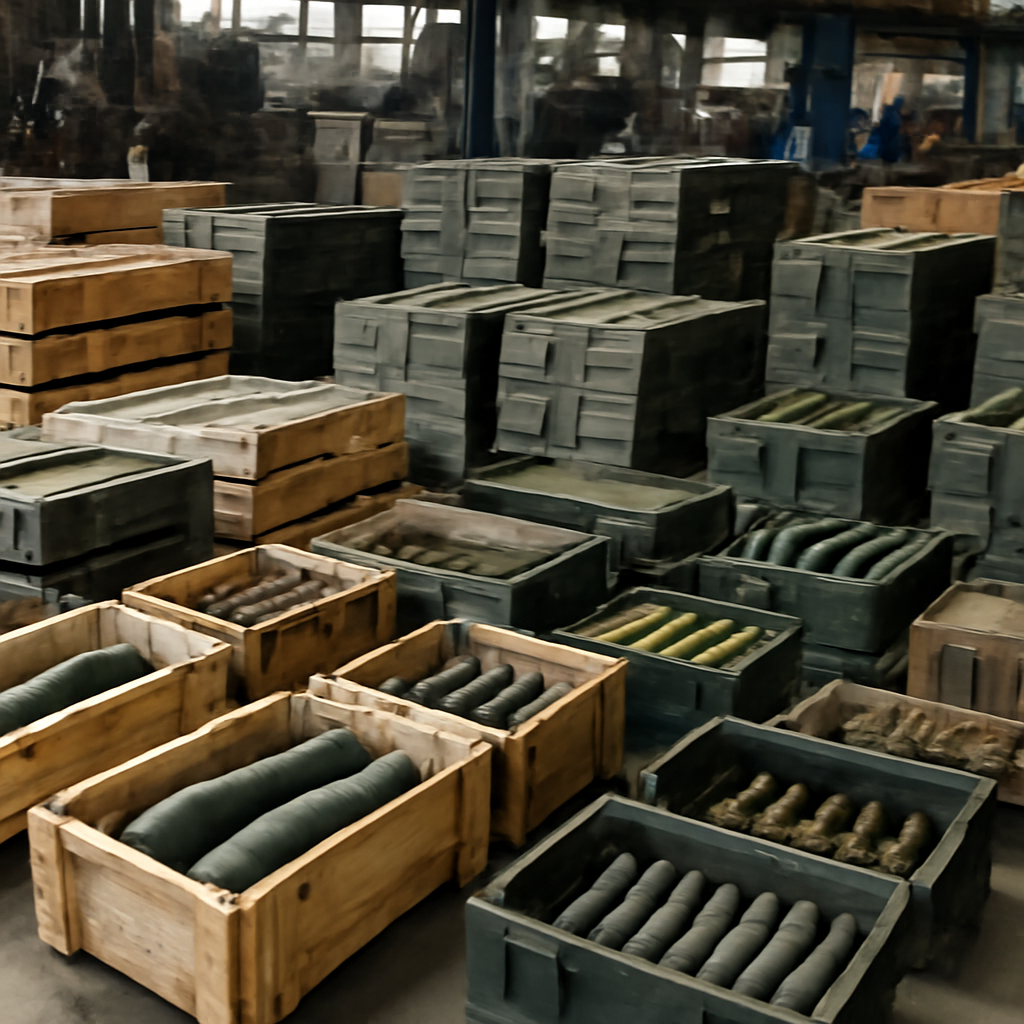
“…we have a lot,” President Donald Trump proclaimed to reporters aboard Air Force One when asked if he is concerned about a shortage of high-end munitions like interceptors for Patriot and Terminal High Altitude Area Defense (THAAD) systems.
President Donald Trump on munitions and diplomacy
Mr. Trump dismissed worries about depleted stocks, telling reporters on July 27 that “we have a lot of the mid-level stuff too. Maybe more than we could ever use, no matter what. But we have a lot. I’d like to have more, to be honest.” He again blamed the prior administration for giving away weapons to Ukraine and said the United States is “restocking” with plants and production being expanded. He added that “for some of the more sophisticated stuff, we certainly like that part.”
Pentagon agreements with Lockheed Martin and L3Harris
On the same day, the Pentagon announced it signed “two landmark seven-year framework agreements” with Lockheed Martin and L3Harris “to expand production capacity for key components of the Patriot Advanced Capability-3 (PAC-3) Missile Segment Enhancement (MSE) interceptor and the Terminal High Altitude Area Defense (THAAD) weapon system.” The Pentagon said L3Harris will accelerate production of its “advanced two-pulse solid rocket motor, Attitude Control Motors, and the Lethality Enhancer.” A separate THAAD propulsion agreement — signed by the DoW, L3Harris, and Lockheed Martin — will expand manufacturing of the solid rocket boost motor and the Liquid Divert and Attitude Control System (LDACS), which the Pentagon described as providing “vital in-flight maneuverability.”

Audit-ready is a season. It shouldn't be.
Evidence in spreadsheets, controls drifting between audits, frameworks multiplying on flat headcount. Nubivance runs continuous compliance on Rapid7 Cyber GRC - SOC 2, HIPAA, ISO 27001, PCI, CMMC.
End the scrambleProduction rates: CSIS baseline and Lockheed’s January contract
A May report cited by the source noted current PAC-3 MSE production “is around the baseline rate of 650 interceptors per year, with half the deliveries going to the United States and the rest to allies and partners,” attributing that estimate to CSIS. Under a contract with the Pentagon inked in January, Lockheed is committed to boosting Patriot annual production to 2,000. Still, reporting in The Wall Street Journal said concern about shrinking Patriot and other interceptor stocks was a large factor in the administration’s decision to pause attacks on Iran—an operational pause that followed 13 straight days of tit-for-tat operations.
CENTCOM operations, blockades, and regional attacks
Although kinetic exchanges between the U.S. and Iran have abated for the moment, U.S. Central Command (CENTCOM) is continuing a maritime enforcement effort it described on X as redirecting 17 commercial vessels, disabling two, and boarding two “to ensure compliance” as part of a renewed blockade of Iranian ports. The source also reported continued regional violence: Houthi forces in Yemen claimed strikes on Saudi facilities in Yanbu and earlier attacks on Yanbu and Jazan; Saudi Arabia said air defenses intercepted and destroyed a number of drones “launched from Iraqi territory” by “Iranian-backed terrorist militias,” according to Maj. Gen. Turki Al-Maliki. Jordan reported its air defenses shot down two drones, and the source noted three U.S. Army soldiers were killed in an attack on Muwaffaq Salti Air Base on July 17.
Pentagon casualty reporting and the Overseas Operations category
The Pentagon revised its casualty reporting, creating a new category called “Overseas Operations” that includes all deaths and injuries from July 7 onward, the date the administration considers Operation Epic Fury (OEFU) to have ended. Four service members — 1st Lt. Tyler James Feehan, Sgt. Angel Rampersad, Pvt. Isabella Gonzales (all killed at MSAB), and Sgt. Michael Emmanuel Swinton (killed during a controlled detonation at Erbil Air Base on July 19) — are now listed in this separate category. Since the launch of OEFU, the source reports, there have been 18 troops killed and the Pentagon’s reworked reporting shows at least 621 troops wounded, an increase of more than 200 over earlier counts.
What this means for Lockheed Martin, L3Harris, and CENTCOM
- Lockheed Martin: Under a January contract, Lockheed is committed to expanding Patriot production to 2,000 annually; delivery timelines and the ability to ramp from earlier baseline rates will determine how quickly inventories recover.
- L3Harris: The company’s accelerated production of two-pulse motors, Attitude Control Motors, and the Lethality Enhancer is central to both PAC-3 MSE and THAAD upgrades described by the Pentagon; performance and supply-chain continuity for these components will be watched closely.
- CENTCOM: The command is maintaining maritime enforcement and has told the public it redirected and interdicted vessels; CENTCOM leaders, including Adm. Brad Cooper according to the reporting, judge the U.S. can “cope with the limited stocks” if strikes resume, but that limited inventories would increase operational risk.
For now, the United States and Iran have paused direct exchanges—no U.S. strike on Iranian territory has occurred since last Thursday—but the pause exists alongside explicit Pentagon efforts to expand interceptor production, reported concern from senior military leaders about declining inventories, ongoing regional attacks on Saudi infrastructure and shipping, and newly reported troop casualties and injuries. The central question the facts leave in plain view: can stepped-up manufacturing and seven-year framework agreements restore the magazine depth that military leaders warn is already strained before hostilities resume?