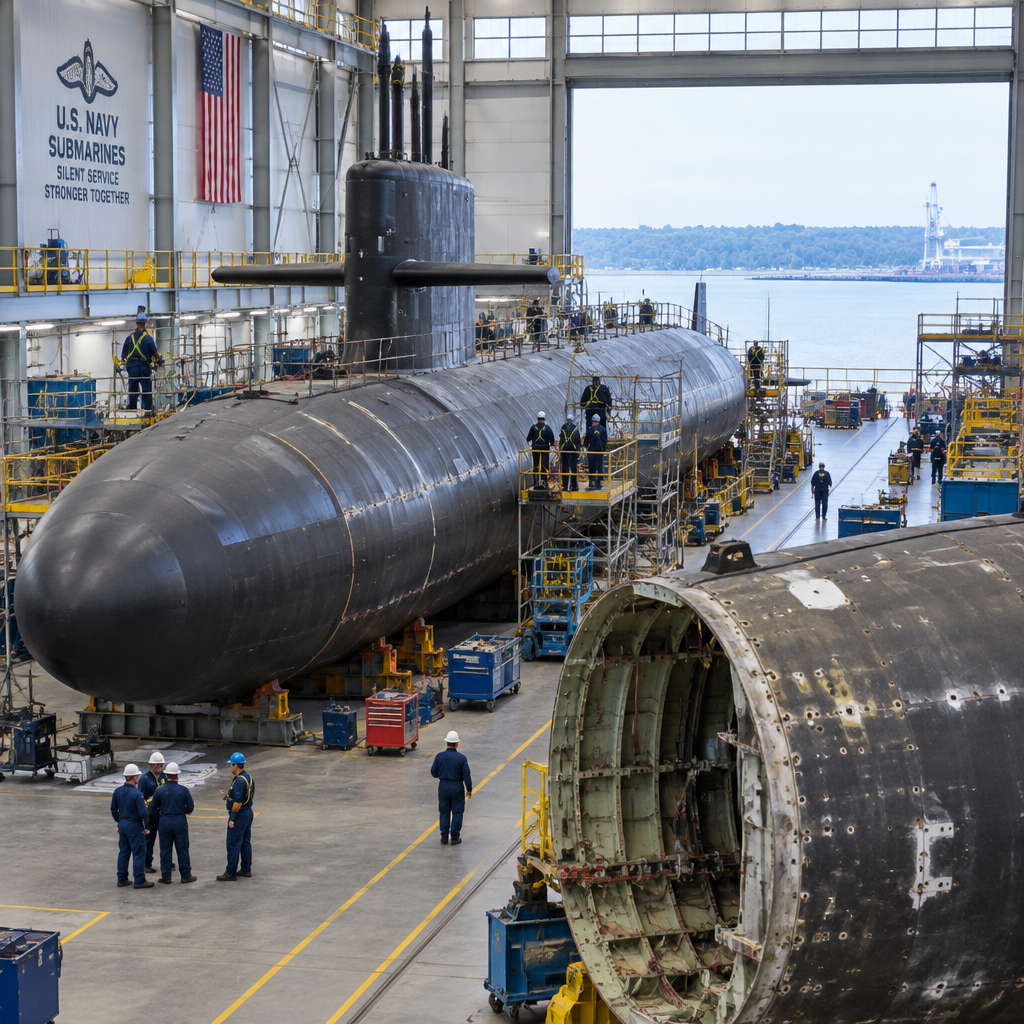
"I want to highlight the significant reduction in days of maintenance delay," Vice Adm. Rob Gaucher said Thursday at the Naval Submarine League Annual Symposium.
Vice Adm. Rob Gaucher and the new DPRM for Submarines
Vice Adm. Rob Gaucher, identified in his remarks as the Pentagon’s first-ever submarine czar and the Direct Reporting Portfolio Manager (DPRM) for Submarines, delivered the most detailed public accounting yet of recent trends in submarine depot maintenance. Gaucher told the symposium that maintenance delay across the fleet fell sharply in fiscal 2026, down to 780 days after roughly 1,400 days of delay in both FY24 and FY25 — a drop he quantified as “more than 40 percent improvement.”
Gaucher framed the FY26 improvement as measurable and attributable to specific actions, and he offered a forward-looking estimate: “I expect maintenance delays will drop further in fiscal year ‘27 to around 500 days.” That projection was presented as part of his assessment of recent investments and schedule management changes.
Investments in Virginia-class spare parts
Gaucher singled out investments in Virginia-class spare parts as a major driver of the improvement. “I attribute a significant part of this to investments made in Virginia-class spare parts over the past few years,” he said, linking logistical spending to operational outcomes. He presented spare-part investments not as an abstract program but as a concrete lever that contributed to reduced maintenance backlog during FY26.

Audit-ready is a season. It shouldn't be.
Evidence in spreadsheets, controls drifting between audits, frameworks multiplying on flat headcount. Nubivance runs continuous compliance on Rapid7 Cyber GRC - SOC 2, HIPAA, ISO 27001, PCI, CMMC.
End the scrambleJohn Warner and Illinois — late to original schedules, early to re-baselines
Two specific submarines were cited as evidence of progress: the Virginia-class John Warner and Illinois. Gaucher said both will be delivered for depot maintenance in a “few weeks.” He acknowledged that both boats are late relative to their original schedules, but emphasized they are “several months early to their re-baseline schedules,” calling that “a huge mark of progress.”
The distinction between original schedules and re-baselined schedules featured prominently in Gaucher’s account. He noted that the Navy had to update delivery schedules on multiple occasions — a process he described as “re-baseline” — and presented early arrivals relative to those re-baselined plans as new evidence of schedule recovery.
Portsmouth and Pearl Harbor shipyards, and the GAO's long-term record
Gaucher reported operational progress at two public shipyards by name: “As of today, every fast attack submarine in Portsmouth Naval Shipyard and Pearl Harbor Naval Shipyard is on plan, with several — I dare say — tracking early to plan.” Those statements place two major depot facilities at the center of the FY26 improvements he described.
That progress sits against a stark long-term performance measure from the Government Accountability Office. An August GAO report found that public shipyards — the entities that perform depot maintenance on nuclear-powered vessels such as submarines — completed only 11 percent of submarine depot maintenance periods on schedule between FY16 and FY25. Gaucher’s FY26 figures were presented as a break from that longer-term pattern.
How the Navy, public shipyards, and policymakers are positioned
- The Navy (as represented by the DPRM for Submarines): Gaucher portrayed the Navy as moving from reactive schedule resets toward meeting or beating re-baselined plans, and he has set an explicit expectation of further improvement to “around 500 days” of delay in FY27.
- Public shipyards (Portsmouth Naval Shipyard and Pearl Harbor Naval Shipyard): Gaucher said every fast attack submarine at these shipyards is currently on plan, with several tracking early to plan — a practical indicator of localized schedule health tied to the FY26 improvement.
- Policymakers and oversight bodies (as reflected by GAO reporting): The August GAO finding that only 11 percent of depot maintenance periods were on schedule from FY16–25 provides the oversight baseline against which Gaucher’s FY26 numbers must be measured; policymakers will likely judge whether the FY26 gains represent durable change or a temporary improvement.
Gaucher’s account ties a clear arithmetic improvement — a drop from roughly 1,400 maintenance-delay days in each of FY24 and FY25 to 780 in FY26 — to targeted supply investments and tighter schedule management. He highlighted individual boats and named shipyards as evidence that depot work is trending toward plan rather than away from it.
The record-to-date is now a mix of recent gains and long-running challenges: a marked FY26 reduction, explicit credit to Virginia-class spare-part investments, re-baselined schedules showing earlier delivery, and the GAO’s decade-long measure showing only 11 percent on-schedule completions through FY25. The next concrete test, Gaucher suggested, will be whether maintenance delays fall further in FY27 to the neighborhood of 500 days — a target that will determine whether FY26 is the start of a sustained turnaround or an isolated improvement.