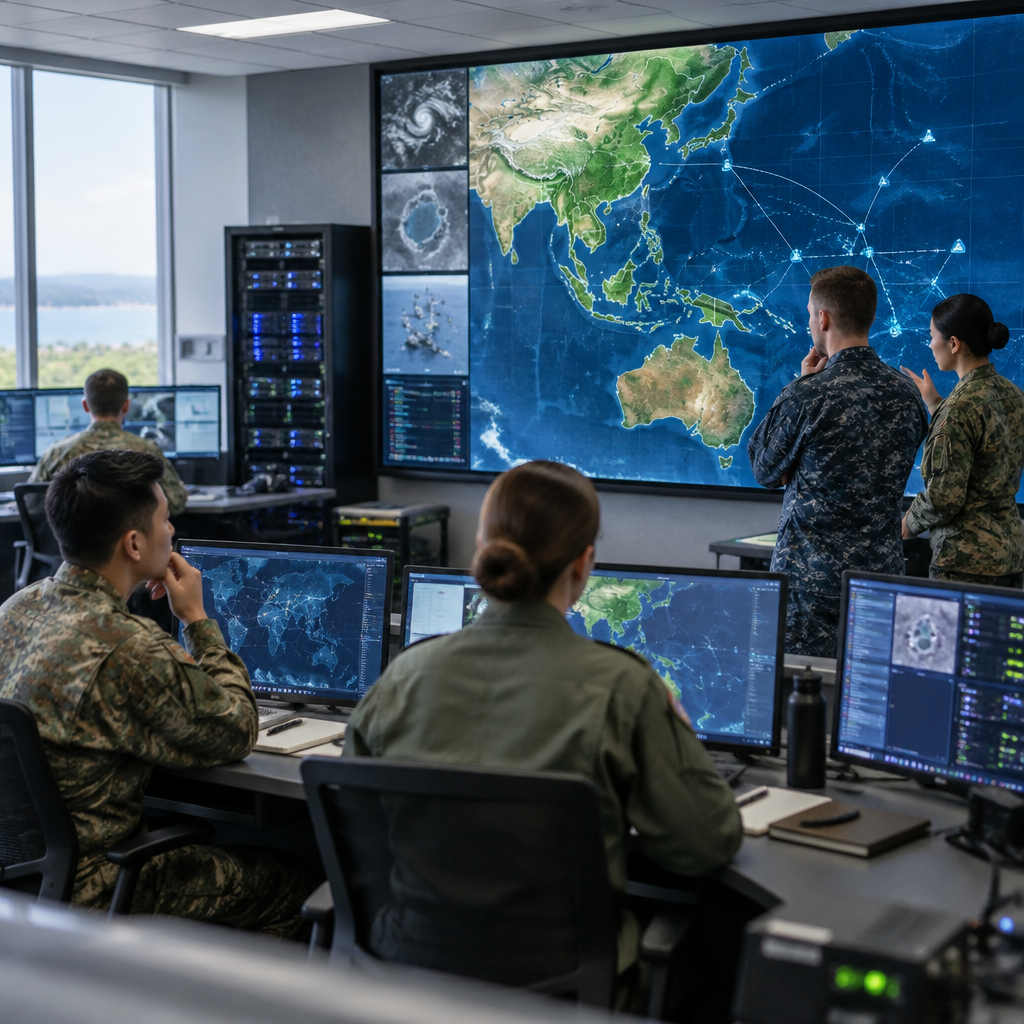
AFCEA’s TechNet Indo‑Pacific 2026: a convening of concern
At AFCEA’s TechNet Indo‑Pacific 2026, senior military leaders and defense experts gathered to outline a set of interconnected risks that now define the region’s digital battlespace. Breaking Defense summarized those conversations in an eBook that collects the conference coverage, flagging technologies, strategies and partnerships that participants said will shape military readiness and deterrence across the Indo‑Pacific.
Persistent electronic warfare threats on the Korean Peninsula
Panelists singled out the Korean Peninsula for a persistent electronic warfare problem set. The conference presentations and discussions identified electronic warfare as an active, ongoing challenge — a domain where interference, jamming and other measures can degrade communications and sensor performance, complicating command, control and situational awareness for forces operating in the region.

This site is the portfolio.
OSINTSights runs on Cloudflare Workers, D1, R2, and Vectorize, with an AI pipeline on Hetzner ARM. Nubivance designed, built, and operates it. We do the same for clients.
See what we buildThe evolving Taiwan conflict timeline
Speakers at the event also discussed an evolving Taiwan conflict timeline. That evolution, as framed in the conference coverage, changes requirements for preparedness: planners and systems architects must now design networks and defensive postures that can operate under compressed timelines and under contestation, rather than assuming long warning periods or uncontested information flows.
Stronger regional data‑sharing capabilities
A common refrain at TechNet was the need for expanded regional data‑sharing capabilities. Multinational information sharing was presented not as a political nicety but as a tactical and operational necessity — a means to accelerate decision cycles, align intent among partners and maintain deterrence. Participants emphasized that without robust channels and agreements to exchange data, allied forces risk slower responses and degraded collective situational awareness.
Resilient networks, cyber defense and multinational information sharing
Resilience in networks and hardened cyber defenses emerged as the connective tissue of the conference narrative. The discussions linked three priorities: networks that remain functional under attack or disruption; cyber defenses that reduce adversary freedom of maneuver in the digital domain; and multinational information sharing that leverages allied capacity to detect, attribute and respond to threats. The eBook pulls together those themes, highlighting the technologies, strategies and partnerships conference speakers identified as central to securing the Indo‑Pacific digital battlespace.
How US and allied forces, defense technologists, and regional policymakers are responding
- US and allied forces: The conference framed military forces as prioritizing resilient communications and shared situational awareness to sustain readiness and deterrence in contested spaces like the Korean Peninsula and around Taiwan.
- Defense technologists and security teams: Technologists were urged to focus on systems that sustain operations under electronic warfare and cyber pressure, and on interoperability that supports rapid multinational information exchange.
- Regional policymakers: Policymakers were depicted as needing to enable data‑sharing frameworks and partnerships so that operational actors can exchange the information required for timely collective decisions.
TechNet Indo‑Pacific 2026 did not offer a single technological silver bullet. Instead, the conference cast the challenge as systemic: resilience, defense and cooperative information flows must be advanced together if forces are to deter and, if necessary, operate effectively across a fast‑moving Indo‑Pacific security environment. Breaking Defense’s eBook collects those assessments and the related discussions for readers looking to understand how military and civilian communities are aligning strategy, technology and partnership to meet the region’s digital challenges.