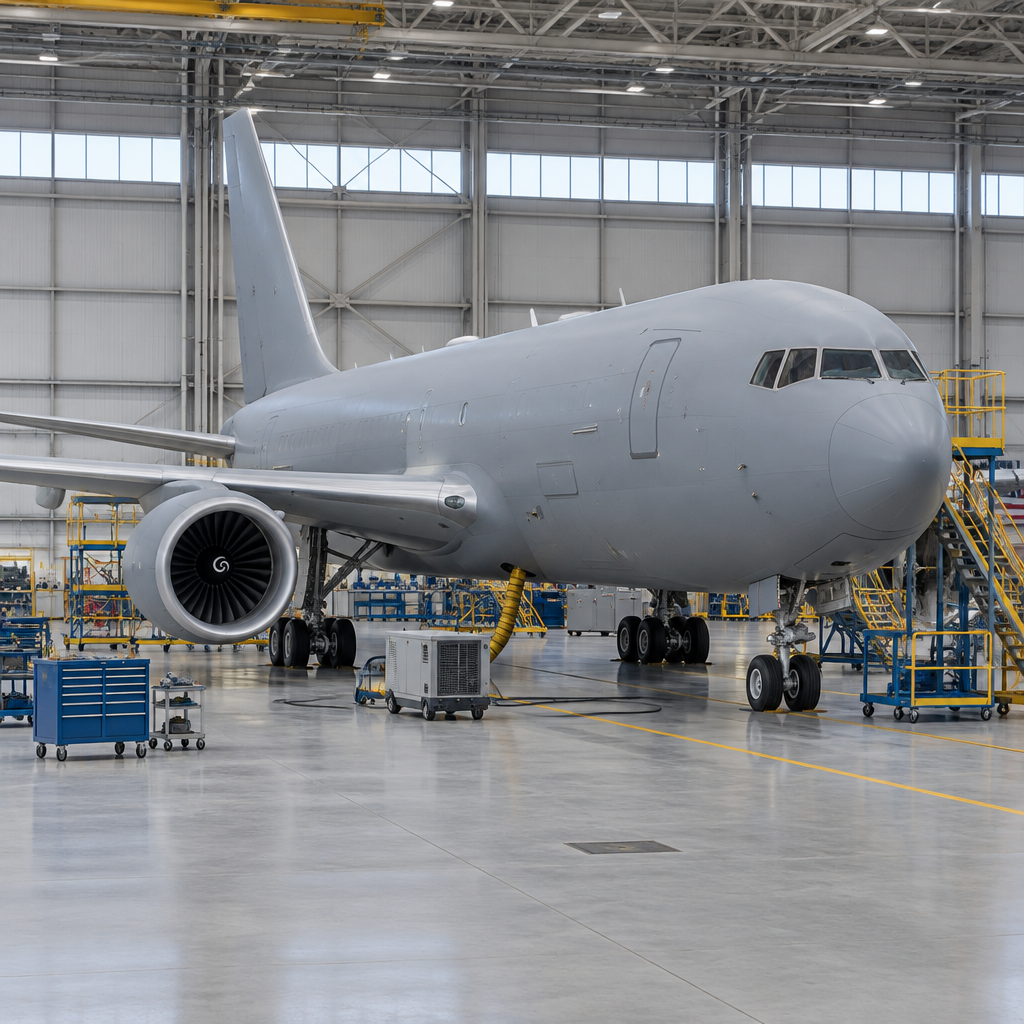
“We’re grateful for the trust the U.S. Air Force continues to place in our team,” Jake Kwasnik, KC-46 program vice president at Boeing, said yesterday.
USAF orders final 15 KC-46s under the 2011 contract
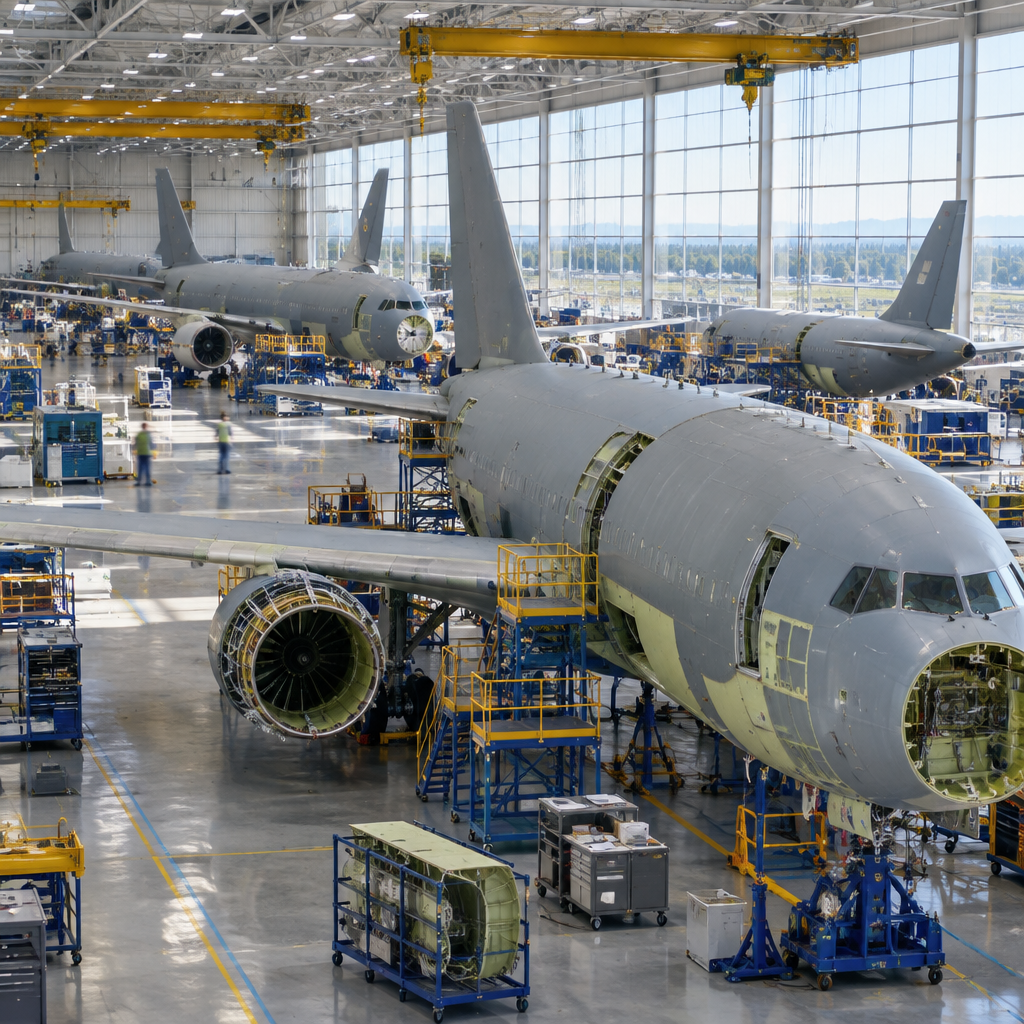
The U.S. Air Force and Boeing announced a new production deal for 15 KC-46A Pegasus tankers valued at just over $2.81 billion — the final order placed under the original 2011 fixed-price contract. Work on these aircraft is currently expected to be complete by June 30, 2030. The acquisition closes a chapter on the original procurement line even as the Air Force contemplates additional Pegasus purchases.
Boeing says 203 Pegasus tankers are now “on contract or in service globally.” That total includes 116 delivered to the U.S. Air Force to date out of a planned fleet of 188 aircraft, plus six aircraft for Japan and two for Israel. The first KC-46 was delivered to the U.S. Air Force in 2019; the type’s first flight was in 2015. The first KC-46 for Japan made its maiden flight in 2022, and the first tanker for Israel arrived there earlier this year.
Remote Vision System (RVS) problems and the RVS 2.0 schedule slip
Central to the KC-46’s lingering technical troubles is the Remote Vision System (RVS) used by boom operators to connect with receiving aircraft. The current hybrid 2D/3D RVS has “presented particular issues for years,” and the Air Force has acknowledged that boom operators have relied on established workarounds and their own experience to make safe connections. KC-46 boom operators perform their tasks from stations in the aircraft’s main cabin — a departure from earlier tankers where operators worked from the rear of the airplane.
Boeing has been developing an entirely new RVS 2.0. In June, Boeing announced it had completed the first round of flight testing of that system, but the original goal to begin fielding the replacement in October 2025 has slipped into 2028.

This site is the portfolio.
OSINTSights runs on Cloudflare Workers, D1, R2, and Vectorize, with an AI pipeline on Hetzner ARM. Nubivance designed, built, and operates it. We do the same for clients.
See what we buildBoom hardware, production quality, and Boeing’s financial exposure
The KC-46 has faced multiple hardware and quality-control issues. Boeing continues work to resolve problems with the boom itself — notably stiffness that has created particular problems when refueling A-10 Warthog jets — as well as other deficiencies and production-line quality troubles. Under the Air Force’s original firm, fixed-price contract, Boeing has absorbed many of the costs of fixing those issues. “As of January, the company had lost more than $8 billion on the Pegasus program,” the reporting notes.
Advanced Tanker Systems (ATS), alternatives, and survivability concerns
The Air Force is simultaneously conducting a review of next-generation aerial refueling under the Advanced Tanker Systems (ATS) effort, which has supplanted a previous Next Generation Air-refueling System (NGAS) program that itself replaced concept work known as KC-Z. ATS has prompted examination of a wide range of concepts — crewed and uncrewed, stealthy designs, and blended-wing-body proposals. The story cites public concept work from Lockheed Martin’s Skunk Works and a blended-wing-body rendering from JetZero as examples of the types of ideas under consideration.
Air Force leaders have been explicit about trade-offs. “A brand-new, clean-sheet design is incredibly expensive,” Air Force Chief of Staff Gen. Kenneth Wilsbach told Aviation Week, adding that making a large airplane stealthy “is just insanely expensive to do, and it’s hard.” Wilsbach said the service faces a cost-benefit choice: buy a small number of very advanced platforms or continue with relatively proven technology.
Lieutenant General Daniel Tulley, head of Air Mobility Command, told Aviation Week that continuing KC-46 production “could be a KC-46,” while adding “I recognize it’d be easy to continue production of the KC-46 but not if it doesn’t meet the requirement.” The Air Force has said it will not finalize the planned purchase of 75 additional KC-46s — which would raise the service’s planned Pegasus fleet from 188 to 263 — until RVS 2.0 and other issues are resolved.
The Air Force is also pursuing upgrades across its tanker fleets: new communications and networking capabilities; plans to integrate a hard-kill interceptor system through Platform-Agnostic Kinetic Self-Defense (PAKS-D); and funding for artificial intelligence–driven autonomous capabilities intended to reduce crew workload, increase operational efficiency, and raise safety margins. Those developments are described as potentially opening pathways to operating KC-135s and KC-46s with skeleton crews or even no crews at all. Future drones, including Collaborative Combat Aircraft (CCA) types, are also expected to contribute to tanker defense and protection of high-value airlift and surveillance assets.
The reporting also notes persistent operational pressure on tanker fleets and a stressed demand picture: the Air Force’s existing tankers face growing threats in the air and on the ground, a reality the article says has been “reinforced by the war with Iran and other conflicts in recent years.” Officials have warned about aerial refueling capacity gaps in recent years, and the planned interim purchase of 75 KC-46s is intended to help address those shortfalls — timing and delivery remain unclear. The Air Force, Navy, and Marine Corps have also expanded use of contractor-owned and operated tankers to meet non-combat refueling needs and reduce demand on organic assets.
What this means for the Air Force, Boeing, and allied operators
- Air Force: Will keep interim options on the table while ATS explores what the service “needs,” and will hold final decisions on the 75 additional KC-46s until RVS 2.0 and other deficiencies are fixed.
- Boeing: Must finish RVS 2.0 development and resolve hardware and quality-control problems while absorbing further costs under the original fixed-price contract after having “lost more than $8 billion” as of January.
- Allied operators and international customers: Will see continued deliveries — Japan and Israel are already recipients — but international fleet expansion and operational employment will hinge on Boeing fixing RVS and other defects.
The Air Force has placed the last KC-46s under the original 2011 contract even as it keeps open the option to buy many more Pegasus tankers — provided Boeing can fix systems that remain central to safe refueling operations. The program now sits at a crossroads: a contracted production line that is closing under a legacy deal, an RVS upgrade slipping into 2028, and an ATS review that could point the service toward either continued KC-46 buys or substantially different tanker concepts.
https://www.twz.com/air/final-kc-46-tankers-under-original-contract-with-boeing-ordered-by-usaf