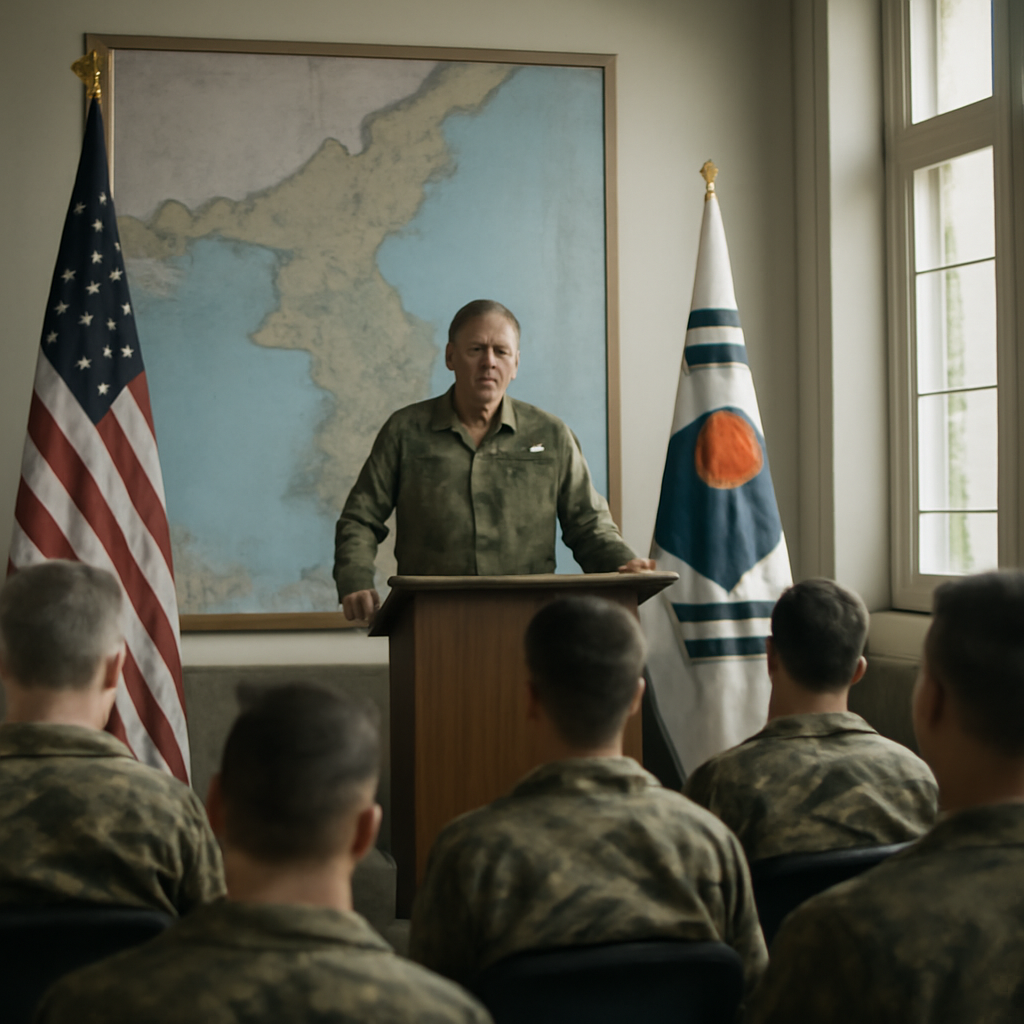
"OPCON transfer has thus passed beyond a political question of changing a command-authority title – it has become a matter of military necessity, and the essential rite of passage for the qualitative maturation of the South Korea-U.S. alliance," the article argues.
A transformed strategic reality and the 2026 NDS
The security environment on the Korean Peninsula has shifted in ways that the article describes as fundamental. North Korea’s nuclear and missile programs remain central, but the probability that a Korean contingency would occur in isolation has fallen: scenarios now routinely include simultaneous crises in the Taiwan Strait, clashes in the South China Sea, or even a conflict involving Russia. The analysis notes concrete signs of deeper military linkage between Pyongyang and Moscow, saying that "North Korea has provided military logistics support to Russia and bilateral military cooperation has deepened."
The 2026 National Defense Strategy (NDS) is cited as explicit about the U.S. orientation: it designates China as "the most consequential strategic competitor" and signals a U.S. structural reorientation that concentrates U.S. military power on the Indo‑Pacific, especially deterrence in the Taiwan Strait. The article frames that reorientation as structurally linked to handing conventional responsibility for the Korean Peninsula subtheater to South Korea while the United States focuses on nuclear deterrence and strategic mobility.
Operational tempo, combined command, and the F‑CFC proposal
More than 70 years of combined defense practice have produced a dense institutional architecture—treaties, procedures, directives—that is now, the article argues, both an alliance strength and a potential liability. In particular, the dual-command arrangement in which the ROK Joint Chiefs command in peacetime and the Combined Forces Command (CFC) commands in wartime creates the risk of a break in command continuity "at precisely the most critical moments of crisis escalation." Strategic wargames, the piece notes, have repeatedly identified the complex command structure as a problem.
To remove that vulnerability, the article presents the Future Combined Forces Command (F‑CFC) design, under which a ROK four‑star general would exercise consistent command authority from peacetime through wartime. That seamless command, it says, would resolve "administrative delays that are out of sync with the tempo of the battlefield"—especially in scenarios of strategic surprise or rapid localized provocation.

The cyber insurance questionnaire just landed. Now what?
SOC 2, HIPAA, insurance renewals - someone has to own security strategy. Nubivance provides fractional CISO leadership without the full-time salary.
Get a security leadDoctrine and DOTMLPF‑P: why structure matters
The piece frames OPCON transfer as an organizational imperative under the DOTMLPF‑P rubric (Doctrine, Organization, Training, Materiel, Leadership, Personnel, Facilities, Policy). Military innovation, it argues, requires comprehensive change across those elements; structure—organization and doctrine—cannot be left unchanged while other elements are upgraded. The article invokes U.S. Army Doctrine Publication 3‑0’s principles—Agility, Convergence, Endurance, and Depth—as the test for what OPCON transfer must enable.
Put simply, the author contends, genuine integration of multi‑domain capabilities and agile decision‑making depend on a seamless command architecture that carries from peacetime into wartime.
Kill Chain, KAMD, KMPR—and the speed of decision
The analysis foregrounds South Korea’s three‑axis system—Kill Chain, Korea Air and Missile Defense (KAMD), and Korea Massive Punishment and Retaliation (KMPR)—as the backbone of independent deterrence described in South Korea’s Defense White Paper. The piece stresses that the system’s effectiveness depends on decision speed: "Kill Chain aims to reduce the time from target identification to strike decision to within minutes." That strike decision, it asserts, must be made by a commander with the best real‑time picture—something the author says is constrained if wartime OPCON remains vested in the CFC.
The article also connects conventional operations to U.S. extended deterrence through the Conventional‑Nuclear Integration (CNI) concept and the Nuclear Consultative Group (NCG). It argues that institutionalizing ROK operational primacy makes consultations operationally meaningful and that a Korean-led wartime command changes the political framing of any conflict—shifting it toward sovereign self‑defense rather than a U.S.‑led campaign.
What this means for the ROK Armed Forces, the United States, and deterrence
- ROK Armed Forces: The article frames OPCON transfer as the "essential rite of passage" for a matured military—enabling theater‑level command, integration of independent ISR into rapid strike decisions, and direct alignment of military choices with Korean political objectives.
- The United States / USFK: The piece presents the transfer as structurally necessary for the United States to reorient USFK into highly mobile forces operable across the Indo‑Pacific while South Korea assumes primary conventional defense responsibility in the peninsula subtheater.
- Deterrence dynamics: By placing operational control with Seoul, the article argues, the political calculations of potential third‑party actors change—"the framing of any conflict shifts"—and Seoul gains direct control over escalation timelines, signaling, and the balance between offense and diplomatic space.
The article closes with a pointed caution: institutions must evolve as capabilities grow, citing the ROK‑U.S. Missile Guidelines revisions (1979, 2001, 2012, 2017, 2021) as precedent. It warns that a transfer executed only after a wider regional crisis erupts will occur "under the worst possible conditions." The decisive variables, it says, are the granular details—the scope of authority for a future ROK four‑star commander, the integration level of C4I, and the design of post‑transfer training and assessment—that will determine whether OPCON transfer secures the agility the modern battlespace now requires.