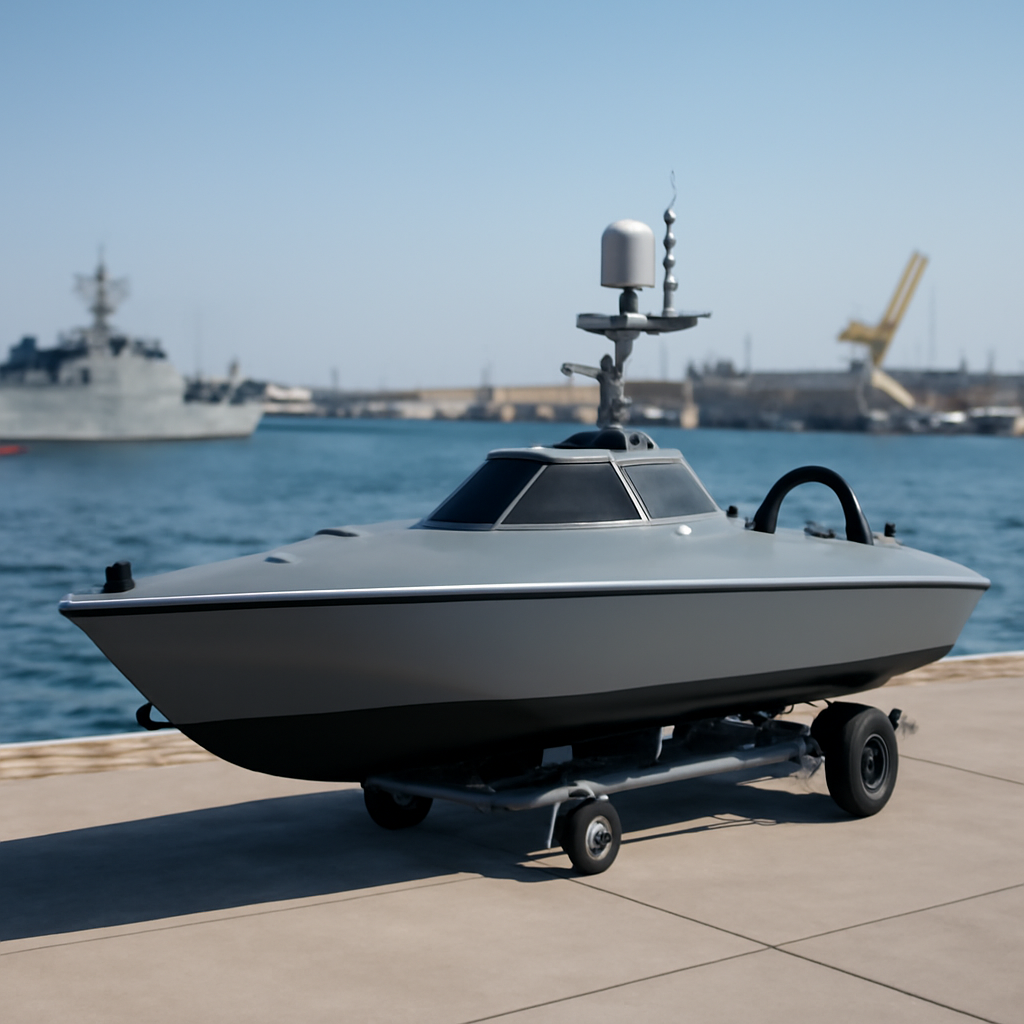
On 13 July 2026, U.S. Central Command announced that three Saronic Corsair unmanned surface vessels had struck submarine and ship‑maintenance facilities at Iran’s Bandar Abbas Naval Base — the first acknowledged American combat use of a one‑way attack sea drone.
CENTCOM’s Bandar Abbas strike and the Saronic Corsair
The Corsair involved in the strike is a 24‑foot unmanned surface vessel with a 1,000 lb payload capacity, a range exceeding 1,000 nautical miles, and a top speed above 35 knots. Saronic describes the platform as attritable, networked, and configurable for ISR, maritime security, logistics, electronic warfare, and strike missions. In December 2025 Saronic won a $392 million U.S. Navy production contract, and U.S. forces had already used Corsairs for surveillance, security, and a June rescue of two U.S. Army aviators from a downed AH‑64 Apache before the Bandar Abbas strike.
Low‑cost, scalable weapons: the sea joins the trend
The Bandar Abbas episode illustrates a wider shift toward affordable, scale‑friendly munitions. The source links the Corsair to a family of low‑cost approaches that includes aerial one‑way loitering munitions (the U.S. LUCAS program, analogues to Iran’s Shahed and Russia’s Geran), the Extended Range Attack Munition (ERAM), and the Precision Strike Missile (PrSM). The logic is plain in the source: expendable, cheaper systems can be fielded in numbers that overwhelm defenders, absorb high‑cost interceptors, and preserve high‑value platforms. In maritime terms, a small boat that can place a warhead beside a defended facility achieves access without risking a crew or a major warship.

Audit-ready is a season. It shouldn't be.
Evidence in spreadsheets, controls drifting between audits, frameworks multiplying on flat headcount. Nubivance runs continuous compliance on Rapid7 Cyber GRC - SOC 2, HIPAA, ISO 27001, PCI, CMMC.
End the scramblePakistan’s unmanned maritime programs today
The Pakistan Navy has active programs across surface and subsurface unmanned systems. Woot‑Tech and the National Research and Development Institute’s Platform Design Wing jointly developed a five‑ton USV capable of 40 knots with EO/IR, a laser rangefinder, obstacle‑avoidance radar, satellite navigation, and twin outboard engines; the project moved from requirement to sea trials within two months and was selected for ISR. Private firms are also experimenting: Beyond Koncept markets the Muhassir for ISR, and Stingray Technologies has displayed an armed USV for maritime interception. Underwater, the Israr AUV is around 3 m long, 0.3 m in diameter, can reach 7 knots, operate at depths to 300 m, and has a demonstrated four‑hour endurance for tasks like seabed mapping, harbour surveillance, and mine countermeasures — a demonstrator rather than a persistent picket.
Counter‑USV and counter‑AUV requirements for Karachi, Gwadar, and Ormara
The source stresses that the exacting problem for the Pakistan Navy is not merely detection but classification and timely decision‑making. Coastal radars will see small boats, but distinguishing a hostile one‑way attack USV from hundreds of fishing craft in approaches to Karachi, Ormara, and Gwadar — early enough to engage — is the harder task. A layered defensive architecture is therefore necessary: coastal radars, EO sensors, electronic support measures, patrol UAVs, harbour sonars, hydrophones, magnetic sensors, and seabed arrays for detection and classification; EW to disrupt navigation and command links; physical barriers such as nets and booms; and kinetic responses including remote‑controlled guns, small guided weapons, armed UAVs, helicopters, interceptor USVs, and defensive AUVs. The source cites Türkiye’s TORK anti‑torpedo torpedo as a model for an underwater hard‑kill capability that could be adapted into an interceptor for hostile AUVs.
What this means for the Pakistan Navy, Alsons Group, and Naval Headquarters (NHQ)
- Pakistan Navy (PN): The PN has a clear operational rationale to organize current experiments into a structured family of reusable ISR USVs and expendable one‑way attack boats. Reusable ISR/ELINT USVs could extend sensor reach off Sir Creek, Karachi, Gwadar, the Makran coast, and the northern Arabian Sea; a separate OWA fleet would layer into PN A2/AD posture alongside submarines, ASCMs, naval aviation, and shore‑based weapons.
- Alsons Group and domestic industry: Attritability requires domestic manufacture of hulls, control systems, communications, and payload integration. The source notes Alsons Group’s piston‑engine work for airborne applications as a plausible route to localize USV propulsion, mirroring how many foreign USVs use commercial outboard piston motors. Imported systems remain relevant for demanding, low‑volume roles, with China and Türkiye identified as potential suppliers for larger AUVs and specialized subsystems.
- Naval Headquarters (NHQ): The source argues NHQ should revisit platform procurement strategies in light of USV/AUV threats. High‑cost surface warships face preexisting conventional risks; the emergence of sea drones suggests NHQ should reevaluate whether such ships can continue as conventional warfighting factors or if surface forces should be reframed toward peacetime roles while accepting persistent unmanned threats from state and non‑state actors.
Bandar Abbas did not showcase a massive explosive load so much as access: the ability to place a warhead alongside a defended target at low cost. For Pakistan that is both an invitation and a warning — an operational blueprint for what to build and a reminder that the same technology will be aimed back at coastal ports, ships, and infrastructure unless detection, classification, decision timelines, and industrial scale are addressed.