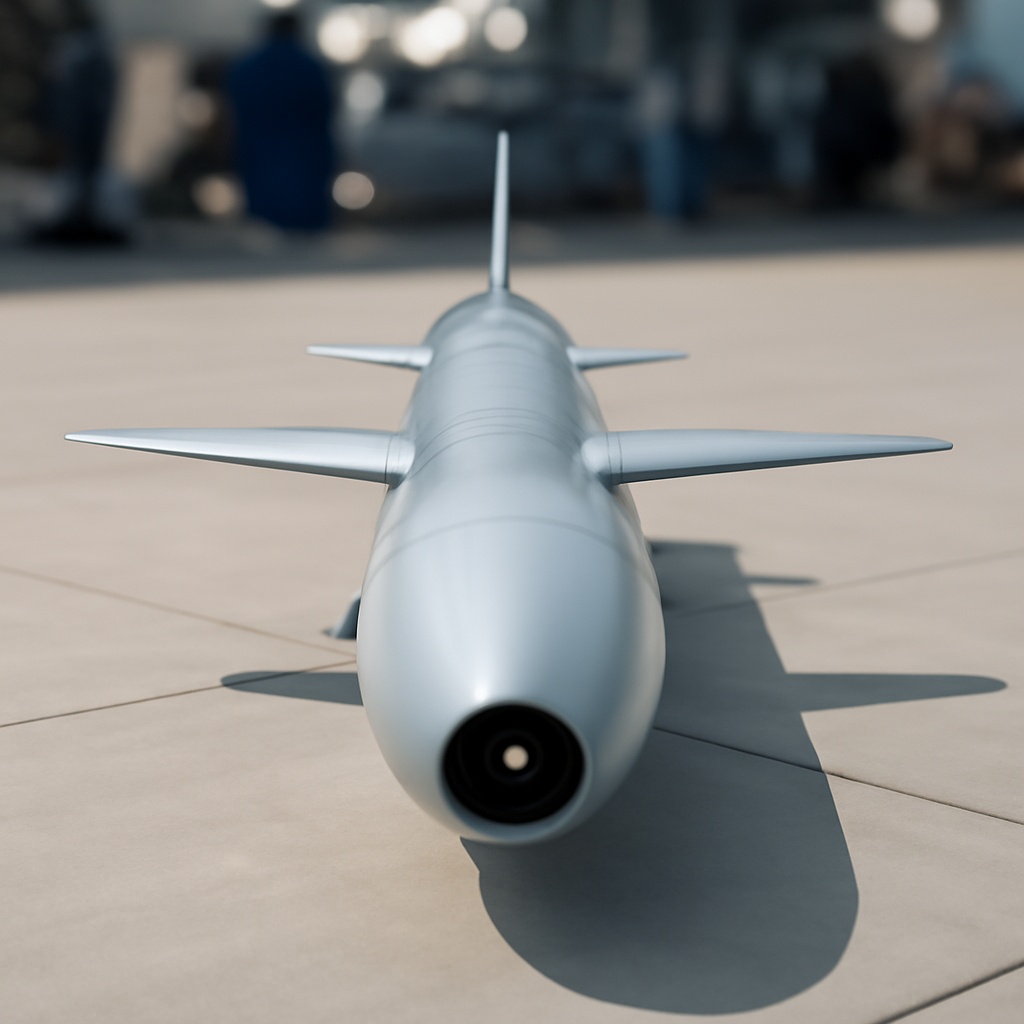
3.2 kN of thrust — the figure at the center of Türkiye’s announcement this week that the Turkish Air Force is receiving the SOM-B1T, a version of the SOM-B1 cruise missile fitted with Kale’s KTJ-3200 turbojet.
Türkiye’s Ministry of National Defence: acceptance activities and delivery
The Ministry of National Defence said acceptance activities for a quantity of SOM-B1T cruise missiles will run at Roketsan from 13 to 17 July, ahead of delivery to the Turkish Air Force. The ministry did not state a count; its notice referred only to a “quantity of munitions.” Roketsan produces the SOM family while TÜBİTAK SAGE designed the original weapon for strikes against high-value land targets.
Kale Jet Engines’ KTJ-3200 turbojet: technical specifics and claims
The KTJ-3200 that powers the SOM-B1T produces 3.2 kN of thrust, weighs 50 kg and measures 63 cm long by roughly 30 cm across. Kale built it around a four-stage axial compressor, an annular combustion chamber, and a single-stage turbine. The engine can be started from sea level up to 6,000 m and is rated to operate up to Mach 0.95. Kale describes the KTJ-3200 as “ITAR-free,” built without American-controlled content, and has marketed the engine on lower fuel burn and longer service life rather than increased range.

Audit-ready is a season. It shouldn't be.
Evidence in spreadsheets, controls drifting between audits, frameworks multiplying on flat headcount. Nubivance runs continuous compliance on Rapid7 Cyber GRC - SOC 2, HIPAA, ISO 27001, PCI, CMMC.
End the scrambleSOM-B1 missile: performance, seeker change, and family variants
Roketsan’s datasheet lists the SOM-B1 at roughly 4 m long and 600 kg, carrying a 230 kg high‑explosive fragmentation warhead to a range of 250 km while cruising at about Mach 0.94. Guidance combines inertial and satellite inputs with terrain‑referenced navigation and automatic target acquisition; the weapon flies a terrain‑hugging or sea‑skimming profile. What separates the B1 from the earlier SOM‑A is the seeker: an imaging infrared head that lets the missile identify its target in the terminal phase and an automatic target detection mode that permits completion of the engagement without a human in the loop.
The SOM family also includes the SOM‑B2, which replaces the blast‑fragmentation warhead with a tandem penetrator, and the SOM‑J, a lighter reduced‑observability variant sized for the F‑35’s internal bay. Roketsan lists the F‑4 and F‑16 as the missile’s launch platforms. The missile was first shown in public at Çiğli Air Base in İzmir on 4 June 2011; an F‑16 fired the first KTJ‑3200‑powered SOM‑B1 in 2025, with the Industry and Technology Minister Mehmet Fatih Kacır saying the missile hit a static target with a terminal dive.
Roketsan’s industrial footprint and the sovereignty argument
Roketsan opened new missile integration, warhead and fuel plants in April, an investment President Recep Tayyip Erdoğan valued at $3 billion; the company announced deliveries of the SOM alongside Tayfun, Atmaca, Çakır and Siper to the Turkish armed forces at the opening. Serial deliveries of the KTJ‑3200 began in the second half of 2022, and Kale reported a foreign sale in April 2025 when it sold the KTJ‑3200 to Brazil for the MANSUP‑ER anti‑ship missile.
The central operational change is not range: Roketsan’s current datasheet still advertises 250 km for the SOM‑B1, the same figure the weapon carried when it used the French TR‑40 turbojet from Microturbo (now part of Safran). Neither the ministry nor Kale has claimed a longer reach after the engine swap. The gain Kale and Turkish officials highlight is political and logistical sovereignty — a cruise missile “with no French propulsion inside it cannot be held up by a French export licence,” the reporting notes — a meaningful consideration for a country that has “spent years on the wrong end of other people’s export controls,” including its removal from the F‑35 program and the CAATSA sanctions Washington has only now moved to lift.
What this means for the Turkish Air Force, Kale Jet Engines, and international buyers
- The Turkish Air Force: Will receive SOM‑B1T missiles following the 13–17 July acceptance activities and gains an inventory item that, on paper, is free of French propulsion restrictions while retaining the same published 250 km range and terminal seeker capabilities.
- Kale Jet Engines: Has placed the KTJ‑3200 into operational service on at least two Roketsan products (SOM‑B1 and the Atmaca anti‑ship missile) and demonstrated exportability with the April 2025 sale to Brazil; Kale markets the engine on fuel efficiency and service life.
- International buyers and export control observers: The substitution of a domestic turbojet removes a named European propulsion supplier from the chain, which, per the reporting, reduces vulnerability to foreign export licences even though missile range and seeker performance are unchanged in published datasheets.
For now, the concrete change is straightforward: Türkiye’s SOM‑B1T pairs an existing air‑launched cruise missile airframe and seeker suite with a domestically produced, ITAR‑free turbojet. The technical performance figures — 250 km range, a roughly 230 kg warhead and Mach 0.94 cruise — remain as listed by Roketsan, while the industrial shift alters who controls the throttle on future deliveries and exports.