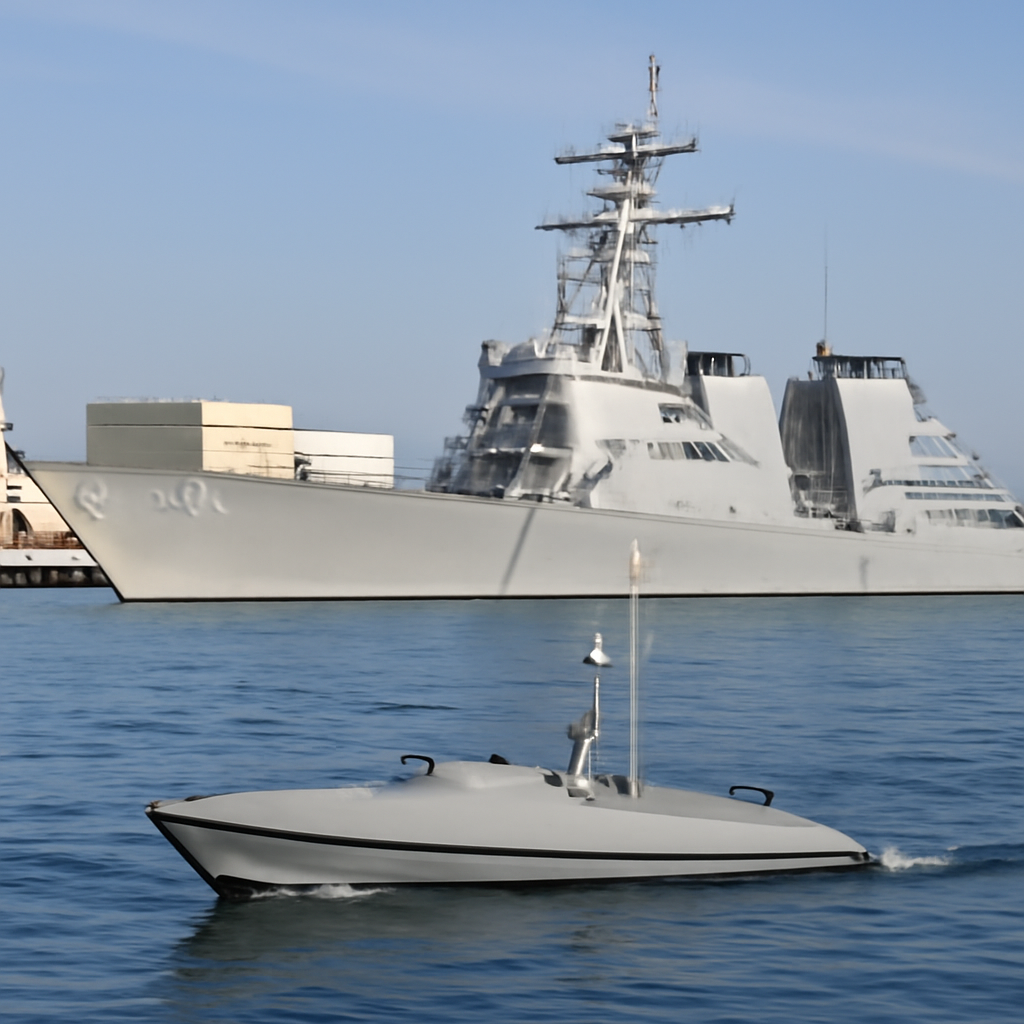
"It was the first American combat use of sea drones," CENTCOM announced on 13 July, describing strikes a day earlier that targeted a submarine and ship maintenance facility at Iran’s Bandar Abbas Naval Base.
The CENTCOM account of the 12–13 July strikes
CENTCOM said three Saronic Corsair unmanned surface vessels (USVs) struck a raised dock holding what appears to be a submarine at Bandar Abbas on 12 July, releasing unclassified video that shows a small craft closing on the berth and then detonating. The command framed the strikes as degrading Iran’s ability to continue attacking commercial shipping through the Strait of Hormuz. CENTCOM also said its forces hit “dozens of targets” across southern Iran that day, naming air-defence systems, coastal radar sites, missile and drone assets, and small boats among the targets. Qeshm Island was reported as one of the areas struck.
Saronic Corsair: platform, contract, and origin
The Corsair is built by Saronic, a Texas-based firm. According to the account, the USV is a 24-foot autonomous surface vessel capable of carrying a 1,000 lb payload over 1,000 nautical miles and reaching speeds above 35 knots. The U.S. Navy placed the design on a $392 million production contract in December 2025, awarded through the Defense Innovation Unit. CENTCOM traces the Corsair’s lineage to the Pentagon’s Replicator program.

Audit-ready is a season. It shouldn't be.
Evidence in spreadsheets, controls drifting between audits, frameworks multiplying on flat headcount. Nubivance runs continuous compliance on Rapid7 Cyber GRC - SOC 2, HIPAA, ISO 27001, PCI, CMMC.
End the scrambleTask Force 59, fielding, and prior missions
Task Force 59—the unmanned systems unit of U.S. Naval Forces Central Command (NAVCENT) and the U.S. 5th Fleet—operates the Corsair in the region and began fielding it in late March. CENTCOM noted that, until this strike, the task force had used the boats for surveillance, maritime security, and, in June, the recovery of two U.S. Army aviators after an AH-64 Apache went down in the Gulf of Oman. The command separated that June rescue from Sunday’s strike, emphasizing the latter as the first combat employment of the type. The report also links the Navy’s earlier retirement of its last Gulf minesweepers to a broader plan to shift mine countermeasures to unmanned systems.
LUCAS drones and the wider strike wave
The sea drones were part of a larger, multi-domain operation. Fighter aircraft, naval vessels, and one-way attack aerial drones took part alongside the Corsairs. CENTCOM identified the one-way attack aerial drones used in the operation as LUCAS, a low-cost American system reverse-engineered from Iran’s Shahed-136; CENTCOM first used LUCAS in February. The command said the combined attacks against coastal and air-defence targets and maritime infrastructure formed a coordinated effort across southern Iran.
What this means for the U.S. Navy, Iran’s naval forces, and regional navies
- For the U.S. Navy: The Corsair’s combat employment converts a program of record—fielded by Task Force 59 since late March and under a $392 million production contract—into an operational strike tool, validating the shift the Navy has been making from crewed Gulf minesweepers toward unmanned systems for both surveillance and kinetic tasks.
- For Iran’s naval forces: Bandar Abbas, described as the headquarters for a large part of Iran’s navy and previously struck during Operation Epic Fury (which opened on 28 February), now faces an additional dimension of vulnerability from small, high-speed autonomous surface craft designed to deliver a 1,000 lb payload.
- For regional navies and procurement planners: The CENTCOM employment arrives as other navies move toward similar capabilities—Turkey ordered 100 expendable kamikaze USVs and Pakistan is developing three combat-capable USV designs—suggesting a near-term regional trend toward expendable, low-cost offensive surface drones.
Timing, public messages, and open follow-ups
CENTCOM has not explained why the Corsairs, which had been in theatre for roughly three and a half months, were committed on 12 July after a period when Iranian coastal and naval targets were frequently available. Separately, the source records that Trump said the United States would reinstate its naval blockade of Iranian ports and keep the Strait of Hormuz open “with or without Tehran.” Those public statements and the timing question together leave a narrow set of concrete facts and several operational questions: why the delay in committing the Corsairs, what measures will follow to secure commercial shipping, and how Iran and other regional navies will respond to an acknowledged U.S. capability now used in combat.
The CENTCOM video and the details of the Corsair’s design and contract turn what has been until now a programmatic and experimental asset into a demonstrated kinetic tool. Whether this single combat employment signals a durable shift in naval doctrine, an escalatory step in the present campaign, or simply a one-off operational choice will depend on follow-up actions—questions the public record set out by CENTCOM and the other statements cited does not yet answer.



