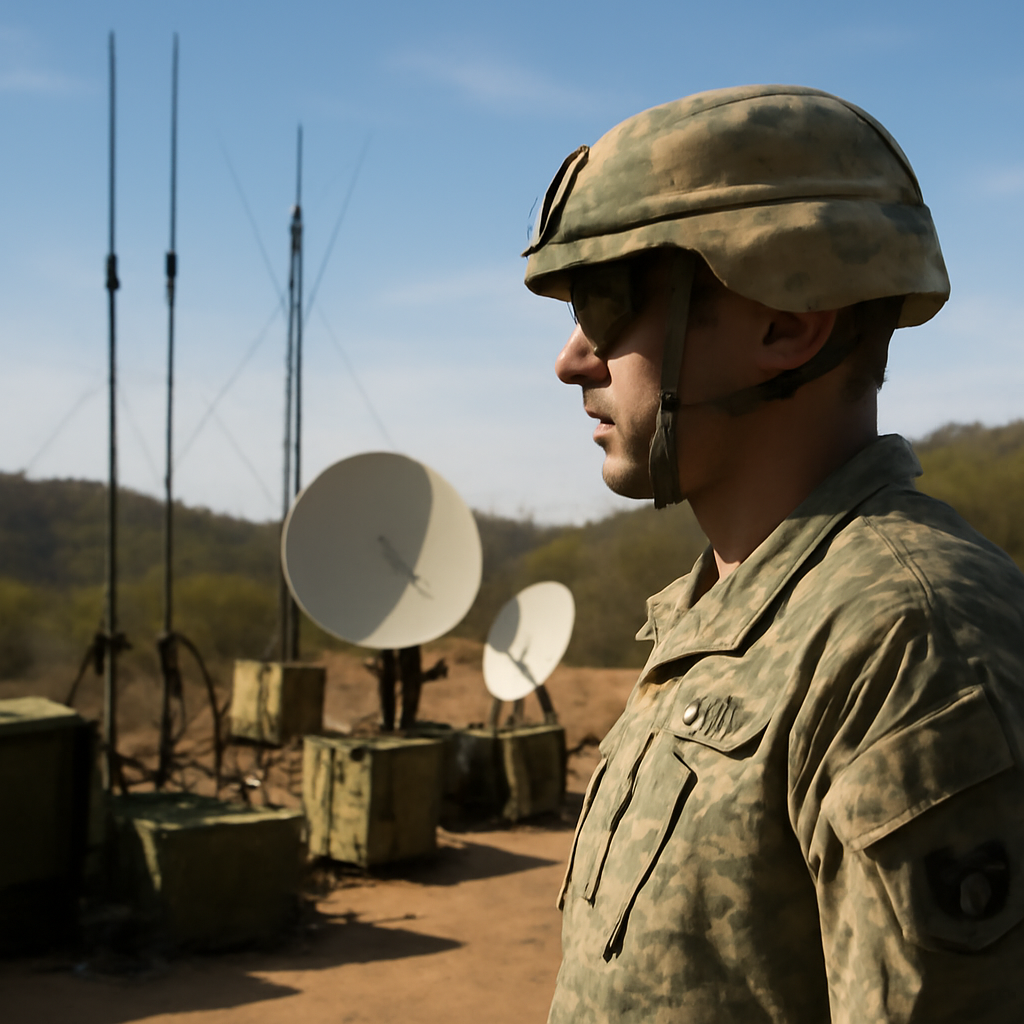
"a great source of military advantage, and as a result, it’s potentially a great source of military vulnerability." — Major General Greg Novak, commander, Australian Defence Force Space Command
Major General Greg Novak on the operational framing and resilience
At ASPI’s 2026 Defence Conference in June, Major General Greg Novak underlined a central tension: space delivers decisive military advantage, but that advantage also creates vulnerability. Novak said the Australian government does not adopt the "warfighting domain" lexicon, adding that treating space as an "operational domain" better reflects the current policy stance. He emphasised practical resilience design: "we’ve got no single points of failure" and systems should be able to "absorb losses and disruption and have a gradual degradation rather than a complete turn off of services with catastrophic effect."
Novak laid out three complementary sources of mitigation that Canberra should draw on: Australian national space capabilities, cooperation with partners, and the commercial sector. He warned that failure to build such resilience could expose Australia to not only a "day without space" but "potentially weeks or months without access to critical space services."
Melissa De Zwart on law, regulation and new commercial actors
Adelaide University space law expert Melissa De Zwart focused on the legal and regulatory challenge posed by a rapidly changing space economy. She pointed to the "huge number of commercial actors in space … who are undertaking activities for or on behalf of governments, on behalf of military," many of whom "are very new, and many don’t come from a defence contracting background." De Zwart warned that much of today's commercial orbital architecture "was new and wasn’t designed to be hardened against attack," and stressed the need to strengthen national space expertise because "this is a technology and domain we are still learning to work in."
De Zwart also noted a shifting mix of activity in orbit — commercial providers are supplying many essential services that modern societies rely on, with the role of private actors expected to expand. She framed regulation and law as essential tools to manage that "radical transformation" in use and ownership of space assets, including emerging concepts such as placing data centres for AI in orbit: "as space becomes more valuable, it becomes more vulnerable. … Now we’re talking about putting up things like data centres for AI in space."

Audit-ready is a season. It shouldn't be.
Evidence in spreadsheets, controls drifting between audits, frameworks multiplying on flat headcount. Nubivance runs continuous compliance on Rapid7 Cyber GRC - SOC 2, HIPAA, ISO 27001, PCI, CMMC.
End the scrambleMotoya Nakamura and the Australia–Japan industrial proposition
Motoya Nakamura, head of the Satellite Constellation Project Group at IHI Corporation, outlined concrete industrial cooperation between Japanese companies and Australia. He suggested Australia’s "vast land area" makes it "a very promising candidate for a launch site," while Japan brings "good capability for the rocket manufacturing and launching operation." Nakamura proposed combining those strengths to "improve the resilience of the space system, even in an emergency."
Nakamura described IHI’s proposed "all-in-one" low-Earth-orbit constellation concept — a single constellation hosting various ISR (intelligence, surveillance and reconnaissance) satellite types that would share information among partners as part of a "capacity sharing initiative." He said: "By sharing the open capacity with each other, we can significantly improve the resilience, overall system resilience, and also revisit the rate for the actual operation or tactical operation." He framed such capacity-sharing as a deterrent measure in orbit, and argued it was only possible "with a trusted partner … like Australia and Japan."
Resilience, assured access, and the accelerating weaponisation of space
The panel tied growing strategic dependence on space to a heightened incentive for counterspace development by adversaries. The discussion noted that although space has supported terrestrial military operations since the early 1960s, modern joint and integrated military operations depend more heavily on space support — a dynamic that is "accelerating the weaponisation of space" and prompting debate over whether space is becoming a warfighting domain. Against that backdrop, speakers urged hardening of critical capabilities, greater system redundancy, and stronger legal and regulatory frameworks to promote norms of responsible behaviour in orbit.
How Australian defence, Japanese industry, and commercial operators are responding
- Australian defence: Novak signalled a policy of treating space as an operational domain and prioritising resilience through no single points of failure, national capability development, and partner and commercial integration.
- Japanese industry (IHI and partners): IHI advances a combined Australia–Japan model of launch tradeoffs and an "all-in-one" LEO constellation, proposing capacity-sharing with partners ICEye and Inovor Technologies to improve ISR and overall system resilience.
- Commercial space operators: De Zwart highlighted that many new commercial actors provide essential services yet lack defence contracting backgrounds, underscoring the regulatory imperative to ensure those commercial architectures are resilient and governed by appropriate norms.
Panelists agreed on a practical imperative: build systems that can absorb disruption, expand trusted partnership models, and strengthen legal and regulatory measures as commercial architecture grows ever more central to national security. The central, open question the conference left on the table is whether planned industry partnerships and capacity-sharing initiatives will translate into the hardened, distributed capabilities Novak and others say are needed to avoid prolonged outages of critical space services.