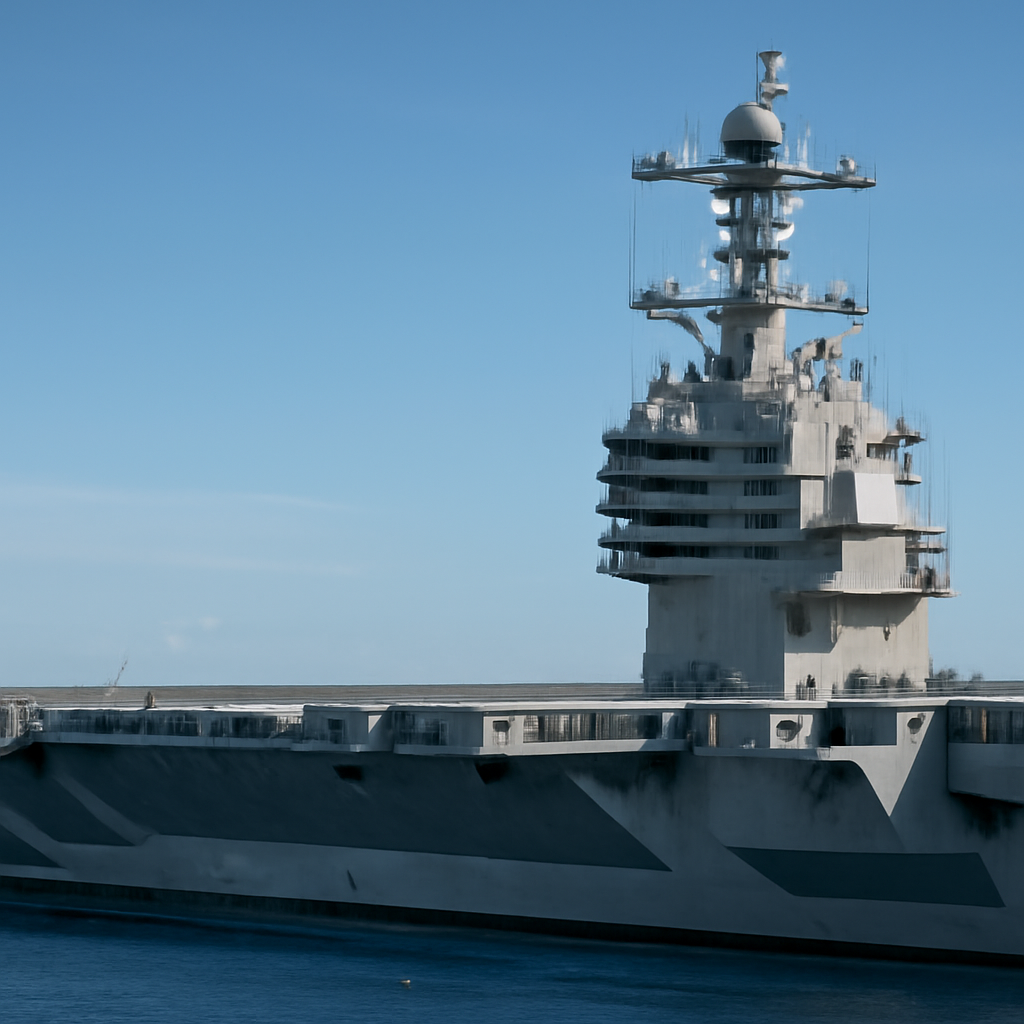
The Ford’s island sits 140 feet farther aft than the Nimitz class—a change that the Navy argues buys more usable flight-deck real estate and a different operational rhythm, and that the White House has recently suggested should be reversed for aesthetic reasons.
Why the island was moved aft: design studies and operational aims
The island placement on the Ford class was not accidental. Between 1996 and 2000 the Navy examined roughly 75 conceptual carrier configurations, including many island locations, before settling on the current layout, a slide from retired Navy Capt. Tal Manvel’s 2015 presentation shows. The Ford class is close in overall length to the Nimitz class—337 meters (1,106 feet) versus 332.8 meters (1,092 feet)—but its island is 140 feet further aft and is smaller and more angular.
The physical layout produces measurable differences in flight-deck operations. The Ford has three aircraft elevators—two starboard and forward of the island and one on the port side—compared with the Nimitz arrangement of three starboard elevators (one aft of the island) and one port elevator. The Navy says these design choices yield more total flight-deck space on Ford: five acres (217,800 square feet) versus 4.5 acres (196,020 square feet) on the Nimitz class.
Then-Capt. Paul “Paulie” Lanzilotta, speaking in a 2022 interview, explained how the Ford’s layout supports “cyclic flight operations to continue to generate sorties over many hours a day.” He said the forward elevator placement and revised deck flow reduce the need to pause recovery operations to troubleshoot and reset aircraft systems—“Less likely that you’re going to need that break and a lot more likely that I can refuel you and rearm you more efficiently,” Lanzilotta said.
President Donald Trump’s directive and the push for a World War II look
Media reporting in recent days says the president has pushed the Navy to reposition the island on Ford-class carriers so the ships “look more like those that were in service during World War II,” according to The Washington Post and The Hill, both citing anonymous current and former U.S. officials. The Hill reported the review was due in “several” weeks and that “Trump ordered the Navy to ‘implement design changes to our future aircraft carriers’ and that the service branch ‘has begun moving out on options to meet the President’s intent.’”
The president has also been explicit about aesthetics elsewhere: “I’m a very aesthetic person,” he said in December 2025 at the public rollout of plans for the Trump class battleship. And just last Thursday he publicly ordered the Navy and the Pentagon to come up with a plan for abandoning the Electromagnetic Aircraft Launch System (EMALS) catapults and Advanced Weapons Elevators (AWE) on the Ford class, starting with the future USS Doris Miller, the reporting says.

This site is the portfolio.
OSINTSights runs on Cloudflare Workers, D1, R2, and Vectorize, with an AI pipeline on Hetzner ARM. Nubivance designed, built, and operates it. We do the same for clients.
See what we buildTechnical complexity, cost, and program risk of moving the island
Relocating the island would be more than a cosmetic change. The source material stresses the island is tightly integrated into the ship’s overall structure: moving it would affect seakeeping, structural stability and basic balance, and would require broad accompanying changes. Because the island houses main radars and many key systems, “a substantial amount of additional testing would have to be done to ensure everything works as intended in the new location.”
The Washington Post reported a prior Navy study found moving the island could “cost billions of dollars in redesign costs and significantly delay the program.” That study came amid an already troubled program: the Ford class is running years behind schedule, with problems tied to EMALS catapults, AWEs and other long-troubled aspects of the ships’ design. The Navy had originally planned to take delivery of the future USS John F. Kennedy in 2022; the service hopes to take delivery of John F. Kennedy “this year,” the reporting adds.
Delays matter beyond a single hull. Newport News is described as the only U.S. shipyard producing nuclear-powered surface vessels and is already “heavily strained” by current demands. There is only one other U.S. yard that produces nuclear-powered vessels and it is focused on submarine production. Pushing carrier delivery schedules further would add strain to a fleet that is already managing extended Nimitz-class deployments and deferred retirements.
How radar and systems choices reshaped the island already
The Ford’s smaller island was enabled in part by a different main-radar concept than the Nimitz class. The device known as the Dual Band Radar (DBR) proved “extremely complex and troublesome,” the reporting notes, prompting a decision to fit the future USS John F. Kennedy and every subsequent Ford-class carrier with the AN/SPY-6(V)3 fixed-face Enterprise Air Surveillance Radar (EASR) instead of the DBR. The DBR had also been planned for the Navy’s Zumwalt-class destroyers before cost-driven changes removed S-band arrays on that program.
On the flight-deck operations side, Ford replaces the island camera-room approach used on Nimitz carriers with a distributed aperture remote video system that provides situational awareness without the Integrated Launch and Recovery Television Surveillance (ILARTS) operators placed around the island on older carriers. The distributed system, the reporting says, “eliminates the need for individual camera operators” at those island locations.
What this means for Rear Adm. Paul Lanzilotta, Newport News, and Congress
- Rear Adm. Paul Lanzilotta and carrier strike group commanders: would weigh any change against the island’s operational benefits—sortie generation, elevator flow, and deck-space tradeoffs—elements Lanzilotta described as improving mission tempo and fueling/rearming efficiency.
- Newport News and shipbuilders: face added production and schedule risk if redesigns add “billions of dollars” and lengthen timelines; the yard is already described as “heavily strained” supporting Ford-class work and other nuclear-surface demands.
- Congress: could intervene. The reporting explicitly notes Congress “could well step in to take action” earlier than an administration-level change, and any redesign decisions could bleed into the next administration—Trump’s second term is noted to end in January 2029.
Moving the island on a class already in service is, by the reporting’s account, a high-cost, high-risk undertaking that would overturn years of tradeoffs intended to improve sortie generation, radar integration and flight-deck efficiency. Whether the Navy’s review yields a feasible path forward—or whether program cost, shipyard capacity and operational tempo will hold sway—remains the central tension documented in the sources.
Original story: https://www.twz.com/sea/why-the-ford-class-carriers-island-superstructure-is-located-so-far-back