The Navy’s new Request for Information demands an aircraft that can carry four externally mounted weapons weighing up to 2,500 pounds each — a single‑aircraft external load the RFI treats as feasible across the carrier certification envelope.
NAVAIR’s RFI: CCA Increment 1 with unusually demanding capabilities
Naval Air Systems Command (NAVAIR) released an RFI for Collaborative Combat Aircraft (CCA) Increment 1 that sets a concrete, ambitious baseline for a prototype: first flight within 24 months of contract award, carrier certification during a three‑year development effort, and a path toward an affordability target of roughly $30 million per aircraft. The RFI asks industry to show how mission and flight autonomy can support launch through recovery, to demonstrate individual and multi‑aircraft autonomous operations, and to allow incorporation of third‑party mission software.
Weapons carriage and airframe scale: moving toward a UCAV profile
The RFI’s most striking technical demand is weapons carriage. NAVAIR requires the Increment 1 CCA to be able to carry four external weapons up to 2,500 pounds each — a potential 10,000‑pound external load — and it also asks respondents to address internal weapons carriage capacity and survivability. For comparison, the article notes that a very heavily loaded F/A‑18E/F might launch with close to 17,000 pounds of weapons and stores, while the Air Force’s YFQ‑42A Dark Merlin and YFQ‑44A Fury prototypes are expected to be optimized for air‑to‑air missions with a far lighter primary loadout (a pair of AIM‑120 AMRAAMs). The Navy’s emphasis on internal stores and survivability points toward signature reduction and a larger, more capable airframe akin to earlier UCAV concepts.

The cyber insurance questionnaire just landed. Now what?
SOC 2, HIPAA, insurance renewals - someone has to own security strategy. Nubivance provides fractional CISO leadership without the full-time salary.
Get a security leadAutonomy, survivability, and carrier constraints
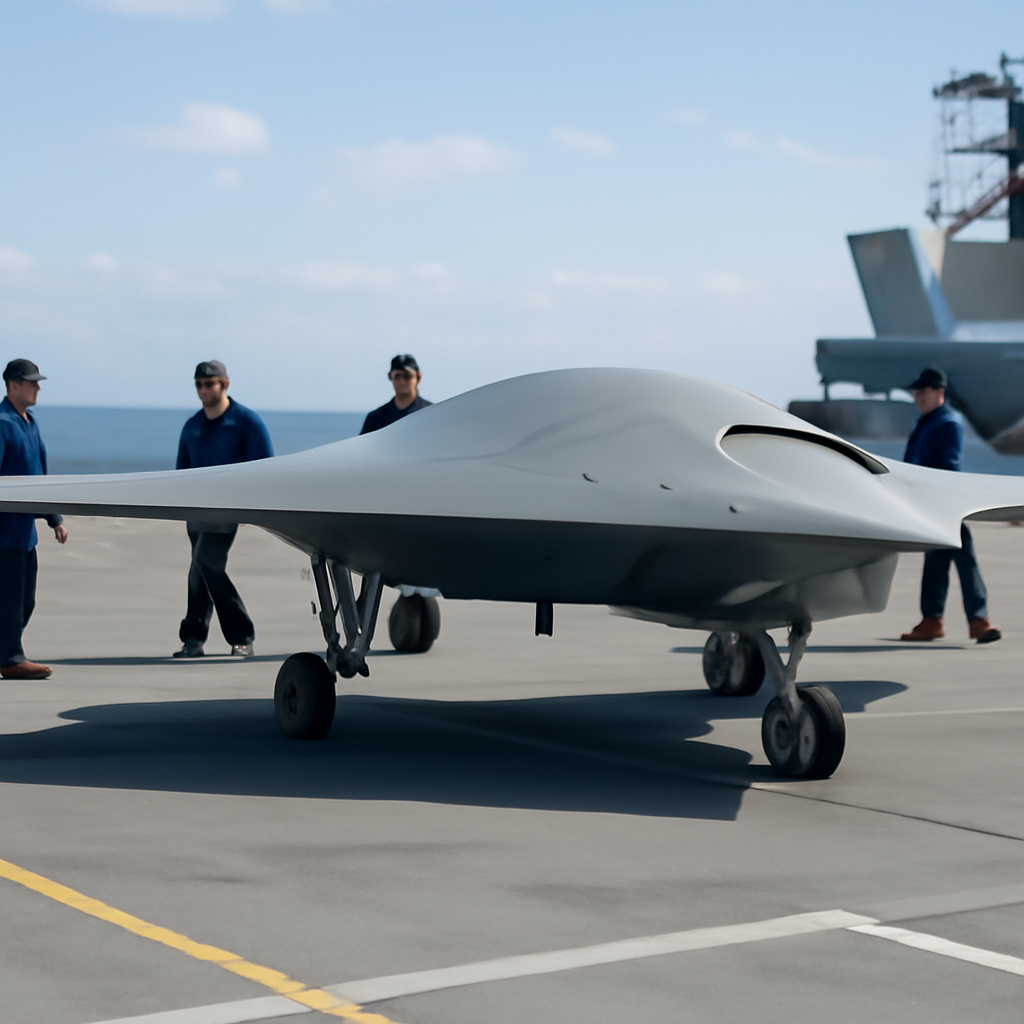
The Navy explicitly wants the CCA to operate in “highly contested environments” and to provide approaches for assessing and managing survivability during collaborative operations. Carrier operation requirements are precise: the aircraft must support catapult launches and arrested landings from both Ford‑ and Nimitz‑class carriers while fitting within current carrier deck, elevator, hangar, and support constraints. The RFI also stipulates a substantial combat radius while carrying the required load and at least 30 minutes on station with sufficient fuel reserves to return to the carrier.
Industry players, past UCAV work, and program lineage
The RFI marks a shift from conceptual work toward a prototype effort. In August of last year the Navy confirmed Anduril, Boeing, General Atomics, and Northrop Grumman were on contract for “conceptual” CCA designs, and Lockheed Martin had been hired to work on a common control architecture. Lockheed Martin is named in the source as prime contractor for control stations and software being integrated onto carriers to support the MQ‑25. The RFI also recalls the Navy’s earlier high‑end UCAV path: Northrop Grumman built two X‑47B demonstrators that flew from 2011 and completed carrier operations and aerial refueling testing; as of 2022 both X‑47Bs had been earmarked for eventual museum display. The follow‑on UCLASS program transformed into the tanker‑focused CBARS effort, producing the MQ‑25 Stingray — a shift the article describes as controversial and one that left UCAV ambitions unfulfilled at the time.
How NAVAIR, General Atomics, and Lockheed Martin are positioned
- NAVAIR — is asking industry whether it can deliver a carrier‑capable prototype that blends heavy payload, autonomy, and survivability within existing carrier constraints; the RFI frames schedule and affordability guardrails (24‑month first flight, three‑year carrier certification, ~$30M target).
- General Atomics (and other conceptual contractors) — were already on contract for conceptual CCA designs and now face a transition from study work to answering a detailed prototype RFI with rapid timelines and robust weapons and autonomy requirements.
- Lockheed Martin — is cited as developing a common control architecture and as the prime for carrier control stations/software tied to the MQ‑25, placing it at the center of one plausible integration path for future CCA control and mission software.
The RFI narrows the conceptual aperture: by demanding heavy weapons capacity, internal carriage for signature reduction, carrier certification, and autonomous launch‑to‑recovery operation, the Navy’s Increment 1 picture begins to resemble a high‑end carrier‑capable UCAV as much as a “loyal wingman” adjunct. The document sets firm near‑term milestones (responses due September 18, prototype flight within 24 months of award, carrier certification in a three‑year development), and it raises a direct challenge the article puts plainly — the Navy appears to be asking whether industry can finally make good on the promise of a U.S. Navy UCAV that earlier programs like the X‑47B and UCLASS once pursued.