What Brig. Gen. Lee Meyer announced about USS Wasp
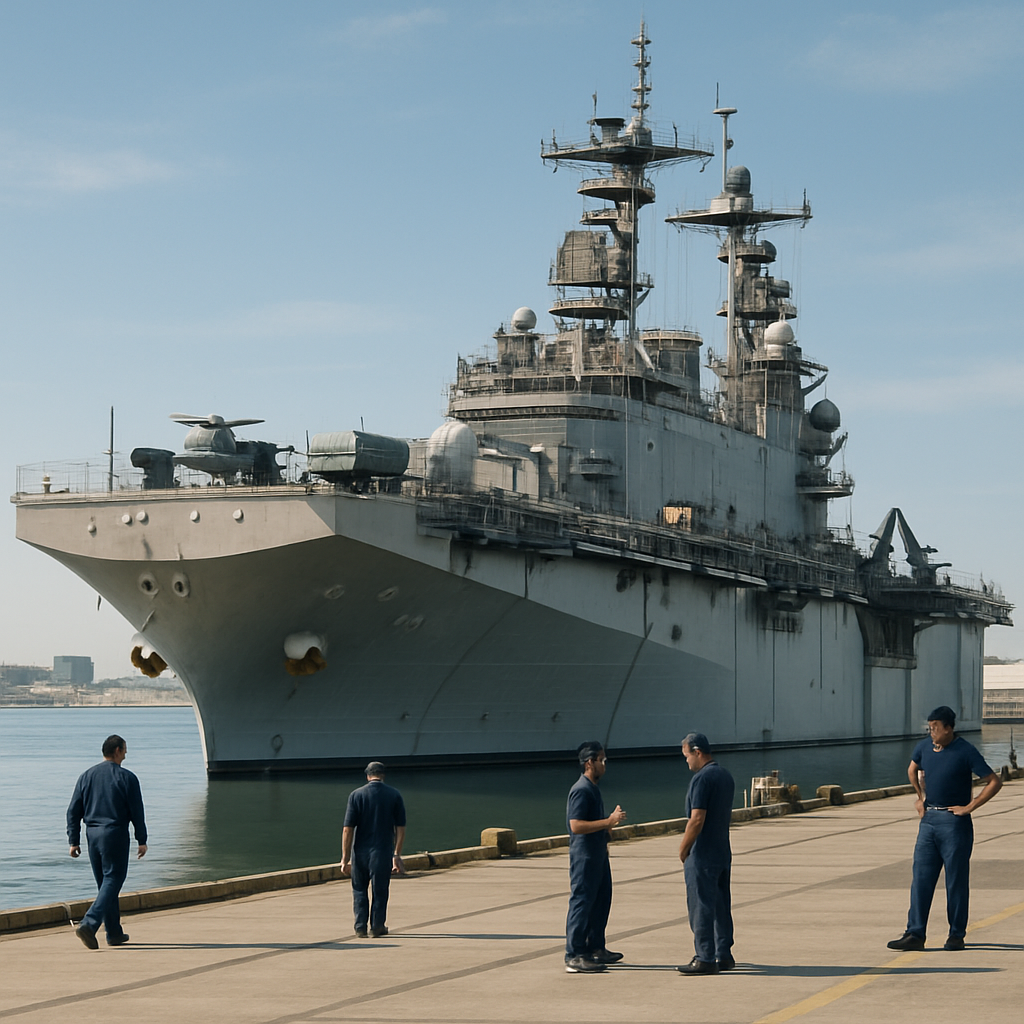
The Navy has formally extended the service life of the amphibious assault ship USS Wasp by five years, moving the ship’s end date to 2034. Meyer identified Wasp specifically as “the LHD one, the first of her class, a steam ship,” and described the extension as an example the services hope to replicate for other amphibious vessels. He cautioned that further extensions are under study and “it’s not a one size fits all,” signalling that each class and hull will be evaluated on its own merits.
Studies underway: other LHDs and dock landing ships (LSDs)
Meyer said the Navy and Marine Corps plan to study additional LHDs to determine whether their service lives can be extended, and that “the plan is going to be to do that.” Separately, he reported a study evaluating the status of the dock landing ship (LSD) fleet that is expected to wrap up “very soon” and will produce recommendations on service life extensions for that class. Meyer said that once those studies are received, the services must decide “how they want to employ, resource, and sustain the fleet.”

Audit-ready is a season. It shouldn't be.
Evidence in spreadsheets, controls drifting between audits, frameworks multiplying on flat headcount. Nubivance runs continuous compliance on Rapid7 Cyber GRC - SOC 2, HIPAA, ISO 27001, PCI, CMMC.
End the scrambleAmphibious Force Readiness Board and the statutory baseline
The services established the Amphibious Force Readiness Board (AFRB) in March to address amphibious readiness issues and to evaluate how many amphibious ships are required. Current law requires the Department of the Navy to maintain at least 31 amphibious ships. Meyer noted, however, that senior leaders have testified that more ships are necessary: Vice Chief of Naval Operations Adm. Jim Kilby and Gen. Bradford Gering, the assistant commandant of the Marine Corps, have both told lawmakers the fleet should be larger, with Gering saying the right number is “probably somewhere near 40.”
ARG‑MEU demand: deployed levels versus requests
The Navy and Marine Corps organize amphibious capability into Amphibious Ready Group–Marine Expeditionary Unit formations, or ARG‑MEUs. An ARG typically includes an assault ship, a transport dock, and a support vessel and carries an embarked Marine Expeditionary Unit of at least 2,200 Marines. The Corps aims to maintain a 3.0 ARG‑MEU presence globally. Commandant of the Marine Corps Gen. Eric Austin said at the Sea Air Space exposition this month that three ARG‑MEUs are currently deployed, while combatant commanders are requesting a 5.5 ARG‑MEU presence— a demand the force “can’t meet,” Austin said.
What this means for the Navy, the Marine Corps, and combatant commanders
- The Navy: will use the Wasp extension as a pilot case while commissioning class-by-class studies to determine which LHDs and LSDs can be extended and what investments in modernization and maintenance are required, Meyer said.
- The Marine Corps: must factor service life extensions into plans for how to “employ, resource, and sustain the fleet,” aligning any extensions with force-design guidance from the commandant and the CNO, Meyer said.
- Combatant commanders and lawmakers: will be directly affected by fleet availability. Combatant commanders’ requests for a 5.5 ARG‑MEU presence are already outstripping what the force can provide, and congressional testimony has flagged a potential need for roughly 40 amphibs instead of the statutory minimum of 31.
Meyer framed the Wasp decision as an operational lever—one of several the services are looking at to improve amphibious availability—while cautioning that recommendations from the LSD study and further LHD assessments must inform any broader extension campaign. “I want to look at every class of amphibious ship in a deliberate way, find out ways that I can invest in that, with modernization, with maintenance, in order to extend the life of those ships,” he said. Smith added that the Navy and Marine Corps are examining “several ways to improve the availability of its amphibious fleet, including extending the service lives of some ships.”
The immediate next steps are concrete: finalize the LSD study “very soon,” complete analyses of other LHDs, and then make resourcing and employment decisions that reconcile statutory minima, service leaders’ testimony about required force size, and combatant commanders’ demand for more ARG‑MEU presence. Whether those studies will recommend widespread extensions, and how the services will pay for the associated modernization and sustainment work, remain the practical questions the services must answer.