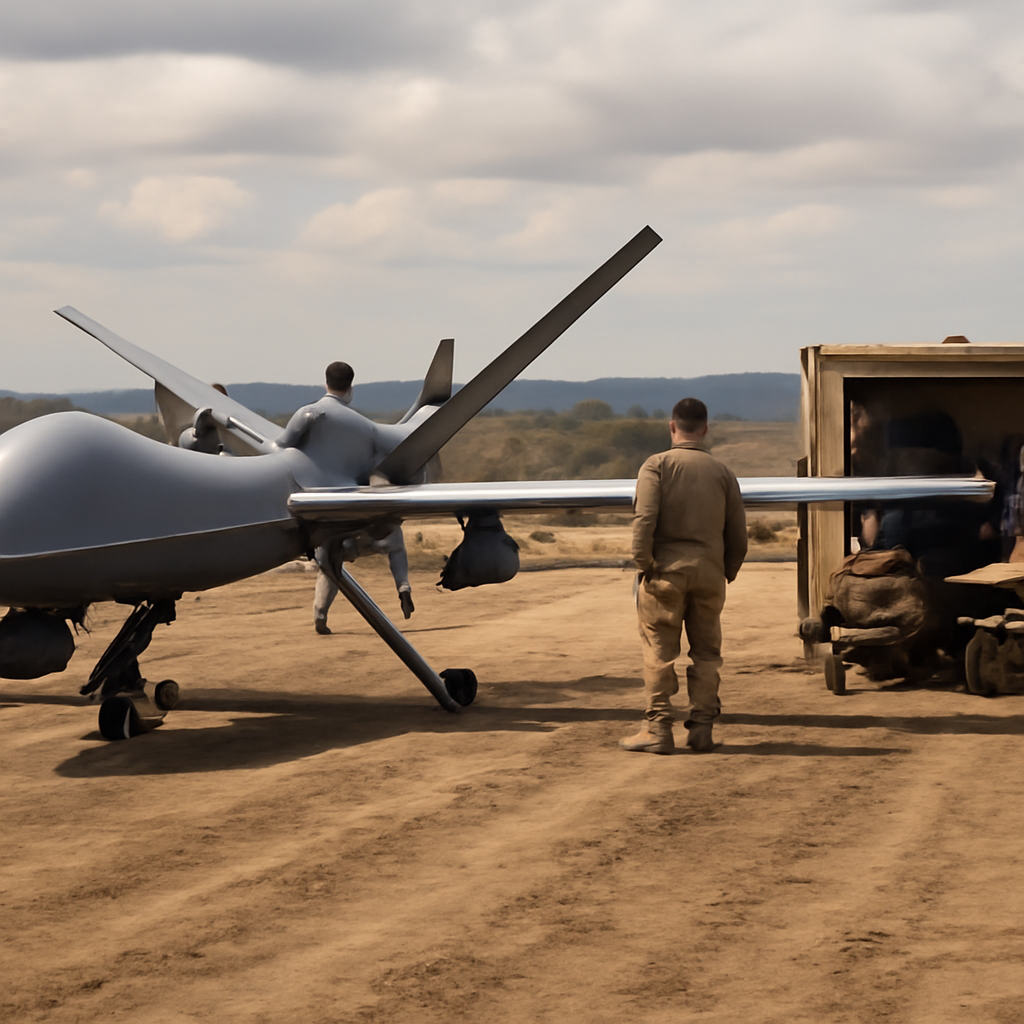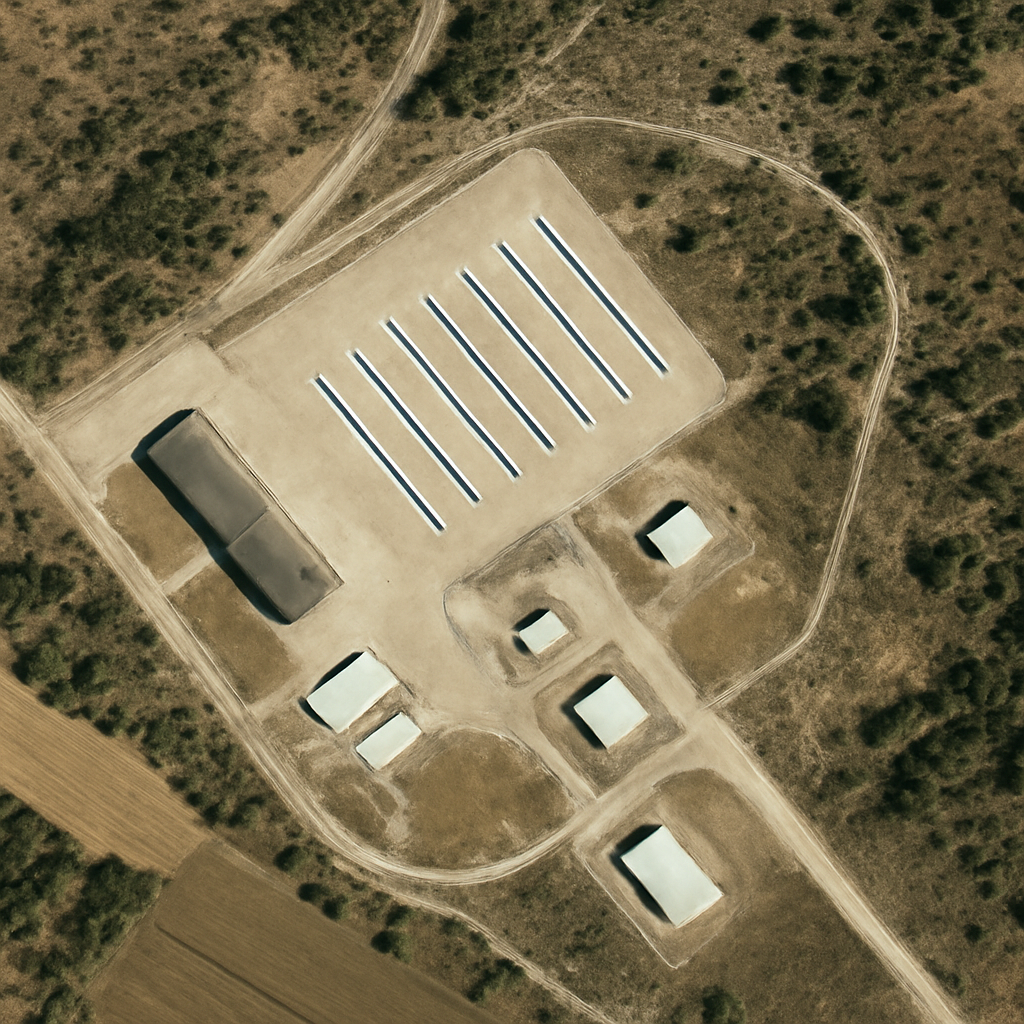
Commercial satellite imagery shows at least 59 new launch rails, roughly 20 of which were assessed to be long enough to support newer Geran-type drones, according to a Telegraph investigation drawing on analysis by drone-intelligence firm DroneSec.
Launch infrastructure: new rails, dispersed sites, and storage
An investigation by The Telegraph, using commercially available satellite imagery and DroneSec analysis, identified at least 10 Russian sites with newly constructed or expanded drone-launch infrastructure. The investigation counted at least 59 launch rails, and open-source tracking data indicated seven of the 10 sites had been used in Russian attacks on Ukraine. Some facilities have been converted from existing military bases and civilian airfields; others were built in remote areas.
One clearly documented site is Tsymbulova (also reported as Tsymbulovo) in Russia’s Oryol region. Imagery shows four launch rails there, including two measuring roughly 280 feet, with construction of extended rails visible beginning in late 2025. More recent images reportedly show the facility with 16 launch positions, dozens of drones, storage buildings and additional support infrastructure. The Telegraph reported some facilities have storage capacity for more than 1,000 drones.
Geran-4 and Geran-5: longer rails, heavier payloads
The longer rails have been assessed as associated with Russia’s newer jet-powered Geran-4 and Geran-5 variants. Those variants are described in the reporting as faster, more survivable, and capable of carrying substantially larger payloads than the propeller-driven Shahed-136/Geran-2.
Official and open-source attributions in the record offer differing performance figures. The Ukrainian Ministry of Defense’s Main Directorate of Intelligence (GUR) provided one set of measurements for the Geran-5: a length of around 20 feet, a wingspan of approximately 18 feet, a payload around 200 pounds, and an estimated range of around 620 miles. Separately, an image posted with technical annotations claimed a Geran-5 speed of 650 km/h, a 90 kg warhead and a range of 900 km.
The reporting also notes that the propeller-driven Geran-2/Shahed-136 is assessed to reach roughly 1,200 miles, while the newer jet variants trade range for larger warheads and greater ability to penetrate air defenses at altitude or by speed.

Audit-ready is a season. It shouldn't be.
Evidence in spreadsheets, controls drifting between audits, frameworks multiplying on flat headcount. Nubivance runs continuous compliance on Rapid7 Cyber GRC - SOC 2, HIPAA, ISO 27001, PCI, CMMC.
End the scrambleProduction scale and operational tempo
Russia’s production surge underpins the infrastructure expansion. TWZ reported that output of Shahed/Geran-family drones reached “thousands” per month and that production at the Alabuga complex could potentially exceed 50,000 drones annually in 2026. Earlier estimates cited production of roughly 2,000 drones per month with plans to increase to 5,000.
TWZ documented a steep rise in operational tempo: barrages that began as relatively small numbers in 2022–23 grew to hundreds, and by 2026 included attacks using more than 1,000 drones in a single 24-hour period. Satellite analysis indicates Russia launched about 16,000 long-range drones against Ukraine between January and March 2026, roughly 6,000 more than in the same period of 2025.
Geographic reach and NATO implications
The expanded launch network alters the map of potential reach. Some newly developed sites sit close enough to Russia’s western borders that, depending on the actual performance of the newer drones, parts of Poland could fall within theoretical reach and the entirety of the Baltic States would be covered. The Telegraph cautioned that coverage “does not demonstrate an intention to attack NATO,” but it gives Moscow additional options should the conflict broaden.
Those concerns are already affecting allied posture. Lithuania warned earlier in August 2026 that Russia was considering a staged attack against the Baltic region; the Baltic States and Poland have stepped up security around dams, power plants and other critical infrastructure amid fears of false-flag operations likely using drones. A NATO official told The Telegraph that drones “have fundamentally altered the character of modern warfare” and that the alliance is expanding its ability to produce, operate and neutralize drones at scale.
What this means for Ukraine, NATO, and Russian forces
- Ukraine: Expanded, dispersed launch infrastructure and large stockpiles increase the tempo and scale of mass-drone attacks that Kyiv must track and defend against. The reporting notes Ukraine has attacked launch sites before, but disrupting sustained launch operations remains difficult.
- NATO allies (Baltic States, Poland): New launch locations closer to western borders widen theoretical reach into allied territory, prompting hardened security around critical infrastructure and heightened concern about “gray zone” measures, including false-flag scenarios involving drones.
- Russian long-range strike campaign: Increased domestic production (including Alabuga’s reported potential output) and purpose-built launch infrastructure allow Moscow to put Geran-series drones at the center of a mass-attack layer that complements, rather than replaces, ballistic and cruise missiles and air-launched weapons for high-priority targets.
Russia’s construction of extended rails and storage, combined with rapidly rising production, changes the operational calculus: it increases the number of launch points, the volume of munitions available, and the range of targets that can be threatened from dispersed sites. The facts on the ground — at least 59 rails, sites in Oryol with dozens of launch positions and storage, and satellite-estimated launches in the tens of thousands over months — point to a deliberate effort to scale long-range one-way attack drones as a mass capability. Whether that capacity will be employed beyond Ukraine remains a policy and intelligence question; what the imagery does show is Moscow expanding choices and complicating defense planning for Kyiv and its neighbors.