Nine American destroyers stand at the vanguard of the U.S. Navy’s efforts to integrate laser weapons into the battlefield of the future.
The nine destroyers and where they are deployed
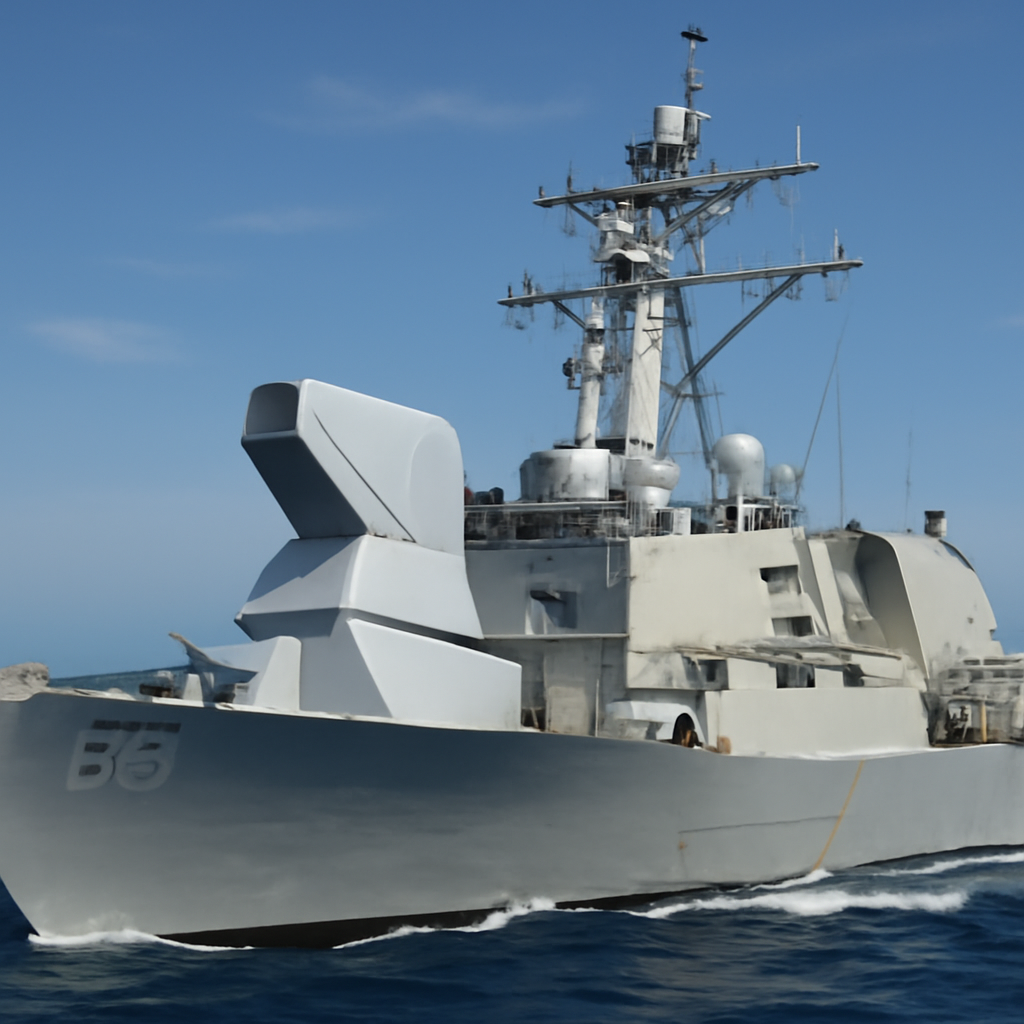
The Navy has armed nine Arleigh Burke–class guided-missile destroyers with shipboard solid state lasers (SSLs). Ships identified in public imagery and reporting include USS Stockdale (DDG‑106), USS John Finn (DDG‑113), USS Spruance (DDG‑111), USS Dewey (DDG‑105), USS Gridley (DDG‑101), USS Sterett (DDG‑104), USS Halsey (DDG‑97), USS Kidd (DDG‑100), and USS Preble (DDG‑88). Two ODIN‑equipped destroyers—USS Spruance and USS John Finn—are on combat deployments in the U.S. Central Command (CENTCOM) area of responsibility and are operating in the Indian Ocean in support of ongoing operations against Iran. USS Gridley is underway in the South Atlantic escorting aircraft carrier USS Nimitz to her new homeport at Norfolk. Several of the other destroyers are at their homeports in San Diego and Yokosuka, and USS Preble is forward‑deployed and at homeport in Yokosuka, Japan.
ODIN: a multi‑ship dazzler for countering sensors and small UAS
The Optical Dazzling Interdictor, Navy (ODIN) is a low‑powered laser fielded across multiple destroyers as a “dazzler.” ODIN is designed to blind or confuse electro‑optical and imaging infrared seekers on incoming weapons such as one‑way attack drones and to neutralize cameras and ISR sensors aboard enemy platforms. Initially installed on eight ships, one ODIN unit was transferred from USS Kidd (DDG‑100) to Naval Surface Warfare Center Port Hueneme for training while Kidd completed a two‑year maintenance availability in Everett, Washington. The Navy confirms that “directed energy systems” have been placed on nine ships and that testing and employment in the fleet is being expanded, though a Navy official declined to discuss whether the systems have been employed against Iranian forces in the Middle East.

Audit-ready is a season. It shouldn't be.
Evidence in spreadsheets, controls drifting between audits, frameworks multiplying on flat headcount. Nubivance runs continuous compliance on Rapid7 Cyber GRC - SOC 2, HIPAA, ISO 27001, PCI, CMMC.
End the scrambleHELIOS (Mk 5 Mod 0) on USS Preble: a higher‑power, integrated system
The High Energy Laser with Integrated Optical‑dazzler and Surveillance (HELIOS), also designated Mk 5 Mod 0, is installed solely on USS Preble (DDG‑88). HELIOS is a roughly 60‑kilowatt (kW) class laser capable of disabling smaller unmanned aerial systems and burning holes in fast inshore attack craft while also functioning as a dazzler. HELIOS is integrated with the ship’s Aegis Combat System. During a demonstration prior to January 2025, Preble successfully disabled four incoming drones. Funding for additional tests and maintenance for these efforts was included in the FY2027 budget request.
Budget moves and planned scaling: JLWS, JBCS, and HELCAP
The recently released FY2027 budget allocates billions for scaled directed energy research and development programs, reflecting a push to field higher‑power systems. Specific programs supported in the latest request include a containerized 150kW Joint Laser Weapon System (JLWS) for cruise missile defense, the Joint Beam Control System (JBCS) technology to develop a 300–500kW laser, and upgrades for the High Energy Laser Counter Anti‑Ship Cruise Missile Project (HELCAP). Lockheed Martin has discussed the possibility of scaling HELIOS to about 150kW, and the Navy’s budget documents say DE capabilities offer “an inexpensive cost‑per‑shot alternative to conventional systems, increased magazine depth, and enhanced defense‑in‑depth.”
Operational trade‑offs and technical constraints
Laser weapons offer a reusable, low cost‑per‑shot option compared with single‑use missiles, freeing ships from the strict limits imposed by the number of vertical launch system (VLS) cells. But their application is constrained in several concrete ways: effective ranges are measured in single miles at best, making them close‑in defenses; atmospheric conditions (humidity, rain, haze) heavily impact performance; the beam must dwell on a target for extended periods to burn through materials; thermal management and shipboard power availability limit rapid follow‑up shots; and delicate components have contributed to reliability challenges in the field. Despite these limits, the systems are improving, and the Navy is funding efforts to extend range, power, and reliability.
What this means for the Navy, CENTCOM, and procurement leaders
- The Navy: will continue to expand testing and employment of directed energy on destroyers while seeking higher‑power and more robust systems that integrate with existing combat suites.
- CENTCOM and deployed commanders: already have two ODIN‑equipped destroyers operating in the Indian Ocean, giving afloat forces a close‑in, reusable option to counter small UAS and sensor threats during operations against Iran.
- Procurement leaders and program offices: will monitor FY2027 investments—JLWS, JBCS, and HELCAP upgrades—to determine which fieldable configurations and power levels can be matured for fleet sustainment and wider deployment.
Lasers are no longer laboratory curiosities; they are aboard frontline destroyers and funded for scaling. But the record here is pragmatic: for now these systems provide inexpensive, short‑range defenses and sensor‑denial tools, while higher‑power solutions and improvements in range, environmental robustness, and reliability remain the explicit goals of ongoing R&D. The hope driving those investments is plain in the record—an eventual ability to rapidly down faster‑flying missiles—but for the moment the Navy’s laser fleet is focused on close‑in, reusable resilience.
Source: TWZ — These American Destroyers Are Equipped With Laser Weapons