"Coming soon to a theater near you…BLACKBEARD!" — the Navy’s Office of the Portfolio Acquisition Executive for Aviation (PAE-A) wrote in a social post accompanying new flight‑test footage released this week.
First public flight tests on the F/A-18E/F Super Hornet
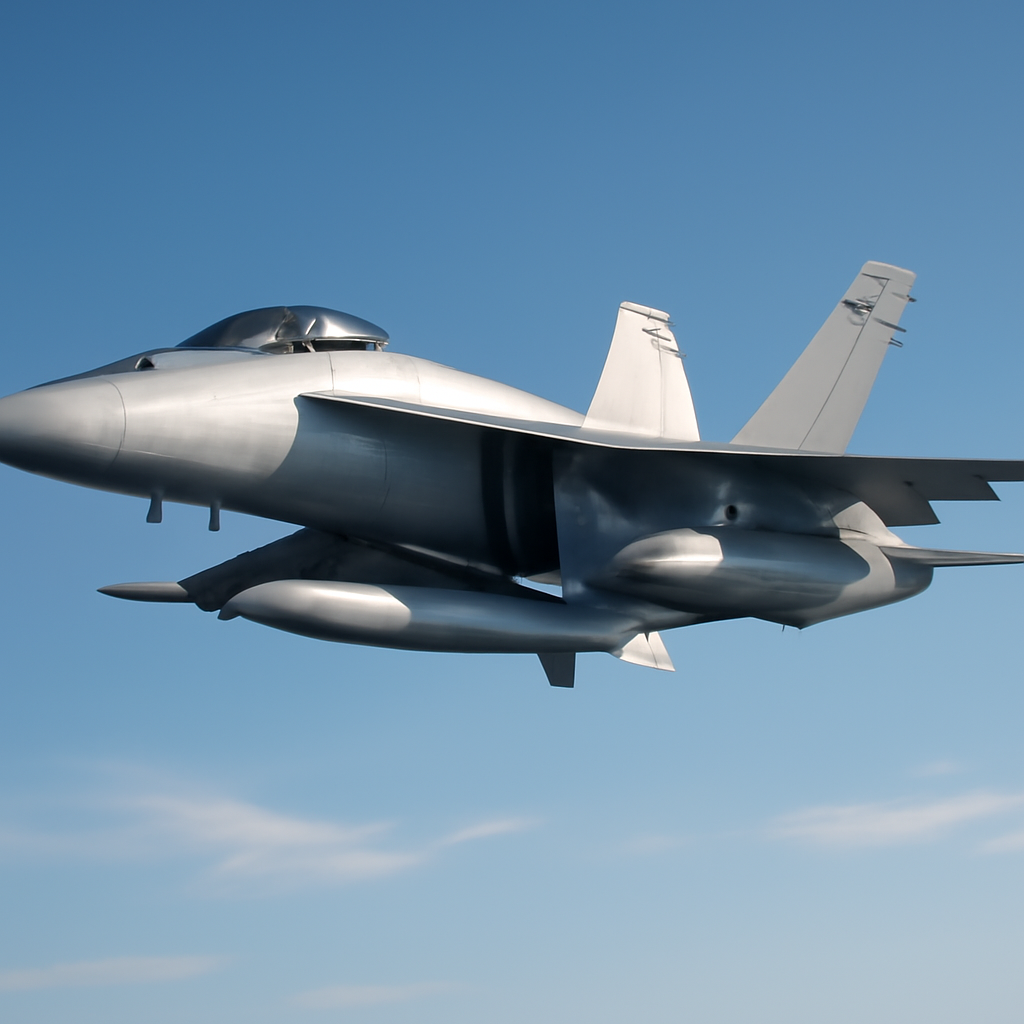
The U.S. Navy has released a video montage showing Blackbeard hypersonic strike missiles mounted under the wings of F/A-18E/F Super Hornets during flight testing, marking the first public footage of the weapon in the air. The service had earlier confirmed it had begun test‑loading the missiles onto Super Hornets in a presentation at the Tailhook Association’s annual convention; the new footage shows the program has progressed substantially beyond those initial demonstrations.
Castelion’s role and the first production contract: $43.65 million for 444 All‑Up Rounds
Defense start‑up Castelion is the company behind Blackbeard and has received several multi‑million‑dollar contracts from the Navy this year to support integration onto the Super Hornet and to accelerate development. On September 14 the Pentagon announced a Navy agreement with Castelion valued at $43.65 million “for the manufacturing, assembly, testing, and delivery of the first production lot of 444 All‑Up Rounds (AURs), defined as fully functional tactical missiles packaged within specialized shipping and storage containers.”
Separately, the Pentagon announced a framework agreement to buy 12,000 Blackbeards over the next five years, underscoring an emphasis on production scale as the program moves from testing toward fielding.

Audit-ready is a season. It shouldn't be.
Evidence in spreadsheets, controls drifting between audits, frameworks multiplying on flat headcount. Nubivance runs continuous compliance on Rapid7 Cyber GRC - SOC 2, HIPAA, ISO 27001, PCI, CMMC.
End the scramblePhysical design and likely capabilities
Public images and the new footage provide a clearer look at Blackbeard’s layout. A profile photo shown at Castelion’s headquarters and screen captures from the Navy video indicate a two‑stage arrangement: a ballistic missile‑like booster with a second stage mounted above it that resembles an unpowered hypersonic glide vehicle (HGV). Both stages carry cruciform fins; the upper stage displays a prominent chine line and a slightly beaklike nose.
The missile’s trolley and the images released emphasize Blackbeard’s relatively small size for a hypersonic weapon, which is a recurring design goal for integration on carrier aviation. Blue stripes seen on each stage normally signify an inert, non‑explosive round used for training or tracking — suggesting the test rounds shown were real but unarmed, rather than simple mockups.
Photos shown at Tailhook also exposed what looks like an aperture on one side of the wedge‑shaped nose. The published analysis notes such a downward‑angled aperture could house a seeker — for example, an imaging infrared sensor — which would be logical for a weapon the Navy is pursuing primarily as an anti‑ship strike missile. The program has not published precise performance figures, but Castelion previously suggested Blackbeard could reach targets “out to just under 500 miles.” The upper stage might be unpowered or could contain its own motor to sustain or accelerate high‑speed flight; the published description leaves both possibilities on the table.
MACE program goals, platform plans, and timelines
Blackbeard is being acquired under the Navy’s Multi‑mission Affordable Capacity Effector (MACE) program. MACE requirements the Navy released previously explicitly sought a design compact enough that carrier‑based F‑35C and land‑based F‑35A Joint Strike Fighters could carry four Blackbeards internally, although the current status of that internal‑carry goal is unclear. The Super Hornet is set to be the first operational launch platform, and the Navy’s new footage underscores that Blackbeard is likely to be integrated on other aircraft shortly thereafter.
The Navy is targeting an early operational capability with Blackbeard by 2028, “if not sooner.” The program release tagged U.S. Central Command (CENTCOM) and U.S. Pacific Command (PACOM) in the social post, and PAE‑A’s “Coming soon to a theater near you” caption indicates the Navy sees near‑term operational utility for both the Middle East and the Indo‑Pacific. The source also notes the U.S. Army is pursuing a ground‑launched version, and that the U.S. Air Force’s separate Hypersonic Attack Cruise Missile (HACM) program has said it is aiming for at least limited operational capability before the end of Fiscal Year 2027.
What this means for the U.S. Navy, Castelion, and CENTCOM/PACOM
- The U.S. Navy: The service is moving to field a relatively compact, standoff hypersonic strike option for carrier air wings and aims for early operational capability by 2028. Integrating a new hypersonic weapon onto carrier aviation, plus a planned five‑year purchase framework for 12,000 rounds, signals a focus on both capability and stockpile depth.
- Castelion (the manufacturer): Castelion has received multiple development and integration contracts this year and the $43.65 million award for 444 AURs is the program’s first production‑lot procurement, putting supply‑chain and manufacturing scale squarely on the company’s immediate agenda.
- CENTCOM and PACOM (regional commands): The Navy’s public tagging of CENTCOM and PACOM — and the program’s stated anti‑ship emphasis and 500‑mile range hint — suggests planners see Blackbeard as relevant to both operations in the Middle East, including ongoing operations involving Iran, and high‑end fights in the Indo‑Pacific.
Blackbeard is now clearly deep into flight testing on Super Hornets, backed by an initial production contract and a multi‑year purchase framework. The coming milestones to watch in the program’s public record are the delivery and fielding of the first 444 All‑Up Rounds under the $43.65 million agreement and the Navy’s stated target of an early operational capability by 2028 — concrete, funded benchmarks that will determine whether Blackbeard moves from test footage to operational inventory.
Source: TWZ — Blackbeard Hypersonic Missile Seen Flying On F/A-18 Super Hornet For The First Time