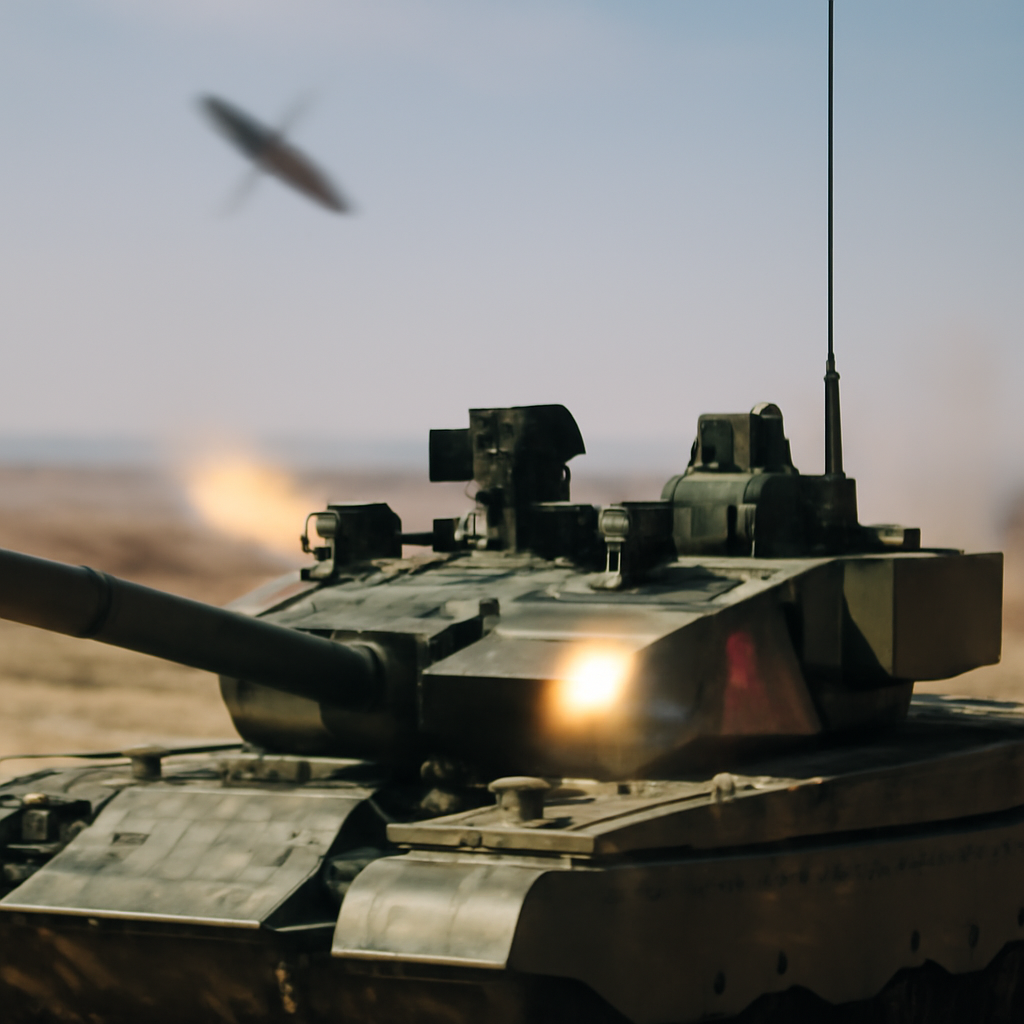
In early 2025, Chinese state media published footage showing a Norinco-fitted tank using a GL-6 active protection system to knock out a descending overhead threat while engaging another from the side — a clear, visual answer to a problem battlefield observers say changed after Ukraine: cheap FPV drones and high-angle attacks turn the turret roof into a lethal vulnerability.
Norinco’s GL-6 and the move toward hard-kill roofs
That early-2025 footage is the most conspicuous demonstration of one technical tack: active protection systems (APS) that can engage threats from above as well as laterally. Reporting described the GL-6’s ability to defeat high-angle attacks — whether from drones, rockets, missiles or loitering munitions — while simultaneously countering side-on threats. Chinese coverage frames this capability as a step toward making tanks resistant to “overhead attack” and to a more three-dimensional battlefield environment.
From single systems to a layered, networked approach
Norinco’s demonstrations sit alongside a broader doctrinal shift described in Chinese reporting. At the 2024 Zhuhai Airshow, Norinco unveiled an "intelligent combined brigade" concept: armored vehicles operating together with reconnaissance drones, electronic-warfare assets and counter-drone tools to detect and disrupt incoming threats. PLA Army researchers in 2025 argued for a mixed toolkit — integrated warning, electronic countermeasures, kinetic defenses, camouflage and decoys — rather than reliance on a single technology.

Audit-ready is a season. It shouldn't be.
Evidence in spreadsheets, controls drifting between audits, frameworks multiplying on flat headcount. Nubivance runs continuous compliance on Rapid7 Cyber GRC - SOC 2, HIPAA, ISO 27001, PCI, CMMC.
End the scrambleImprovisation made doctrine: add-ons, concealment and training
The PLA’s response is not limited to new electronics or interceptors. Like forces observed elsewhere, Chinese units have tested pragmatic add-ons — roof barriers, cage-like covers, localized reinforcement — and incorporated simple signature-management and concealment techniques into training. Recent PLA exercises emphasized hiding in roadside depressions, erecting camouflage netting, erasing vehicle tracks and using smoke to mask movement during live tactical drills. Chinese reporting explicitly links these measures to the same operational aim as roof screens and add-on armor: buy time, disrupt targeting and force attackers to work through more layers before achieving a clean strike.
Engineering trade-offs and the logistics of scaling protection
Chinese military writers have stressed that turning battlefield improvisation into fielded capability requires trade-offs. An April 2026 assessment in the PLA Daily reviewed cages, wire barriers and composite screens used abroad and highlighted penalties in visibility, weapon movement and mobility. A September PLA Daily piece noted Russian manufacturers had begun incorporating physical and electronic anti-drone measures into newly produced tanks after battlefield feedback. Across reporting, Chinese sources emphasize lighter composites and modular protection alongside active and electronic defenses — an attempt to balance protection with production, maintenance and logistics.
What this means for U.S. forces, Taiwanese analysts, and the PLA
- U.S. forces and partners: The central concern raised by Chinese reporting is operational tempo — can these layered measures be fielded fast enough to make overhead shots less easy, less cheap and less certain? Even modest gains in complicating top-attack targeting could matter for how anti-armor teams plan strikes.
- Taiwanese analysts: The source notes Taiwanese military analysts already interpret PLA displays of APS-equipped heavy armor as direct responses to asymmetric, drone-centered tactics — a signaling effect that shapes regional assessments of PLA adaptation.
- The PLA: Chinese authors themselves recognize persistent problems — small-target detection, short engagement windows, costly interception, and increasingly jam-resistant fiber-optic or autonomous drones. Their reporting shows an operational logic of combining hard-kill interception with concealment, obscurants and modular barriers to complicate the drone kill chain rather than expecting a single silver bullet.
Chinese military commentators conclude there is no magic fix: APS, roof protection, camouflage, smoke and reinforcement can force attackers to use denser salvos, mixed-axis strikes, deception and closer reconnaissance, and they can make support and enabling vehicles more attractive targets. The pattern in reporting is unmistakable — a move from isolated demonstrations to a layered, connected approach that blends active defense, roof adaptation, modular reinforcement, signature management and better coordination between vehicle and formation.
The decisive variable, repeatedly underscored in PLA and industry pieces, is speed of adoption. The technology may not be flawless; the doctrine is not final. But if armored units can be equipped quickly with integrated hard- and soft-kill measures and with the logistics to sustain them, the commonplace overhead kill that dominated recent battlefields could become harder and costlier to achieve.