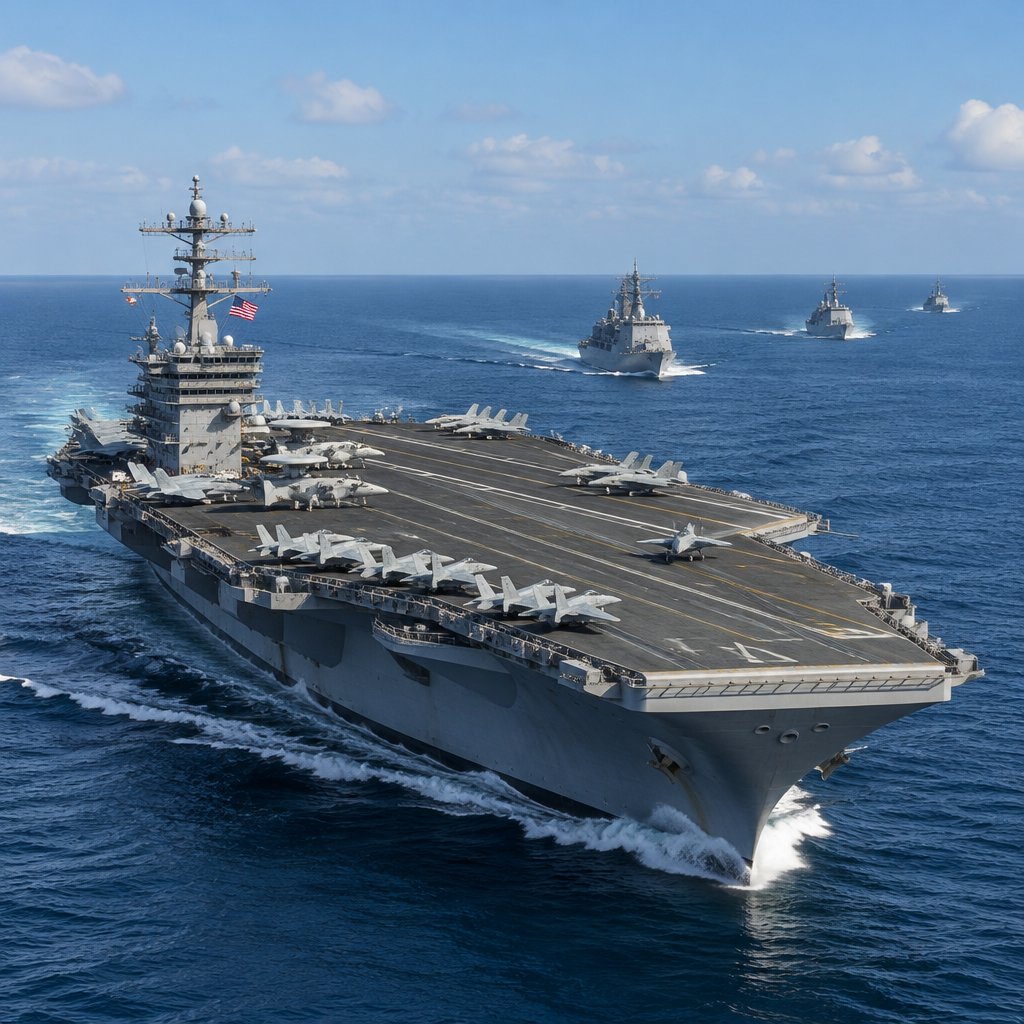
"The criteria is for them to agree to a non-nuclear Iran." Acting Secretary of the Navy Hung Cao offered that stark line when asked what would bring USS George H.W. Bush’s strike group home — an answer that helps explain why three U.S. carriers briefly operated in the Middle East this week and why a long-stay posture persists.
USS Theodore Roosevelt’s movement and the carrier mix on station
USS Theodore Roosevelt departed Singapore on November 8 after a short stop at Changi Naval Base, transited the Strait of Malacca, and entered the CENTCOM area of responsibility on or around November 15. Guided‑missile cruiser USS Chosin and guided‑missile destroyer USS Decatur accompanied the carrier through the strait; destroyer USS Paul Hamilton steamed east in the South China Sea, and destroyer USS Carl M. Levin had been disaggregated and operating in the theater since October. Roosevelt’s arrival briefly produced an overlap with USS George Washington and USS George H.W. Bush — three American carriers in the Middle East — although the George Washington Carrier Strike Group has since left the region and likely begun a return to Yokosuka, Japan.
Airpower on deck: the tactical jet picture
During the short overlap of carrier presence, the three Carrier Air Wings in the region combined for 10 squadrons of F/A‑18E/F Super Hornets, two squadrons of F‑35C Lightning IIs, and three squadrons of EA‑18G Growlers. USS George Washington and USS Theodore Roosevelt each embarked a squadron of F‑35Cs; USS George H.W. Bush’s embarked tactical jets are Super Hornets and Growlers only. The strike-group rotation was a one‑for‑one swap that kept a single squadron of fifth‑generation fighters in theater.

The cyber insurance questionnaire just landed. Now what?
SOC 2, HIPAA, insurance renewals - someone has to own security strategy. Nubivance provides fractional CISO leadership without the full-time salary.
Get a security leadOperational tempo, strikes, and the blockade
The U.S. blockade of Iranian ports and coastal cities remained in effect: CENTCOM reported that a U.S. aircraft fired precision munitions to disable the St. Kitts‑flagged cargo ship M/V Huda in the Gulf of Oman on November 7, the fifth vessel disabled since July and the first in nearly a month. CENTCOM said roughly 150 other vessels have been redirected. Iran resumed attacks on American bases between November 13 and 17; CENTCOM said projectiles were intercepted with no damage or casualties. U.S. forces responded by striking targets on Qeshm Island.
USS George H.W. Bush’s extended deployment and relief planning
USS George H.W. Bush is 234 days into a deployment that began from Norfolk on March 31. Navy leaders told families at a town‑hall on November 9 to plan for a worst‑case scenario of 12 months at sea, according to audio obtained by MS NOW. Officials said USS Dwight D. Eisenhower is being prepared to relieve Bush in line with an early‑2027 deployment timeline TWZ reported in June. A full year on station would push Bush past the 326‑day record set by USS Gerald R. Ford; TWZ noted Bush would break that record around February 21, 2027 if the current plan holds.
What this means for naval families, the Navy, and CENTCOM
Naval families: Families were told on November 9 to plan for extended deployments; the record‑length prospect and reports of supply strains — including testimony about food shortages raised to senators — translate into sustained personal stress and prolonged uncertainty for sailors and their households.
The Navy and leadership: Acting Secretary Hung Cao told the Senate Armed Services Committee that delays with Ford‑class electromagnetic catapults and weapons elevators will leave the Navy "down to nine carriers" for five years, two short of the 11 required by law. Cao placed the total battle force at 286 ships and said 17 destroyers are currently supporting the blockade of Iran; he also said development of unmanned surface vessels is being accelerated to relieve tasking.
CENTCOM and regional operations: With multiple carriers supporting blockade operations and strikes on Qeshm Island, CENTCOM continues a high‑intensity, carrier‑supported posture in the AOR while redirecting commercial traffic; that posture depends on rotation plans (the Roosevelt/Washington swap and the planned Eisenhower relief for Bush) and sustainment of escorts and logistics at sea.
Where the rest of the fleet sits
On the West Coast, Abraham Lincoln remains in San Diego ahead of a homeport shift to Bremerton by year‑end; escorts from her long deployments have returned, including destroyer USS Michael Murphy (back to Pearl Harbor on November 12 after a 346‑day cruise) and USS Spruance (into San Diego November 13 after 357 days). USS Ronald Reagan is in Bremerton and USS Carl Vinson is in San Diego. On the East Coast, USS Nimitz returned to Norfolk after carrier qualifications that logged 103 sorties, 442 arrested landings, and 152 touch‑and‑goes; USS Dwight D. Eisenhower is at Norfolk. Three carriers are offline in maintenance: USS John C. Stennis (finishing a Refueling and Complex Overhaul), USS Harry S. Truman (at the start of an RCOH), and USS Gerald R. Ford (in a Planned Incremental Availability expected to run until March 2027). The future USS John F. Kennedy returned to Norfolk on November 5 after Aircraft Compatibility Testing and is expected to be delivered in spring 2027.
TWZ’s weekly carrier tracker summarizes the result: three carriers deployed, three working up, three in maintenance, one post‑deployment and preparing for availability, another being used primarily for training before deactivation, and the next carrier slated for delivery in 2027. Two amphibious assault ships are deployed, one is forward‑deployed, two are preparing for future deployments in port, and four are in maintenance.
Link to original TWZ story: https://www.twz.com/sea/theodore-roosevelt-strike-group-arrives-in-the-middle-east-relieving-uss-george-washington