“I think China is actually following the same path as Boeing here, and it’s heading towards a tanker that can also take on other roles as an ISR platform,” Andreas Rupprecht told TWZ.
The aircraft seen at Pucheng and the imagery trail
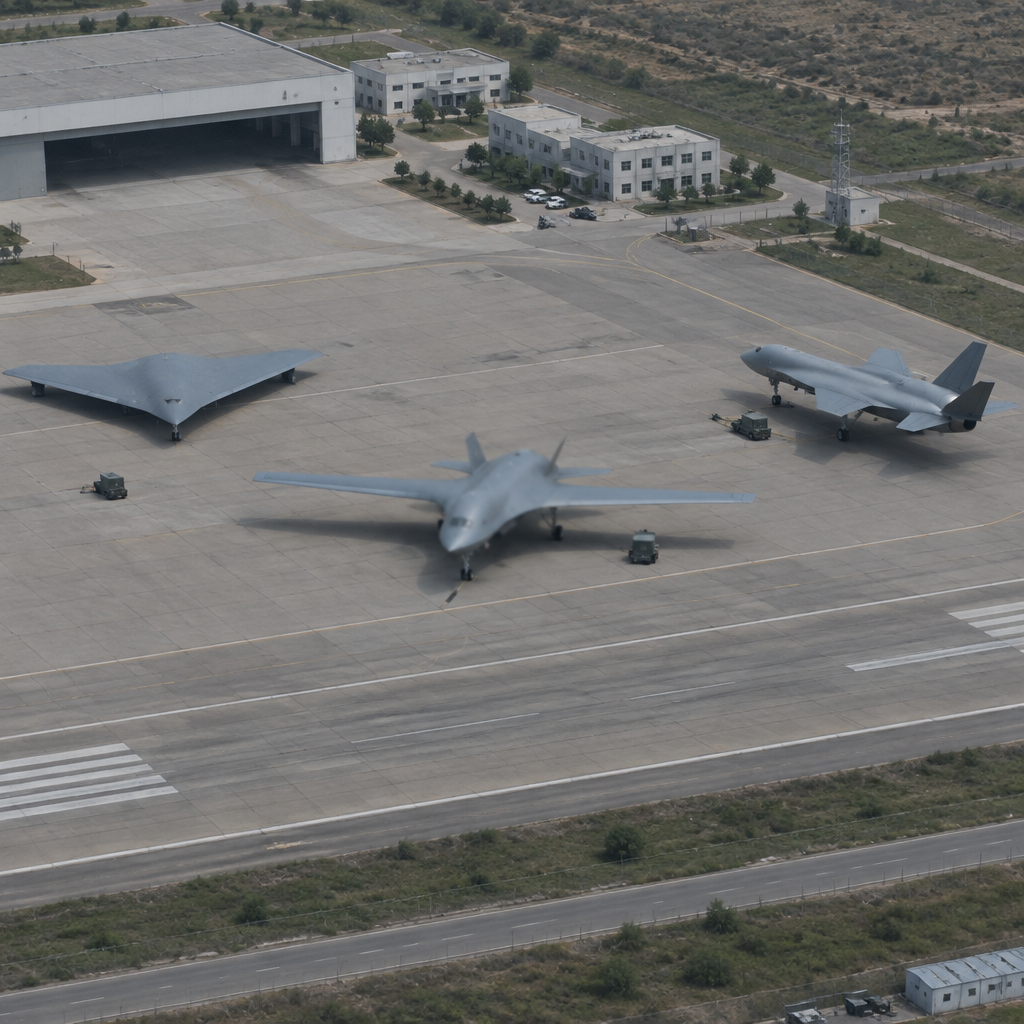
Satellite imagery made available to TWZ by Vantor, and commercial map captures on Apple Maps and Bing Maps, show an unfamiliar uncrewed aircraft sitting on a runway at Pucheng Neifu Airport in Shaanxi Province. Vantor’s wider-view image dates to April 23, 2026; social-media posts by Charles Xu flagged appearances on Apple Maps (November 18, 2026) and Bing Maps (November 19, 2026). Those April images also show two additional uncrewed types at Pucheng that TWZ identified: a CH-7 flying-wing and a Jiutian jet-powered mothership drone.
Design parallels and divergences with Boeing’s MQ-25
The most immediate comparison observers have made is to Boeing’s MQ-25 Stingray. TWZ notes that the mystery aircraft occupies a similar general design category but is not identical. Vantor measured the Chinese aircraft at roughly a 66-foot wingspan and 49-foot length; by contrast the MQ-25 is cited at about a 75-foot wingspan and 51-foot length.
Key visible differences include a tapered, conventional-looking nose — distinct from the MQ-25’s relatively flattened shovel-like forward fuselage — and what appears to be a different air-intake arrangement. Instead of the MQ-25’s flush inlet, the Pucheng aircraft shows a dorsal intake that appears serrated or split, which observers proposed could be a radar-signature mitigation feature or might indicate dual-channel airflow. The nose’s differing colour from the yellow primer-painted airframe has led to speculation it could house a conical radome and radar.
The tail bears a laterally flared V profile similar to the MQ-25, but TWZ notes visible control surfaces rather than an all-moving tailplane. Taken together, the imagery suggests a platform that shares conceptual choices with the MQ-25 family but is not a direct copy.

This site is the portfolio.
OSINTSights runs on Cloudflare Workers, D1, R2, and Vectorize, with an AI pipeline on Hetzner ARM. Nubivance designed, built, and operates it. We do the same for clients.
See what we buildPossible missions, heritage, and size constraints
The MQ-25’s primary role — as described in the imagery’s reporting context — is aerial refueling for the U.S. Navy and providing a foundation for future uncrewed naval aviation capabilities. Observers including Rupprecht argue China could be following a comparable path: a tanker-capable design that can also perform intelligence, surveillance, and reconnaissance (ISR) when not acting as a tanker.
That said, the aircraft at Pucheng is roughly 20 percent dimensionally smaller than the MQ-25, which the reporting notes would likely reduce fuel-carrying capacity and therefore tanker endurance or offload. TWZ also highlights alternative role possibilities: the configuration could fit a multirole UCAV or a Collaborative Combat Aircraft (CCA) concept rather than a pure tanker. Comparisons in the reporting reference historical and conceptual precedents such as Lockheed’s MRE concept, the FQ-42 Vengeance, and the XQ-67 Off-Board Sensing Station.
Rupprecht also pointed to a 2025 propeller-driven demonstrator unveiled by Shenyang Aircraft Corporation (SAC) — a smaller, piston-powered surrogate platform that was shown in video and in a rollout ceremony marked as a “surrogate flight test” pilot verification UAV — as one plausible lineage for the larger jet seen at Pucheng. Whether that demonstrator is related to the Pucheng jet is unknown; TWZ stresses there are no public indicators tying the programs together.
Pucheng Neifu Airport as a growing test hub — and a possible CFTE branch
Pucheng Neifu Airport sits inside an area Apple Maps labels the National Aeronautics Industrial Base Pucheng General Aviation Industrial Park Guanliban, which includes a separate smaller runway. According to Rupprecht, the site was relatively obscure to outside observers until the last one-to-two years, but imagery and recent appearances of varied UAV types suggest multiple manufacturers are conducting testing there. Rupprecht advanced a theory — not yet confirmed in imagery — that Pucheng could function as a dedicated uncrewed testing facility potentially associated with China’s Flight Test Establishment at Xi’an (CFTE), effectively serving as a branch focused on uncrewed systems.
What this means for Chinese naval aviation, manufacturers, and CFTE
- Chinese naval aviation planners: If the Pucheng aircraft evolves toward a tanker/ISR role it would fit alongside other carrier-focused developments noted in the reporting, such as the GJ-21 navalized UCAV and the Fujian carrier’s introduction of new fixed-wing types. Shipborne testing or integration would be the logical next milestone to validate carrier-relevant capability.
- Manufacturers (including SAC): The presence of multiple designs at Pucheng suggests a shared test environment that can accelerate iterative demonstrator programs — from piston-prop surrogate demonstrators to larger jet designs — while masking specific program ownership in open-source imagery.
- Flight-test organizations (CFTE and related establishments): If Pucheng is functioning as a concentrated unmanned flight-test hub or as a CFTE branch, it would centralize lessons learned across naval and non-naval uncrewed programs and reduce duplication of infrastructure for manufacturers.
The imagery at Pucheng provides a clear visual of a program in progress but leaves core questions open: who is producing the jet, whether it is intended for carrier operations, and whether it is a tanker, a multirole UCAV, a CCA, or a test surrogate. The next publicly visible clues will likely be program attribution in Chinese industry releases, additional imagery showing shipboard trials, or traceable links to smaller demonstrators such as the 2025 SAC piston-prop surrogate. For now, the Pucheng pictures add a distinct, tangible data point to the wider push to integrate uncrewed aircraft into China’s future carrier air wings.