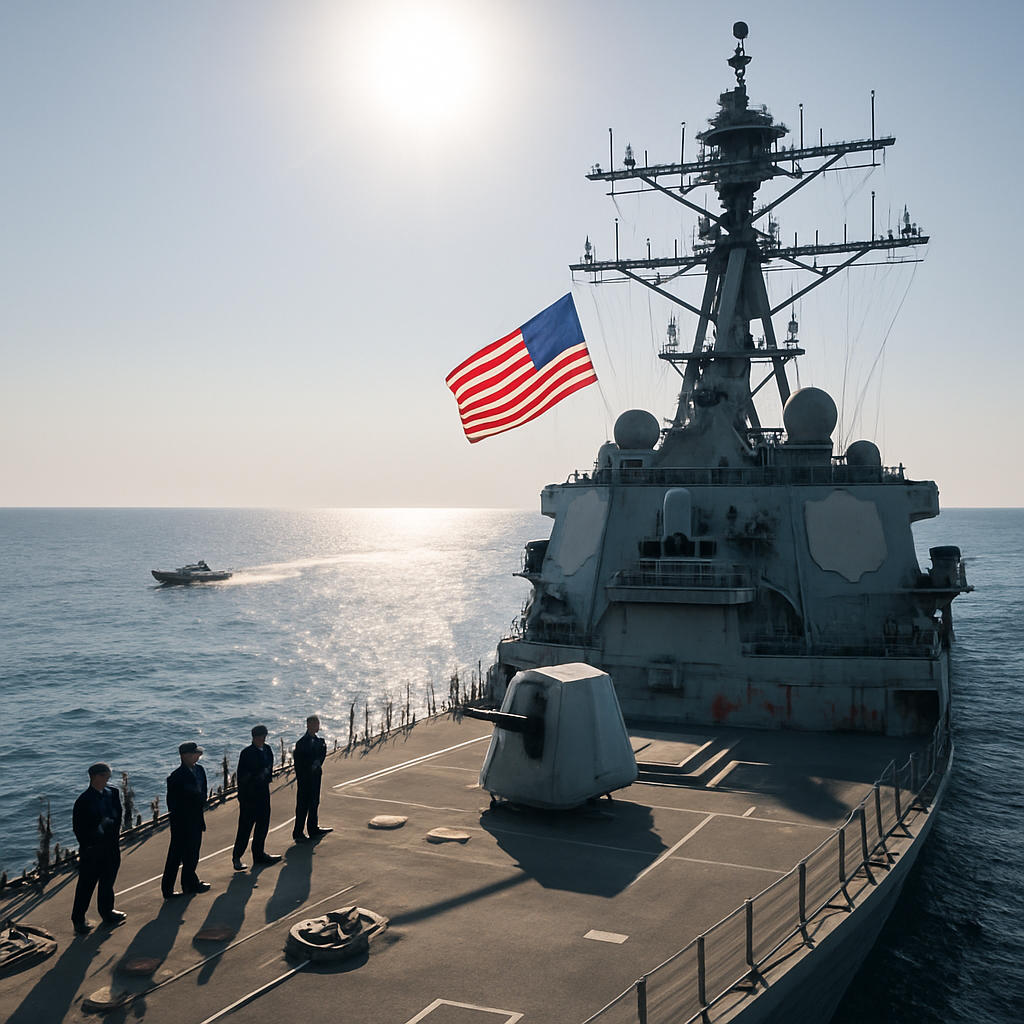
"Moreover, President Trump has authorized the United States Navy to destroy any Iranian fast boats that attempt to put mines in the water or disrupt passage through the Strait of Hormuz, to shoot and kill," Defense Secretary Pete Hegseth told reporters Friday.
Hegseth’s order and the rules he described
At a Pentagon briefing on Friday, Defense Secretary Pete Hegseth framed the U.S. maritime posture as uncompromising: he said the Navy has been ordered to use lethal force against any fast boats suspected of laying mines in the Strait of Hormuz. Hegseth characterized the operation as "a real full blockade" and said the United States will "use up to and including lethal force if necessary."
He further said the blockade would continue "for as long as it takes" and declined to specify an end date. Hegseth also said the administration was "not anxious for a deal" and that the military had "all the time in the world" as the conflict moved into its 55th day.
U.S. naval posture: three carriers deployed
U.S. Central Command announced that the carriers Abraham Lincoln, Gerald R. Ford, and George H.W. Bush are all operating in the Middle East — the first time in decades three carriers have been present in the region, according to the announcement relayed at the Pentagon briefing. Hegseth said the number of warships participating in the blockade was growing and framed that growth as a pressure point on Iran.

The cyber insurance questionnaire just landed. Now what?
SOC 2, HIPAA, insurance renewals - someone has to own security strategy. Nubivance provides fractional CISO leadership without the full-time salary.
Get a security leadMaritime interdictions and detained ships
Gen. Dan Caine, the Joint Chiefs chairman, said the U.S. military had used force against three vessels that were employing "deceptive shipping methods." Caine provided details on the interdictions: U.S. Marines boarded the Touska, described as a 965-foot Iranian container ship, after the crew failed to heed warning shots. A destroyer fired nine rounds from its Mark 45 surface guns into the ship’s engine room; the ship was subsequently boarded, and Caine said the crew and vessel remain in U.S. custody.
Caine also said a Navy control team took over a tanker identified as the Botswana-controlled, aircraft carrier-sized Tifani in the Indian Ocean at the Justice Department’s request; he said it was carrying sanctioned Iranian oil. A third interdiction, of a very large crude carrier known as Majestic X, occurred in the Indian Ocean; Caine said that Majestic X was stateless, and did not disclose its cargo. He said all the vessels and crews from those interdictions were in U.S. custody.
Since the blockade began last week, Hegseth said the U.S. had turned around 34 ships and interdicted at least three vessels. Caine warned that similar maritime interdiction actions would continue in the Pacific and Indian Oceans "against Iranian ships and vessels of the dark fleet."
Allied response and commercial transit
Hegseth used the briefing to criticize European partners, saying "we are not counting on Europe" and urging them to shift from conferences to operational involvement: "they need the Strait of Hormuz much more than we do, and might want to start doing less, talking, having less fancy conferences in Europe and get in a boat," he said. He added that "this is much more their fight than ours."
On commercial transit, Hegseth acknowledged that "transit is occurring, but more limited than anybody would like to see, and with more risk than people would like to see," and blamed the limitation and risk on "Iran ... doing irresponsible things with small, fast boats."
Expert assessment: Jennifer Kavanagh
Jennifer Kavanagh, senior fellow and director of military analysis at Defense Priorities, pushed back on Hegseth’s framing of time as an advantage. In a message cited at the briefing, Kavanagh argued that "the costs for the United States and its allies (and the global economy) are higher than they are for Iran, and Iran’s stakes are much greater." She cautioned that while a blockade "may put pressure on Iran over time, it plays into Iran’s hands—extending the war and allowing the regime to survive," and stated that "coercion will not end the war or reopen the strait. The only exit strategy is through political compromise."
The facts presented at the Pentagon briefing describe an intensified, kinetic maritime campaign: three carriers concentrated in the region, a declared blockade with repeated interdictions and detentions, and an explicit authorization to use lethal force against fast boats suspected of mine-laying. Hegseth framed the posture as open-ended and designed to hold pressure until a new Iranian negotiating proposal appears; his assessment of allied burden and Kavanagh’s countervailing analysis set up a clear policy tension between military pressure and the political path Kavanagh advocates.
How that tension resolves — whether through additional allied operational commitments, sustained interdictions and economic strain, or a shift toward negotiated settlement—remains undefined in the statements released Friday. For now, the operational facts on the water are concrete: interdictions, detained crews, and a standing authorization to destroy fast boats that threaten passage through the Strait of Hormuz.



