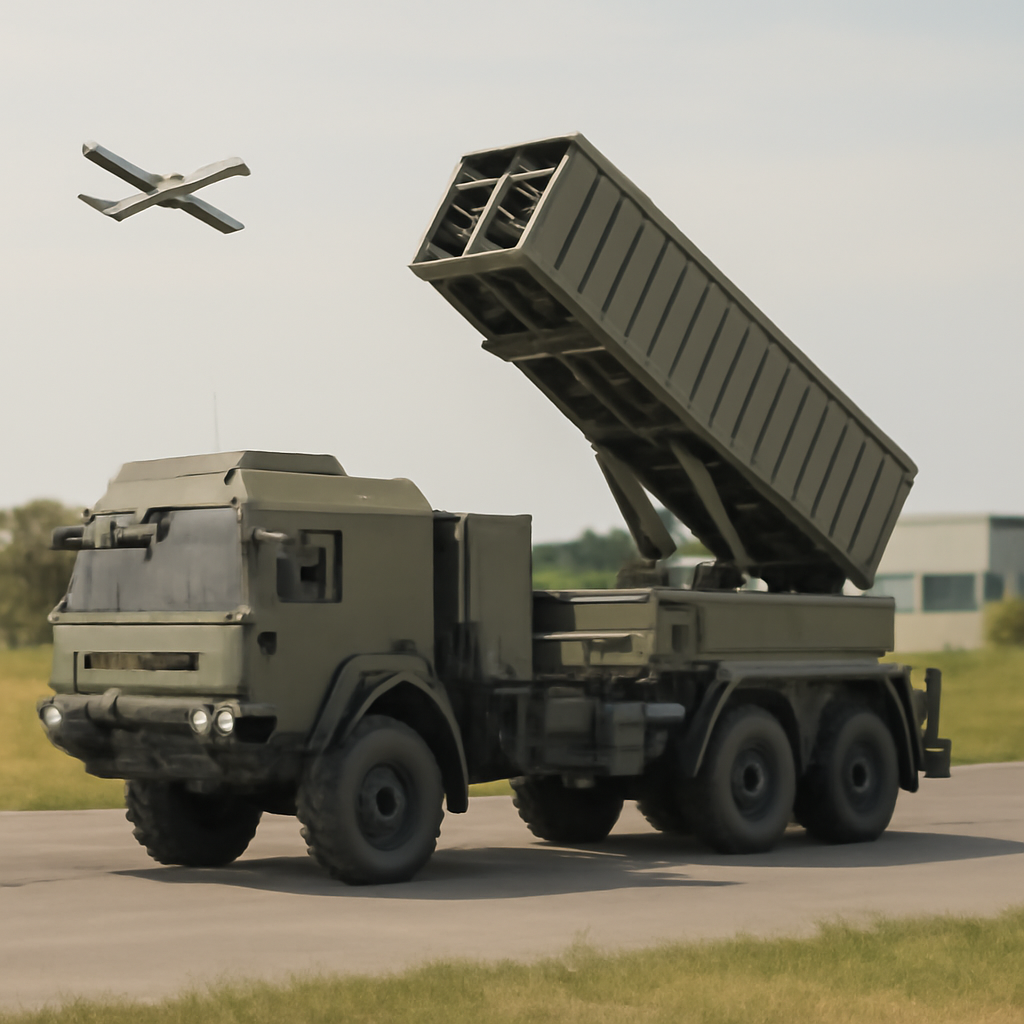
Rheinmetall says the FV-014 loitering munition "has a range of up to 100 kilometers (62 miles) and can remain airborne for as long as 70 minutes." The company demonstrated that capability in July at the National Test Center for Unmanned Aerial Systems at the German Aerospace Center in Cochstedt, Saxony-Anhalt — and for the first time fired the FV-014 from its new Containerized Missile Launcher both from a stationary platform and from an HX-series truck while the vehicle was moving.
The FV-014: size, sensors, and lethal package
The FV-014 is a truck-launched loitering munition designed to perform its own reconnaissance before conducting a precision strike. Rheinmetall describes the system as combining "reconnaissance, target identification and precision strike capabilities within a single system." The weapon has a launch weight of around 50 pounds and carries roughly 13 pounds of payload.
Its warhead is a high-explosive dual-purpose (HEDP) charge that the company claims can penetrate around 24 inches of solid armor steel, while also being usable against unarmored targets and infrastructure. Flight mechanics follow a common pattern: a booster ejects the missile from its tube, the FV-014 unfolds wings and transitions to aerodynamic flight, and an electrically driven propeller provides propulsion in cruise. Rheinmetall also says the design reduces radar and infrared signatures.
Containerized Missile Launcher: mobility, connectivity, and logistics
The launcher is built around a standardized ISO container intended to be modular and widely transportable. In a 20-foot configuration the company says the Containerized Missile Launcher can carry up to 18 FV-014s. Rheinmetall emphasizes that the container can be installed at a fixed site, carried by truck, or potentially integrated on a ship, and that the container format is compatible with existing transportation and logistics infrastructure.
The launcher itself includes an integrated power supply, the ability to connect to command, control, communications, computers and intelligence networks, and the option to operate locally via radio link or through satellite communications. Rheinmetall says the launcher will make extensive use of commercial off‑the‑shelf components to reduce lifecycle costs and incorporates a "sleeper" capability that allows the unit to remain inactive until remotely activated.

Audit-ready is a season. It shouldn't be.
Evidence in spreadsheets, controls drifting between audits, frameworks multiplying on flat headcount. Nubivance runs continuous compliance on Rapid7 Cyber GRC - SOC 2, HIPAA, ISO 27001, PCI, CMMC.
End the scrambleHuman-in-the-loop control, autonomy claims, and GNSS resilience
Rheinmetall states the FV-014 is designed to remain under permanent human control. An operator at a ground station can identify and track targets, authorize an attack, and abort engagements if conditions change — a design choice Rheinmetall links to operational and legal preferences. The report explicitly notes human-in-the-loop architectures bring tradeoffs: they add latency, create communications dependencies, and increase operator workload compared with more autonomous concepts.
At the same time the company is pitching networked and partially autonomous modes. Rheinmetall says the FV-014 has network connectivity and a "high degree of autonomy" intended to help it operate where satellite navigation is being disrupted, and that the weapon is resilient to global navigation satellite system (GNSS) interference. The company has not disclosed technical details of its navigation architecture, nor has it specified the exact level of autonomy or the mechanics of swarm coordination.
Shooting on the move, swarm operations, and concealability
Rheinmetall demonstrated launches from an HX-series truck both while stationary and while moving. The company suggests shooting on the move could be useful for defending convoys, engaging targets of opportunity, or providing rapid fire support to units within range, and that interceptor drones could allow engagements against drone threats while on the move.
The containerized launcher format also offers concealability: a weapons system housed in a standard shipping container can be moved through conventional logistics networks and deployed without the outward appearance of a dedicated missile battery. Rheinmetall has explicitly pitched the standardized container format as supporting "covert operations," and the company notes future versions are planned for other mobile land platforms and seagoing ones.
What this means for militaries, logisticians, and adversaries
- Militaries: Can field a truck‑carried, 100‑kilometer‑class loitering munition with 70‑minute endurance that supports operator-in-the-loop targeting and the option to launch multiple weapons from a single, relocatable magazine.
- Logisticians and procurement officers: Gain a standardized, ISO‑containerized launcher that claims up to 18 missiles in a 20‑foot configuration, integrated power and communications, and compatibility with existing transport networks — all designed to reduce lifecycle costs through commercial components.
- Adversaries and electronic-warfare planners: Must account for a system Rheinmetall calls resilient to GNSS interference and capable of networked operations; the company has also signaled swarm employment, although it has not disclosed the scope or mechanics of swarm coordination.
Rheinmetall’s July demonstration establishes the FV-014 and its Containerized Missile Launcher as a market offering: a truck can arrive with a magazine of relatively long‑range loitering munitions, launch them individually or in groups, and keep a human operator in the loop to search for and authorize attacks. The company has not disclosed the identity of the demonstrated customer, the number of FV-014s fired, the engagement distances used in testing, or specific autonomy timelines — leaving several operational details for future announcements as the system enters an increasingly competitive market.