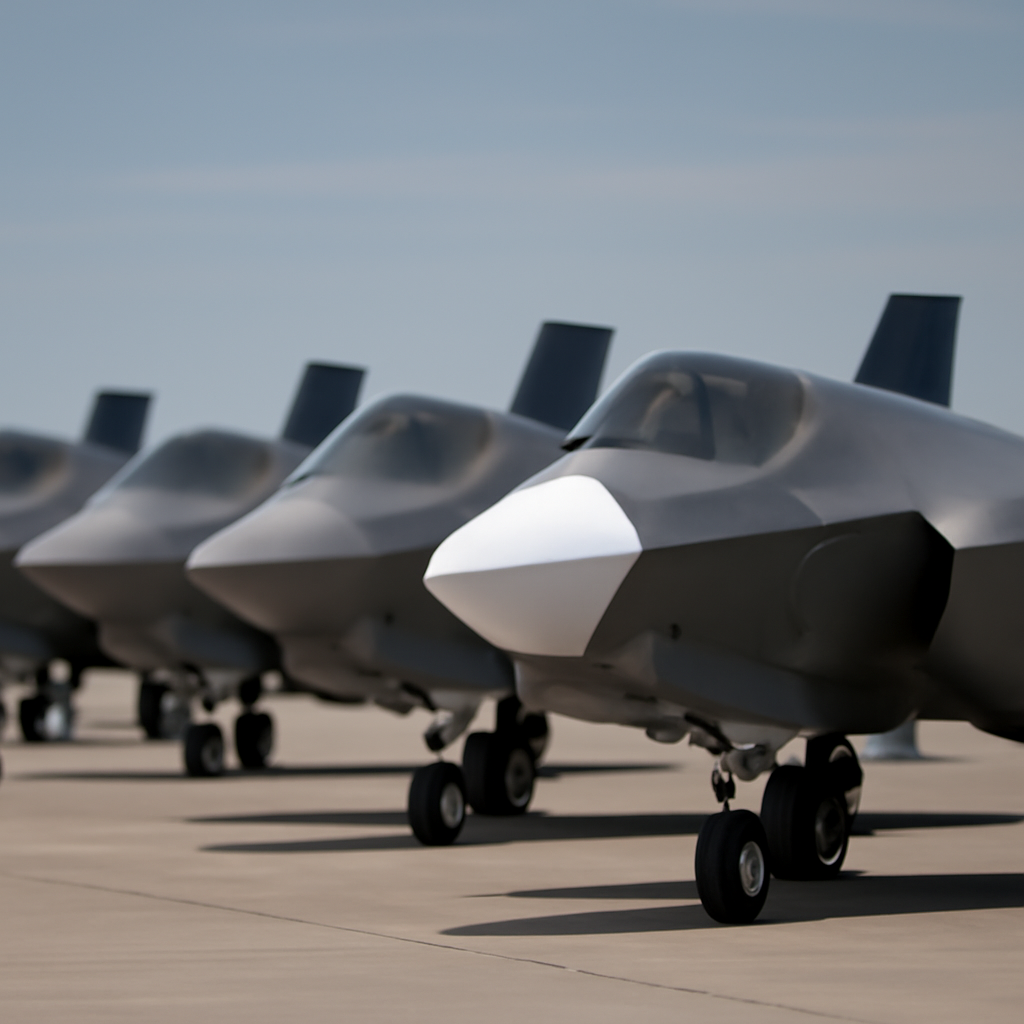
"We have accepted six aircraft for the Marine Corps that do not have a radar installed. That is correct," Marine Corps Lt. Gen. Gregory Masiello told the Senate Armed Services Committee this week.
Lt. Gen. Gregory Masiello’s confirmation to the Senate
At a Senate Armed Services Committee hearing, Lt. Gen. Gregory Masiello, head of the F-35 Joint Program Office (JPO), confirmed that the program has accepted at least six F-35s for the U.S. Marine Corps that were delivered without radars. The exchange with Senator Mark Kelly also underscored a broader debate over readiness: two weeks earlier the Government Accountability Office (GAO) reported the average F-35 full mission capable (FMC) rate across all variants fell from 38 percent to 25 percent between Fiscal Years 2020 and 2025, a metric GAO defines as an aircraft "that can perform all of its missions." Masiello declined to dispute GAO’s figures directly, saying instead that the JPO disagrees with GAO’s methodology; the hearing included an on-record dispute over whether the JPO’s internal FMC figure is 56 percent.
AN/APG-85 schedule, cost, and production lots
The missing radar is the new AN/APG-85, an active electronically scanned array (AESA) radar under development by Northrop Grumman and intended as part of the Block 4 upgrade. Per official budget documents cited by TWZ, the first production AN/APG-85 radars are not expected to be delivered before April 2028. The radar’s unit cost is currently pegged at nearly $9 million. The JPO had planned to integrate the AN/APG-85 starting with production Lot 17; deliveries from Lot 17 began last year, but the first production APG-85s are scheduled later. Hardware used to mount the AN/APG-85 is not backwards compatible with the current AN/APG-81, and Lockheed Martin has discussed but would not have a common mounting solution ready before Lot 20—the Lot 20 jets are expected to arrive sometime between 2027 and 2028.

This site is the portfolio.
OSINTSights runs on Cloudflare Workers, D1, R2, and Vectorize, with an AI pipeline on Hetzner ARM. Nubivance designed, built, and operates it. We do the same for clients.
See what we buildOperational and readiness consequences for Marine Corps operations
The Marines are the only U.S. operator of the B variant, and reports indicate the radarless jets are reportedly F-35Bs, though Masiello did not confirm that detail during the hearing. Senator Kelly pressed the operational implication: "So, I assume that those airplanes can’t count as fully mission capable with no radar?" Masiello responded, "I don’t think I would count them as fully mission capable." TWZ has previously noted that F-35s without radars retain some utility—data sharing via the Multifunction Advanced Data Links (MADL) or Link 16 from other radar-equipped aircraft can provide situational awareness—but the absence of an onboard radar limits tactical flexibility, degrades survivability, and curtails key electronic warfare capabilities that the radar normally provides.
Power and thermal constraints tied to Block 4 and APG-85
Lt. Gen. Masiello raised thermal and power-management questions tied to fully integrating the APG-85 into Block 4. Current cooling capacity is about 30 kilowatts, he said; the program has been operating with 32 kilowatts available. For the full capability of the APG-85 and associated Block 4 systems, Masiello said the program "require[s] 62 to 80 [kilowatts of cooling]." The JPO is pursuing an incremental approach and a broader Power and Thermal Management System (PTMS) upgrade, which Masiello said "would not be required for AN/APG-85 integration" but would be available in time. The JPO also anticipates an engine core upgrade that is expected to be fielded in 2031 and will bring a marginal increase in power-thermal capacity.
What this means for the Marine Corps, the F-35 JPO, and the GAO
- Marine Corps: The service told TWZ that "The Block 4 modernization program is necessary to ensure that the Marine Corps and Joint Force can continue to project air superiority against future threats." The Marines deferred technical questions to the F-35 JPO, and their public position frames acceptance of radarless jets as a deliberate choice tied to a concurrent development and production strategy intended to avoid later retrofit work.
- F-35 Joint Program Office (JPO): The JPO says F-35s are "being built to accommodate the F-35 advanced radar (APG-85)" and that the program "deliberately undertook a highly concurrent development and production program for advanced capabilities." The office has also said it plans to accelerate APG-85 production capacity and that specific modernization plans and schedules for APG-85 remain classified for program security.
- Government Accountability Office (GAO): GAO’s recent report highlighted falling FMC rates and delays across Block 4. The report noted schedule slippage for a truncated portion of the upgrade package—running five years behind as of September 2025—and GAO’s FMC calculation is a central point of dispute between the watchdog and the JPO.
The record is now explicit: American F-35s are being accepted for service without their intended next-generation radars, and the first production AN/APG-85 units are not expected to arrive until 2028. That decision reflects a conscious program trade—building aircraft now to accept future capabilities rather than performing extensive retrofits later—but it leaves operators and policymakers juggling immediate readiness, shared sensor tactics, and technical risks around power and cooling until Block 4 elements and PTMS improvements come online. The next concrete milestones to watch are Lot 17 deliveries already underway and the April 2028 horizon for first AN/APG-85 production deliveries.
Original story: https://www.twz.com/air/its-official-f-35s-are-now-being-delivered-without-radars